Get Full Government Meeting Transcripts, Videos, & Alerts Forever!
Get email alerts on the Program Of Studies topic
No spam. Unsubscribe anytime.
Wilson SD presents updated high school Program of Studies with new cybersecurity and arts options
Summary
Wilson School District officials presented the high school Program of Studies for the 2025–26 school year at the Jan. 20 Board meeting, describing the document as a single, hyperlinked resource of graduation requirements, course pathways and the course-selection process.
Wilson School District officials presented the high school Program of Studies for the 2025–26 school year at the Jan. 20 Board meeting, describing the document as a single, hyperlinked resource of graduation requirements, course pathways and the course-selection process.
"Our program of studies is, our program of studies is, based on the profile of Wilson grama, really focuses on those skills and dispositions," said Dr. Kachuffo during the presentation, describing the document as a "one stop shop" for course offerings.
District staff said the Program of Studies aims to balance college readiness with career preparation. New and revised offerings highlighted include: earned honors credit options in band and orchestra for 11th–12th graders; "A Journey Through Art" expanded from a semester (.5) course to a yearlong (1.0) course covering 2-D and 3-D work; JROTC cyber security pathways tied to industry-standard credentials (CompTIA A+ and CompTIA Network+); a broader pre-algebra offering to serve students before Algebra I; a one-credit dual-enrollment teaching assistant internship option to provide schedule flexibility; an Adaptive Music course to complement adaptive physical education and art; and a re-titled culinary course, now "Food and Industry Fundamentals," that includes the ServSafe certification.
District presenters said several low‑enrollment courses will be removed or suspended, including Honors Tech Internship, Business Ethics and Communication, CP Research, Introduction to Data Science, Introduction to Project Management and several historically under-enrolled CP mathematics and arts sections. The presentation emphasized that these reductions respond to student interest and structural realignments (for example, the phase-out of Algebra 1A/1B).
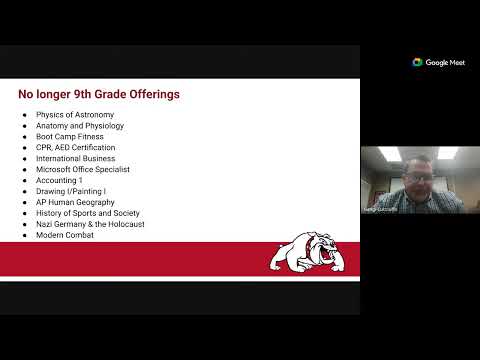
Officials also described a narrower set of choices for 9th graders to ensure a stronger foundation at the transition from middle to high school. "We did take some of the courses away that 9th graders can opt to take ... so they have a very solid foundation," Dr. Kachuffo said.
The district showed standardized, hyperlinked course-flow charts developed with the public relations interns so students and families can view clear, grade-by-grade pathways from 9th through 12th grade. The presentation noted there is no change to the district’s graduation-credit totals: English 4.0, social studies 3.0, math 3.0, science 3.0, physical education 0.5, health 0.5, and 7.0 elective credits.
Board members and committee chairs praised the document’s clarity and the student interns’ work. Board member Casper asked about alumni feedback on post‑graduation preparation; presenters said the district solicits alumni input but welcomes broader outreach to gain more representative results.
The board approved the Program of Studies as part of the teaching-and-learning consent items later in the meeting (roll call vote; 8–0).