Get Full Government Meeting Transcripts, Videos, & Alerts Forever!
Get email alerts on the Urban Forest topic
No spam. Unsubscribe anytime.
Parks commission approves removal of 13 trees on North Milpas Street, conditions at least 30 replacements
Summary
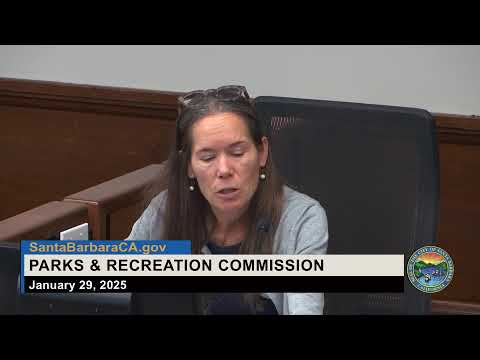
After a lengthy public debate, the commission approved a Public Works request to remove 13 trees along the 0–900 blocks of North Milpas Street to allow curb extensions, sidewalk widening and improved sight lines, with the condition that at least 30 replacement trees be planted as the project advances.
On Jan. 29, 2025, the Santa Barbara Parks and Recreation Commission voted to approve Public Works's request to remove 13 trees along the 0 to 900 blocks of North Milpas Street as part of the Milpas Street Crosswalk Safety and Sidewalk Widening Project.
Public Works planner Michelle Bedard told the commission the corridor-level project combines intersection-safety upgrades, minor sidewalk widening, new traffic signals and lighting, and bicycle-lane buffers. Bedard said staff and consultants evaluated 95 trees in the corridor and proposed 13 removals "based on accessibility and sight-line criteria," including a 36-inch minimum clear ground width and 36 inches width measured at 80 inches in vertical clearance.
The commission heard that the removals are categorized as 8 trees removed for safety and accessibility (for example failing to meet 80-inch vertical clearance), and five trees removed to accommodate intersection curb extensions. Bedard said the project team identified roughly 37 potential tree-planting locations pending utility checks and that the project anticipates starting construction in 2027; she added staff will try to begin early plantings prior to construction when practical.
Members of the Street Tree Advisory Committee reported they reviewed the same site visit and evidence and supported the removals proposed by staff, noting the project creates larger planting opportunities in curb extensions and that replacement trees could be selected to provide future canopy. "There was consensus to support the removals as proposed, with the expectation that staff would continue to work with Public Works on replacement trees and locations," a committee representative said.
Public comment was strongly mixed. Several residents urged the commission to retain mature Indian laurel figs that form the iconic Milpas canopy. Andrew Kendrick, who identified himself as a hydrogeologist and consultant, read the city's Urban Forestry Vision and management-plan findings, saying the urban forest provides measurable environmental and economic benefits. "Santa Barbara's urban forest has the potential to provide the community with $29,000,000 in benefits annually," Kendrick said. Other speakers called the ficus trees "iconic" and urged more creative design solutions to avoid removals.
Commissioners discussed the competing goals: preserving mature canopy versus addressing pedestrian accessibility and intersection sight lines that staff and traffic engineering flagged as safety risks. After discussion, Chair Jacquelyn McGill moved to approve the street-tree removal request for the 13 trees (eight Indian laurel figs, four New Zealand Christmas trees and one Brisbane box) "on the condition that as part of the project at least 30 new trees are planted." Commissioner Michael Ramsey seconded the motion. The motion passed by voice vote; the commission announced the decision may be appealed to City Council within 10 days under Santa Barbara Municipal Code procedures.
The commission also separately considered and later approved a related Street Tree Advisory Committee recommendation to change the Milpas street-tree species designation for the 0–1,100 block segment to include water gum, Sydney red gum, New Zealand Christmas tree and African fern pine. Staff said the change is intended to diversify species, select trees better suited to smaller or larger planting spaces and improve long-term resilience.
What happens next: Public Works and Parks staff will continue coordination on final planting plans and utility checks for candidate tree wells. The commission's approval included the plantings requirement; staff said the project team will return with implementation details as designs are finalized and as funding and construction schedules are confirmed.