Get Full Government Meeting Transcripts, Videos, & Alerts Forever!
Get email alerts on the Flood Control topic
No spam. Unsubscribe anytime.
Butte County: 67,000 cubic yards of sediment in Five Mile Basin; county to pursue parcel assessment, expedited design
Summary
Butte County public works said sediment has raised the floor of the Five Mile Basin in Bidwell Park by about 67,000 cubic yards and reduced the structure’s flood freeboard, driving an estimated removal and permitting cost north of $7 million. The county told the City Council it will pursue an expedited design and permitting process while preparing a Prop 218 parcel assessment to fund the work.
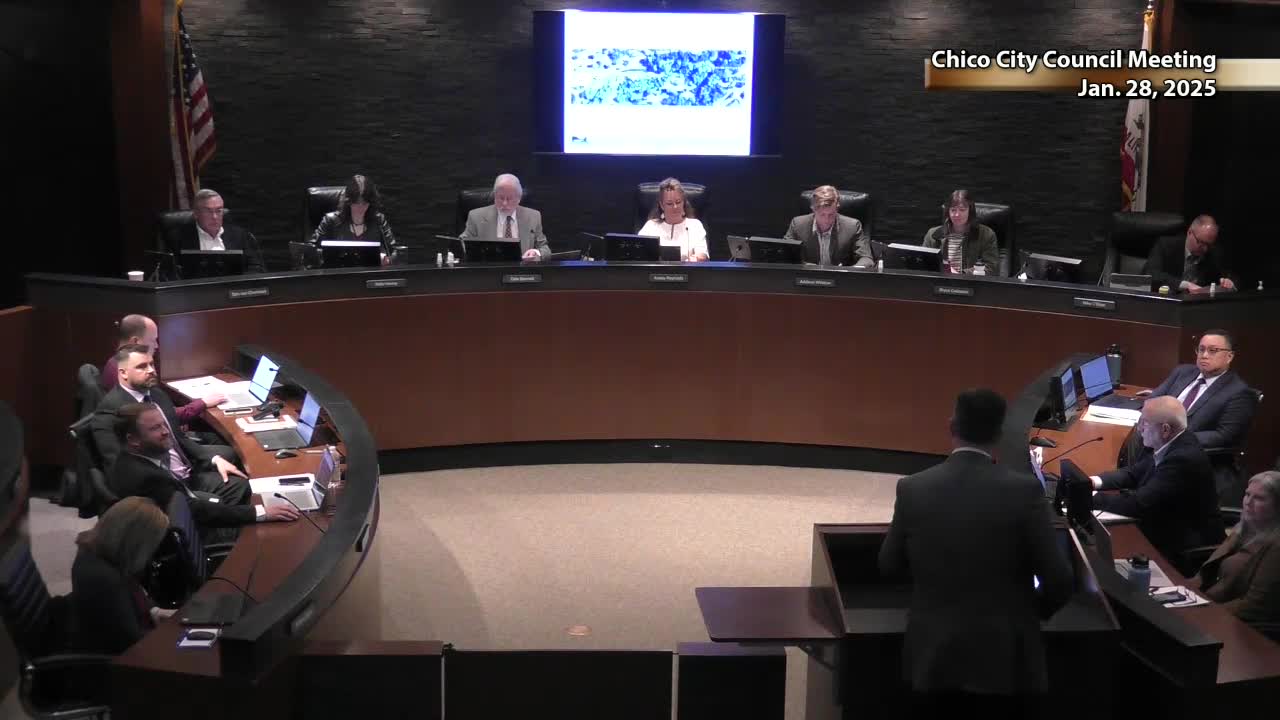
Butte County’s public works director told the City Council that long-stopped sediment removal at the Five Mile Basin in Bidwell Park has left the basin carrying roughly 67,000 cubic yards of material and has reduced its margin of flood protection.
“Based on an analysis done by our consultants, approximately 67,000 cubic yards of sediment have been deposited in the basin,” Joshua Pack, Butte County director of public works, said during a presentation to the council. He said hydraulic modeling shows the sediment is eroding the basin’s design freeboard and that the county now estimates initial removal costs at about $5.4 million, rising to more than $7 million after CEQA compliance and permitting work are included.
The county traced the problem to earlier restrictions on in‑basin operations. Pack said the Army Corps built the original structures in the 1960s and that sediment removal was curtailed in the 1990s after a California Department of Fish and Wildlife cease‑and‑desist order. Vegetation and re‑established riparian habitat in the basin now require careful environmental review before any large‑scale maintenance.
Pack said the county has taken several short‑term steps to reduce near‑term risk, including emergency debris removal during storms, staged equipment, remote cameras at diversion structures and coordinated response procedures shared with city staff. He cited a state WART (Watershed Emergency Response Team) analysis showing the basin can handle smaller storms but that a 10‑year or larger event approaches capacity with current sediment levels.
Why it matters: the basin protects neighborhoods within County Service Area 24, which was set up in the 1960s to fund maintenance. Pack said the CSA includes roughly 15,200 parcels and that existing CSA reserves total about $3 million. He said the county lacks the cash on hand for a full removal and recommended returning to the original intent of a per‑parcel charge under Proposition 218.
Board direction and next steps: Pack said the county board directed staff to pursue a concurrent approach — begin project design and environmental permitting while also starting work toward a Prop 218 parcel assessment ballot of affected parcels within CSA 24. He noted the parcel charge would require a majority of ballots returned under Prop 218 to pass and that county staff will evaluate phased assessments and other funding mixes, including federal earmarks and grants, to reduce the sticker shock of a single large assessment.
Short‑term risk and schedule: Pack said the Park Fire has increased peak runoff risk in the watershed by removing vegetation, and that short‑term flood and debris concerns may continue for two to three years. He warned that the full environmental and permitting process for comprehensive sediment removal is likely to take three to five years under normal conditions.
Public and council response: Council members and members of the public pressed county staff on historical flow numbers and the potential for levee failure in a major event. Pack said the county would request $1 million in advance funding to begin expedited design work and would seek help from state and federal legislative representatives to accelerate permitting where possible.
What the county will do next: Pack said staff will prepare the technical design work, begin environmental review and prepare for a Prop 218 ballot process to fund construction and long‑term maintenance. The county will also pursue grants and earmarks and work with the city to coordinate emergency monitoring and response.
Speakers
- Joshua Pack, Director of Public Works, Butte County (presenter) - Council members (questioners)
Clarifying details
- Sediment estimate: "approximately 67,000 cubic yards" (Pack) collected from consultant analysis; compared to tens of thousands of dump‑truck loads by Pack’s estimate. - Initial cost estimate: about $5.4 million for excavating material; Pack said fully permitting and preparing the project could push costs above $7 million. - Funding history: County Service Area (CSA) 24 created in the 1960s; CSA reserves ~ $3 million; typical annual revenue ~ $300,000. - Timeline: county staff estimate 3–5 years for environmental/permitting and construction under a normal schedule; short‑term Park Fire runoff/erosion risk estimated at 2–3 years of elevated concern.
What’s next for reporters/follow‑up
- Dates and scope of the county’s planned Prop 218 ballot (parcel list, proposed per‑parcel charges, ballot schedule). - The county’s $1 million budget request timing and scope, and any applications for federal or state grant funds to defray costs.
Topics: flood control; CSA funding; Park Fire emergency response; sediment removal.