Get Full Government Meeting Transcripts, Videos, & Alerts Forever!
Get email alerts on the Water Supply Planning topic
No spam. Unsubscribe anytime.
SFPUC outlines long‑term water supply strategy, stresses storage and risk planning
Summary
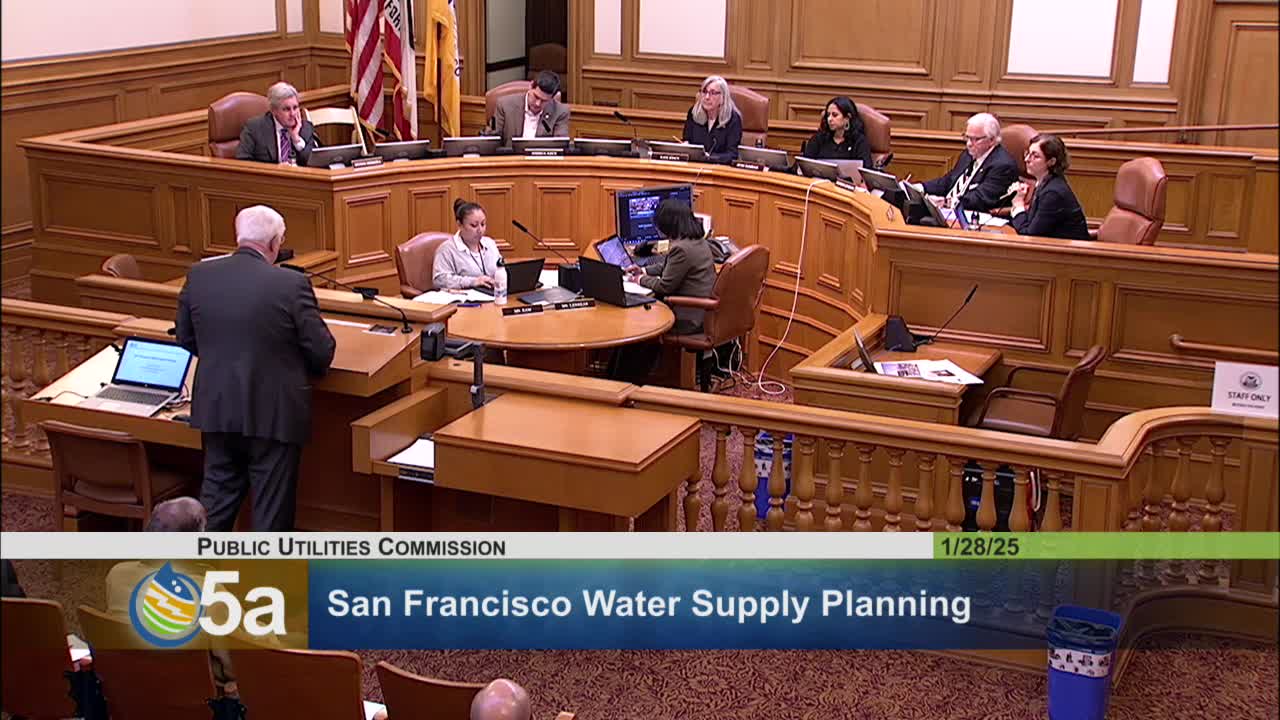
Assistant General Manager for Water Steve Ritchie said the SFPUC must plan for the long haul, citing an 8.5‑year design drought scenario, a reliance on Tuolumne River supplies and a portfolio approach that includes purified water and groundwater storage.
Assistant General Manager for Water Steve Ritchie told the San Francisco Public Utilities Commission that the agency plans for the long term and that storage is central to ensuring reliability.
"We have to provide service in perpetuity," Ritchie said, describing a system that supplies about 2,700,000 people and that relies roughly 85 percent on the Tuolumne River and 15 percent on local reservoirs. He said SFPUC planning is guided by a "water‑first" policy, institutional experience from the 1970s–1990s droughts and formal risk management that assumes "there will always be a worse drought someday." Ritchie said the commission uses an 8.5‑year drought scenario derived from the water supply improvement program environmental review as a planning tool to test system responses and options.
The briefing explained the legal and contractual constraints that shape operations. Ritchie said San Francisco's water rights on the Tuolumne River are junior to irrigation districts and noted the city operates under a 1984 settlement that includes a 184 million gallons per day (MGD) supply assurance to wholesale customers and an 81 MGD allocation for San Francisco. He listed candidate supply actions under study: purified water (converting wastewater to drinking water), regional groundwater storage and recovery, Alameda Creek recapture, a Pure Water SF program, and potential partnerships with Central Valley irrigation districts for groundwater banking.
Commissioners pressed on tradeoffs and practicalities. Vice President Arce asked how to balance river flows, additional storage and costs to ratepayers. "Whenever that settles, it will be just another demand," Ritchie said of state decisions such as Bay‑Delta reflows; the commission must plan to meet added obligations while protecting other uses. Commissioner Jamdar asked whether planning for 7.5 years versus 8.5 years materially changes outcomes; Ritchie said the scenario shapes alarm thresholds and end‑points but the planning curves are similar—the design drought serves as a conservative stress test rather than a forecast.
Commissioners and staff also discussed operations under changing precipitation patterns. Ritchie said a shift from snowpack to more rain would change how reservoirs are operated—"more water coming through continuously"—but not necessarily the total annual volume the system must accommodate.
Public commenters and wholesale customers urged more data, transparency and engagement. Dave Warner told commissioners they act "as a buyer for 2,700,000 of us" and urged outside expert review and additional workshops. Tom Smigel, chief executive of the Bay Area wholesale customer group (BAWSCA), reinforced the importance of SFPUC's level‑of‑service objectives and asked for follow‑up reporting on implementation of audit recommendations. Representatives from Tuolumne River Trust and other NGOs asked for clearer modeling of design‑drought severity and for staff responses to written comments.
Ritchie and commissioners said staff will follow with more technical briefings and a planned future session on firefighting and emergency water systems. Ritchie noted infrastructure for firefighting includes an alternate network of pipelines, kept‑full 70,000‑gallon cistern tanks in strategic locations, bay intakes and large fire‑fighting pumps from fireboats, and said the commission will schedule more detailed briefings on emergency readiness.
Why it matters: The presentation framed the commission's near‑term work plan: refine demand scenarios, continue negotiations and modeling around state regulatory actions, evaluate alternative supply projects (including purified water and groundwater banking) and brief the commission and public more deeply on technical tradeoffs, regulatory risk and rate/cost impacts.
Ending: Commissioners directed staff to continue outreach and technical workshops; several commissioners and commenters asked that future sessions include more modeling detail, alternatives analysis and explicit rate/cost implications of projects under consideration.