Get Full Government Meeting Transcripts, Videos, & Alerts Forever!
Get email alerts on the Healthy Retail topic
No spam. Unsubscribe anytime.
Contra Costa board introduces ordinance to put healthier foods at checkout in larger stores
Summary
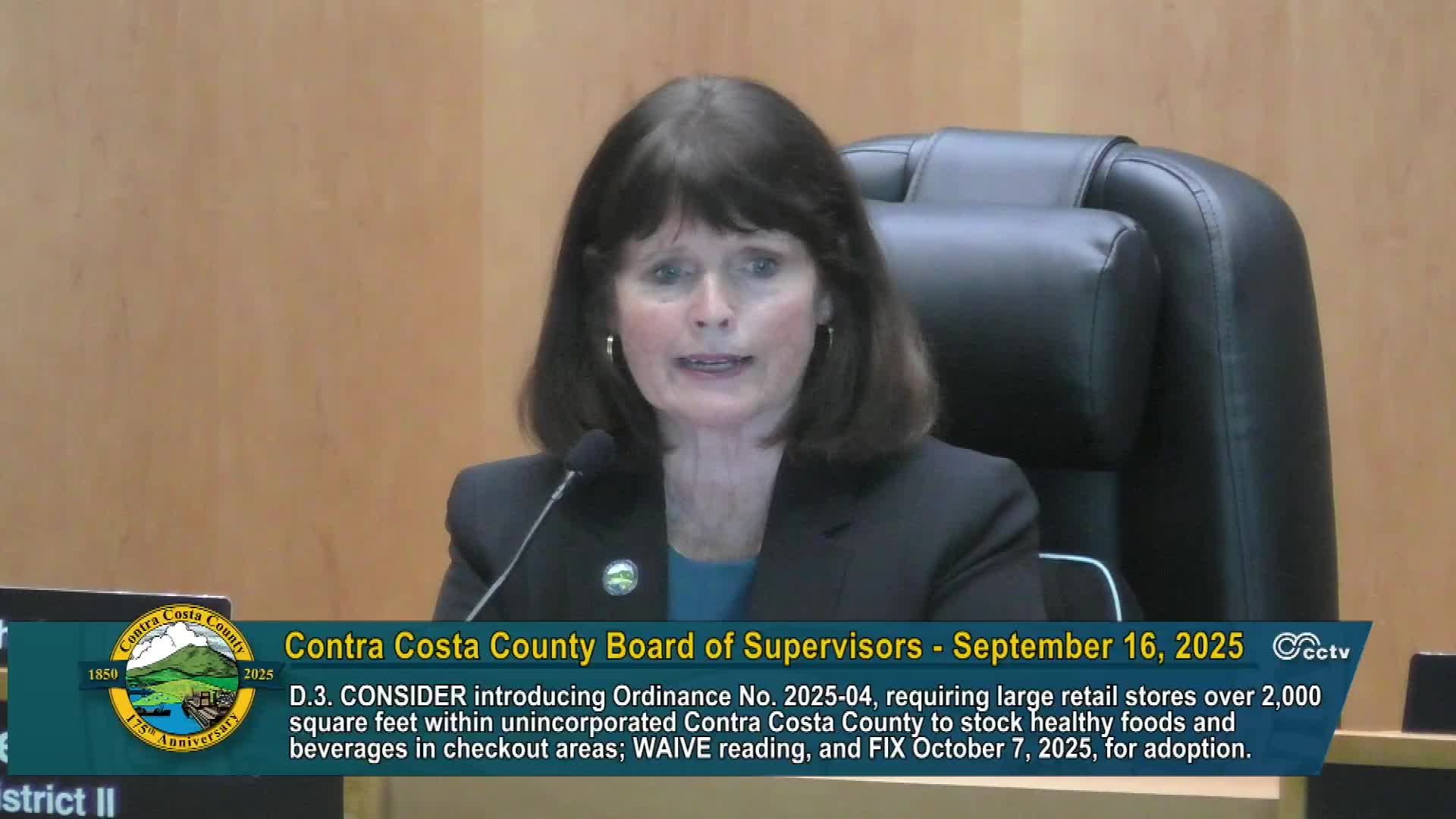
The Contra Costa County Board of Supervisors voted Sept. 16 to introduce an ordinance to require retail stores larger than 2,000 square feet in unincorporated areas to stock healthier foods and beverages at checkout.
The Contra Costa County Board of Supervisors voted Sept. 16 to introduce an ordinance that would require retail stores larger than 2,000 square feet in unincorporated areas to stock healthier foods and beverages at checkout and within three feet of the point of sale.
The proposal, developed with input from high‑school youth advocates known as HOPS, Contra Costa Health staff and community partners, would set minimum nutrition standards for items displayed at checkout: lower added sugar, limits on sodium and a restriction on beverages with added sugars or low‑ and no‑calorie sweeteners. The county plans one year of technical assistance and no‑penalty inspections before enforcement shifts to a complaint‑driven model with reinspection fees.
Public health officials said the regulation is aimed at improving access to nutritious options in neighborhoods with limited grocery access, where impulsive purchases at checkout can contribute to poor diet and chronic disease. “This placement is particularly important as it drives purchasing,” said an allied presenter from Bay Area Community Resources during the hearing.
HOPS youth leaders and partners including the Food Bank of Contra Costa and Solano and local health advocates testified in favor of the ordinance, describing years of community outreach, retail surveys and an initial refrigeration grant that funded healthy product placement pilots. One youth said the ordinance would provide “a better option” for families and help educate young shoppers about healthier choices.
An industry representative from the California Fuels & Convenience Alliance urged the board to avoid overly broad definitions that could unintentionally cover small convenience stores and gas‑station markets, and suggested alternative language to require retailers to offer healthy options rather than restrict product placement. County staff said the 2,000‑square‑foot threshold was chosen to exclude most small footprint convenience stores and that ~42 existing stores in unincorporated areas meet the proposed size threshold.
After the discussion, the board voted unanimously to introduce the ordinance, waive the reading and set adoption for Oct. 7, 2025. Supervisors asked staff to report back on outreach and compliance during the education year and to provide updates to the Family & Human Services Committee as implementation proceeds.
If adopted, the ordinance would apply to the checkout queuing area and items within a three‑foot radius of the point of sale. County environmental health will lead first‑year technical assistance during routine food‑safety inspections; enforcement would begin after the education period.