Get Full Government Meeting Transcripts, Videos, & Alerts Forever!
Get email alerts on the Budget And Finance topic
No spam. Unsubscribe anytime.
Council Reviews Three Tax‑Rate Scenarios as Budget Cuts Meet Growing Service Pressures
Summary
Finance presented three property‑tax scenarios for FY2025–26; council focused on staffing and public‑safety pay parity concerns and asked staff for additional modeling ahead of the Sept. 11 adoption.
Finance staff presented updated FY2025–26 budget projections and three tax‑rate scenarios: the 2024 adopted rate (0.4272), a voter‑approval variant without the unused increment (0.4488), and the higher ceiling previously proposed (0.4613). The presentation showed estimated FY26 general‑fund revenues and expenditures under each scenario, multiyear fund‑balance projections based on hiring assumptions and a schedule of positions added in later years, and reminded council of the calendar (public hearing and Sept. 11 adoption).
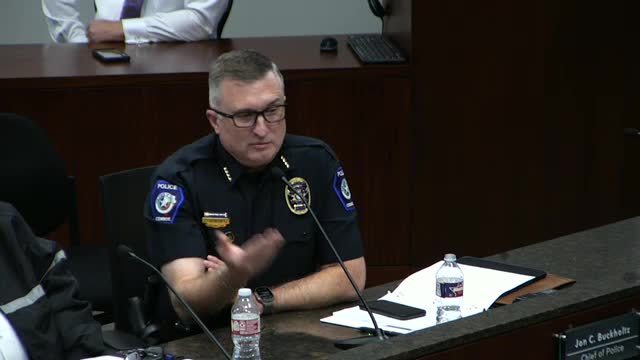
Council members focused discussion on public‑safety recruitment and retention—especially police and fire—and asked staff for modeling that would quantify the cost of matching county pay‑parity or implementing lateral hiring incentives. Chief Buckholz highlighted the department’s operational strain (roughly 19 vacancies at the time of the workshop) and estimated recruiting/training replacement costs in the six‑figure range per recruit, emphasizing the fiscal consequence of losing sworn staff.
Councilors and staff discussed how long‑range water and sewer capital needs and the recently settled SJRA litigation affect budget choices and whether reserves should be used for one‑time capital costs versus ongoing personnel. Finance staff noted the assumptions baked into the slides (3% personnel escalation, staged hiring in FY27–FY29) and said the council should give direction at the public hearing; final adoption is scheduled for Sept. 11. No tax rate was adopted at the workshop; council members varied in preference but several said remaining at the current rate would be difficult to sustain given service demands.