Get Full Government Meeting Transcripts, Videos, & Alerts Forever!
Get email alerts on the Special Education topic
No spam. Unsubscribe anytime.
Howard County unveils multiyear special education strategic plan, pledges staffing and implementation steps
Summary
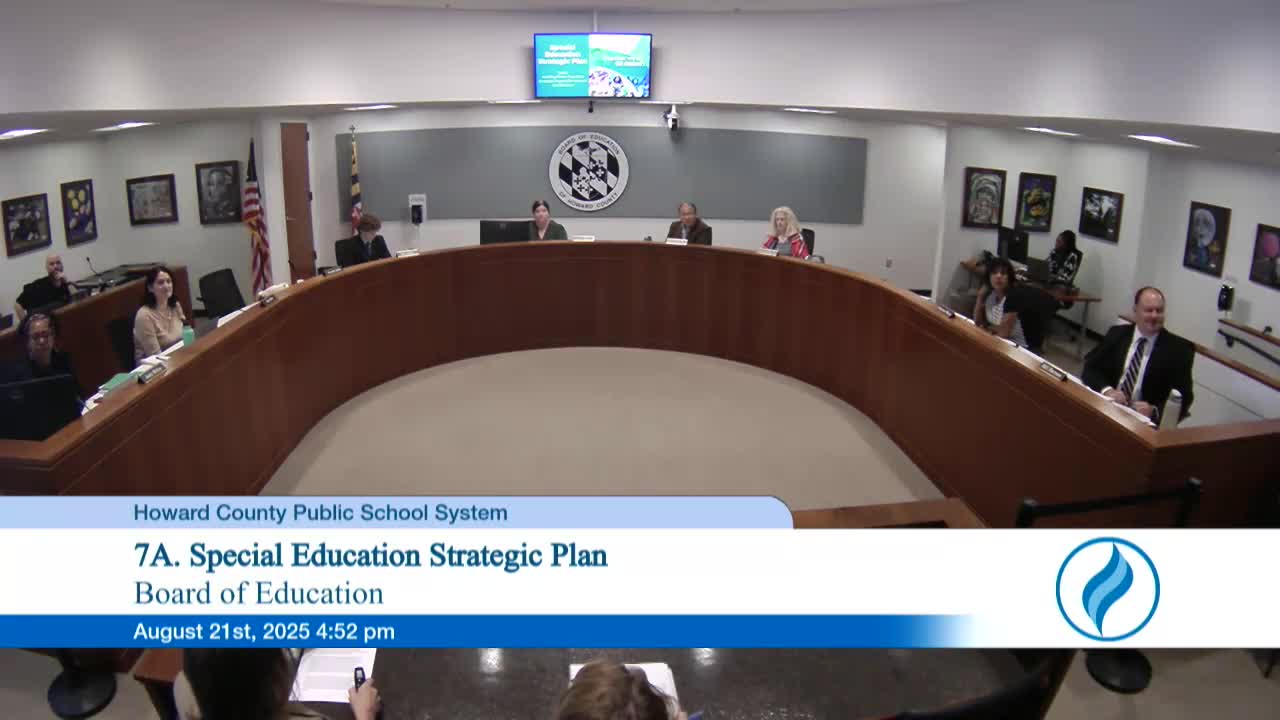
Dr. Jen Webster, the chief academic officer for Howard County Public Schools, and Jen Riccardi, acting executive director for special education, presented a multiyear Special Education Strategic Plan on Aug. 21 that establishes five theme areas and short‑term actions — including three new coordinator positions and a "quick response team" — to address instructional consistency, staffing, and family engagement across the district.
Dr. Jen Webster, the chief academic officer for Howard County Public Schools, and Jen Riccardi, acting executive director for special education, presented a multiyear Special Education Strategic Plan on Aug. 21 that officials said will guide changes to staffing, instructional practice and family engagement across the district.
The plan lays out five interconnected themes: consistent instructional implementation, enhanced supportive and safe learning environments, improved staff support and professional learning, organizational and staffing-formula changes, and stronger family and community engagement. Presenters said the work will be executed as a phased, multi‑year effort with measurable indicators such as IEP goal progress, reductions in suspensions for students with IEPs and improved graduation and college‑and‑career readiness rates for students with disabilities.
"We are already establishing implementation plans that will help us achieve the desired outcomes of the plan," Dr. Webster said when she introduced the plan, calling the presentation a first year of a longer implementation cycle. Riccardi described concrete first‑year steps including the addition of three coordinators to provide direct support to resource teachers and facilitators, and a "quick response team" to deliver rapid, time‑limited in‑school support to school staff who are managing complex student needs.
The plan stresses consistent tier‑1 instruction for all students plus stronger tier‑2 and tier‑3 interventions for students who need additional support. Riccardi cited targeted interventions for students with autism and for students with dyslexia, dyscalculia or dysgraphia and those described as "twice exceptional." Measured outcomes for year one include improved IEP goal progress and increases in grade‑level achievement and graduation among students receiving special education services.
Board members questioned how the plan would affect staffing and daily classroom practice. Several asked about staffing formulas and whether intervention groups would be appropriately small for intensive interventions (for example, dyslexia interventions commonly require smaller group sizes). Riccardi said the central office will examine existing staffing formulas and noted a staffing‑formula committee and other stakeholder groups will inform the work; Dr. Webster added that resource teachers and instructional facilitators will be focused more on time in classrooms and "just‑in‑time" support.
On family communication, Riccardi said the system will publish simplified summaries and a glossary on the district website and provide clearer guidance so families can find resources and follow up. Board members pressed for clearer onboarding for classroom teachers — including how case managers will share IEPs and 504 expectations before students arrive — and presenters said building administrators and special education leaders have an expectation that necessary documents and contact information be shared at the start of the year.
Several board members and educators urged a shift away from compliance‑heavy professional development toward job‑embedded, applicable training, and the presenters said professional learning will include participation and evaluation metrics and reflection data on staff confidence.
Implementation monitoring will use a mix of student progress metrics, participation and satisfaction data from staff professional learning, reductions in centralized placement referrals and family complaint rates to the Maryland State Department of Education. Presenters and the superintendent emphasized the plan is a starting point and will be adjusted through year‑by‑year implementation and community feedback.
"This is the beginning of a lot of hard work," Superintendent Barnes said. "Implementation and accountability are where we will be judged."
The board did not take a formal action on the plan at the Aug. 21 meeting; staff said they will return with implementation updates and ongoing metrics as the plan is executed.