Get Full Government Meeting Transcripts, Videos, & Alerts Forever!
Get email alerts on the Development Process topic
No spam. Unsubscribe anytime.
Middleton city engineer outlines development-review steps, flags pinch points at final plat
Summary
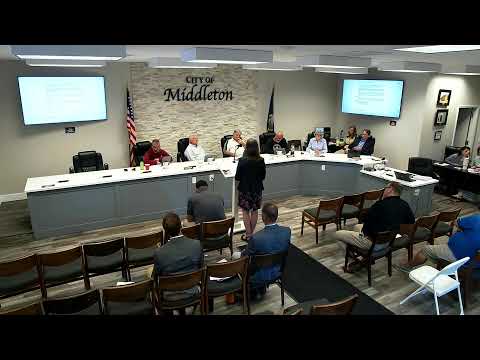
Amy Woodruff, the city engineer, briefed the City Council on Middleton—s development review process and said the most frequent problems occur when project completion packets lack the inspections and testing required by the Middleton supplement to the ISPWC.
Amy Woodruff, the city engineer, told the council the development process begins with code and a pre-application meeting and runs through preliminary plat, phased design and construction, final walk-through and final plat.
"The code is established by council, and it's the foundation for all these developments," Woodruff said, citing Middleton City Code Title 5 and the Middleton supplement to the Idaho State Public Works Construction (ISPWC) standards. She said other technical rules referenced in plan review include Idaho Administrative Procedures (IDAPA) and Idaho Code for water and wastewater standards.
Woodruff walked the council through the sequence she said staff follows: a pre-application meeting covering annexation, rezones, utilities and transportation; a preliminary plat to identify public infrastructure and easements; a plan-review phase in which construction drawings are reviewed by the city against the preliminary plat and ISPWC standards; construction overseen primarily by the developer—s engineer; and final plat submittal when the city will accept dedications.
"The developer's engineer is responsible for heading up the project administration and the project inspection...There is a list of testing requirements and inspection requirements detailed in the Middleton supplement," Woodruff said.
She described the final packet as a recurring pinch point: record drawings, testing logs and the developer—s inspection diary must be compiled and reviewed before the city will accept dedication. She said missing tests or deficient documentation are difficult to recreate after construction is complete.
Woodruff contrasted Middleton—s model with larger cities: "In other cities in the valley, the city has a full time inspection staff. Think Nampa, think Meridian. They have inspectors that take over the role completely of inspecting and documenting the construction as it's underway." Middleton relies more on the developer's engineer and public-works interim inspections at critical milestones.
Council members asked whether Middleton could adopt procedural changes to make the process more consistent for developers. Woodruff said staff believes there are modifications that could improve the process without upending code and offered to meet with stakeholders to compile recommendations.
The presentation included these operational clarifications: certain projects are expected to be built by developers as conditions of development (and thus removed from city-funded CIP lists), phasing changes require council approval, the city conducts a warranty walk-through roughly 11 months after recording and requires repairs within 45 days, and final plat recommendations are accompanied by the city engineer—s confirmation that code standards have been met.
Council did not take formal action on Woodruff—s presentation but discussed follow-up meetings to consider process changes.