Get Full Government Meeting Transcripts, Videos, & Alerts Forever!
Get email alerts on the Peddlers Vending topic
No spam. Unsubscribe anytime.
Charlotte committee backs steeper fines and pilot permitting program after broad public concern about sidewalk vending and safety
Summary
After a public hearing with residents and business owners, the Housing, Safety & Community Committee directed staff to develop an escalating fine structure (up to $500) for illegal vending in congested areas and to design a pilot permitting and enforcement program. The committee—s discussion emphasized food-safety inspections, ADA-obstructing
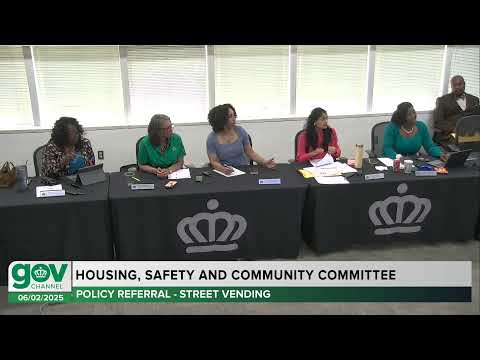
The Housing, Safety & Community Committee on June 2 held an extended public discussion on street vending (peddlers), following a referral to staff earlier in May. Staff summarized existing law and geography: vending is legal without a permit outside the city's Congested Business District (CBD) but is illegal inside the CBD except for permitted Tryon Street Mall vendors (the Tryon Mall vendor program is administered by Charlotte Center City Partners). The committee heard a two‑hour public input session summary (May 22) that included 35 participants.
Public commenters and business owners described repeated sidewalk obstruction, customer-traffic loss, public-health concerns about uninspected food preparation, unchecked generators and ‘‘turf’’ conflicts that sometimes escalated into violence. Multiple business owners said sidewalk obstruction blocked ADA access and deterred families and customers from visiting established brick-and-mortar businesses. Vendors who operate under the Tryon Mall permit said they want consistent enforcement against illegal vendors who do not pay the permit fee and do not meet food‑safety or business‑licensing requirements.
City staff and committee members discussed policy options including: requiring permits citywide (with visible posted permits), designating assigned vendor locations in neighborhoods (a model similar to the Tryon Mall program), stepped/escalating fines for repeat offenders, improved interagency enforcement (Code, CDOT, Health, CMPD) and a district pilot program to test permitting and enforcement approaches. Staff noted existing fines were low (up to $10–$50 in many code sections) compared with peer cities (several of which use fines up to $500); staff recommended consideration of a fine up to $500.
Committee action: the committee unanimously directed staff to develop an escalating fine structure (up to $500) with tracking and to prepare a pilot permitting/enforcement program that addresses sidewalk obstructions, food-safety compliance, repeat offenders and neighborhood-designated spaces. Staff was asked to return to Council with a recommended ordinance change and pilot design for Council consideration at the next available business meeting.