
Subcommittee hears testimony blaming Goshen deal for taxpayer losses, questions MEDC oversight and $23.6M SSRP payment
Get AI-powered insights, summaries, and transcripts
Subscribe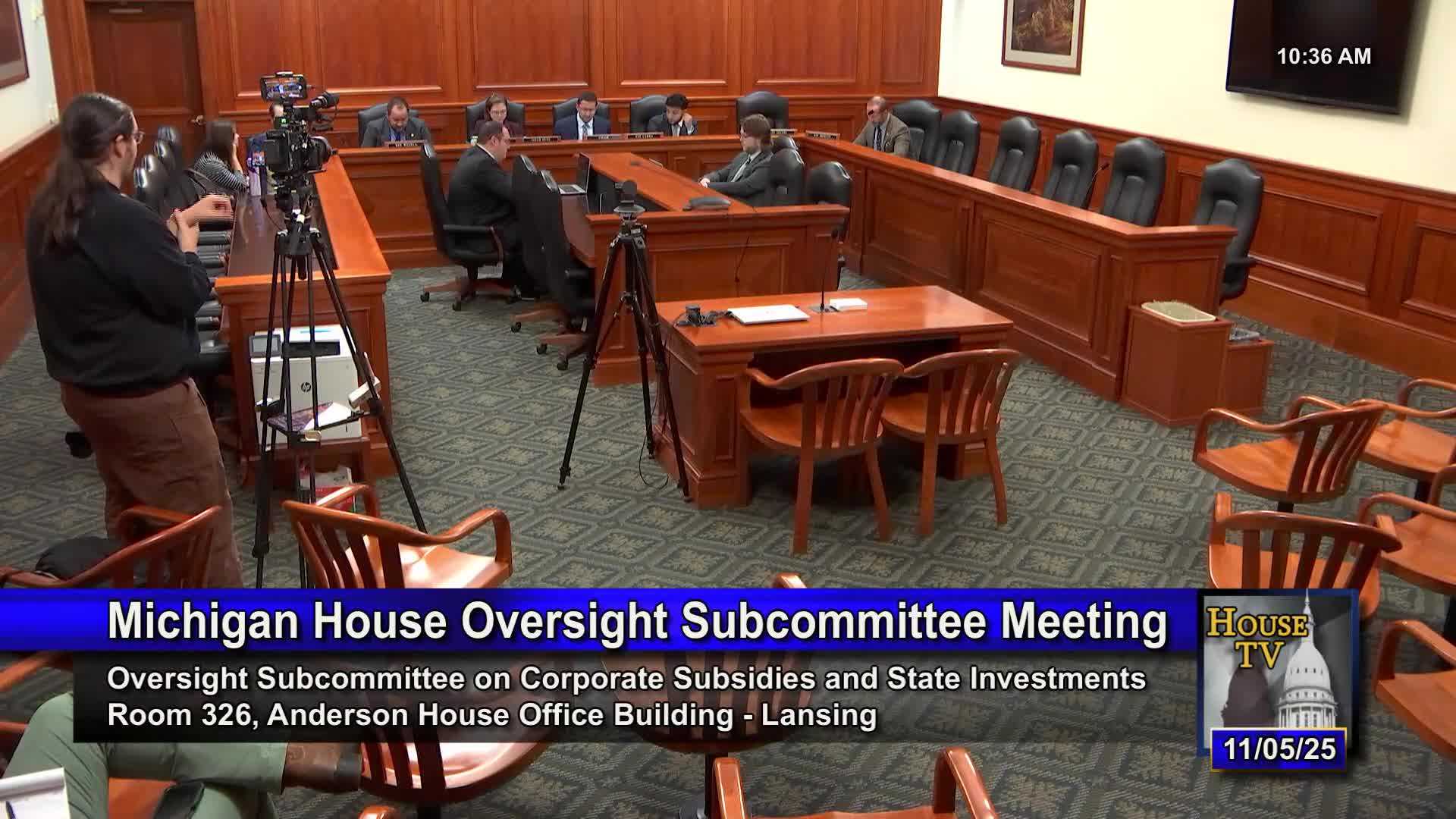
Summary
Members of the Michigan House Oversight Subcommittee on Corporate Subsidies and State Investments continued their review of the failed Goshen electric‑vehicle battery project and state subsidy practices, focusing on recovery of funds and the adequacy of MEDC oversight.
Members of the Michigan House Oversight Subcommittee on Corporate Subsidies and State Investments continued their review of the failed Goshen electric‑vehicle battery project and state subsidy practices, focusing on recovery of funds and the adequacy of MEDC oversight.
"This was no mere business transaction gone awry," testified Ambassador Joseph Sella, who described the Goshen agreement as "one of the worst examples of state driven economic development in the history of the state of Michigan" and alleged ties between Goshen and the Chinese Communist Party that he said were not sufficiently vetted.
The committee heard that the Michigan Strategic Fund (MSF) has declared Goshen in default and that the central fiscal question is recovery of state funds. Chair Cara summarized the appropriations tied to the project, saying there was "$125,000,000 in CIP or critical infrastructure project funding that never got appropriated to Goshen" and that of a "$50,000,000 in SSRP or Strategic Site Readiness Program funding, $23,600,000 was appropriated to Goshen." The chair characterized the $23.6 million as the principal sum under scrutiny.
Why it matters
The testimony framed the Goshen matter as a recurring example of what some lawmakers call ineffective state economic‑development deals: large incentives granted with limited transparency and, at times, little return in realized jobs. Committee members and the witness raised both taxpayer‑protection and national‑security concerns, and discussed legal and administrative pathways for recovering dispersed funds.
Key facts and testimony
- Ambassador Joseph Sella provided a detailed chronology of the deal, noting initial press reports in September 2022, a high‑profile announcement in October 2022 that Sella said touted hundreds of millions in incentives, subsequent secrecy including NDAs reported in February 2023, local approvals and protests in 2023, litigation between the township and Goshen, and an MSF letter in September declaring default or voluntary abandonment.
- Sella said SSRP funds and other appropriations were used for land acquisition, site preparation and some engineering work, though he described engineering work as minimal and land prices as "grossly inflated." He recommended returning the land to Green Charter Township via quitclaim if Goshen settles and urged reimbursement of the township's attorney fees.
- Committee members asked about the scale of township budgets and legal fees; Sella said he did not have a precise total but estimated the fees were likely "south of a million dollars," while noting the figure was uncertain and litigation costs might continue.
- On vetting of foreign‑affiliated companies, Sella recommended pursuing CFIUS review or state equivalents and building a strict checklist for due diligence when deals involve adversarial regimes or critical technologies.
Committee action and process notes
- Procedural motion: Minority Vice Chair Wigela moved to approve the minutes of the Oct. 29 meeting; the motion was approved without objection. No other formal committee votes occurred during the hearing.
- The MEDC had agreed to testify but declined because of the ongoing default and its efforts to recover SSRP funds, according to Chair Cara.
Quotes
"This was no mere business transaction gone awry," Ambassador Joseph Sella said, describing the Goshen deal as "concocted and championed" by state actors and private interests and criticizing a lack of transparency.
"There was $125,000,000 in CIP ... but then of the $50,000,000 in SSRP ... $23,600,000 was appropriated to Goshen," Chair Cara said, identifying the $23.6 million as the main recovery question.
Context and background
Witnesses and members cited broader state policy instruments in the discussion: SOAR (a legislative program created in 2021), the Strategic Site Readiness Program (SSRP), and actions by the Michigan Strategic Fund. Commentators referenced published reporting and analyses, including work by the Mackinac Center and reporting in the Detroit News about secrecy and code names used in some subsidy negotiations.
The committee signaled continued oversight; Chair Cara closed the hearing after questions and thanked the witness.
Ending
The subcommittee did not take further formal action beyond approving minutes; members urged continued investigation, potential legal action by state agencies, and development of stronger vetting procedures for future subsidy agreements.