Get Full Government Meeting Transcripts, Videos, & Alerts Forever!
Get email alerts on the Budget And Finance topic
No spam. Unsubscribe anytime.
Board adopts new budget-deviation policy setting thresholds and mitigation procedure
Summary
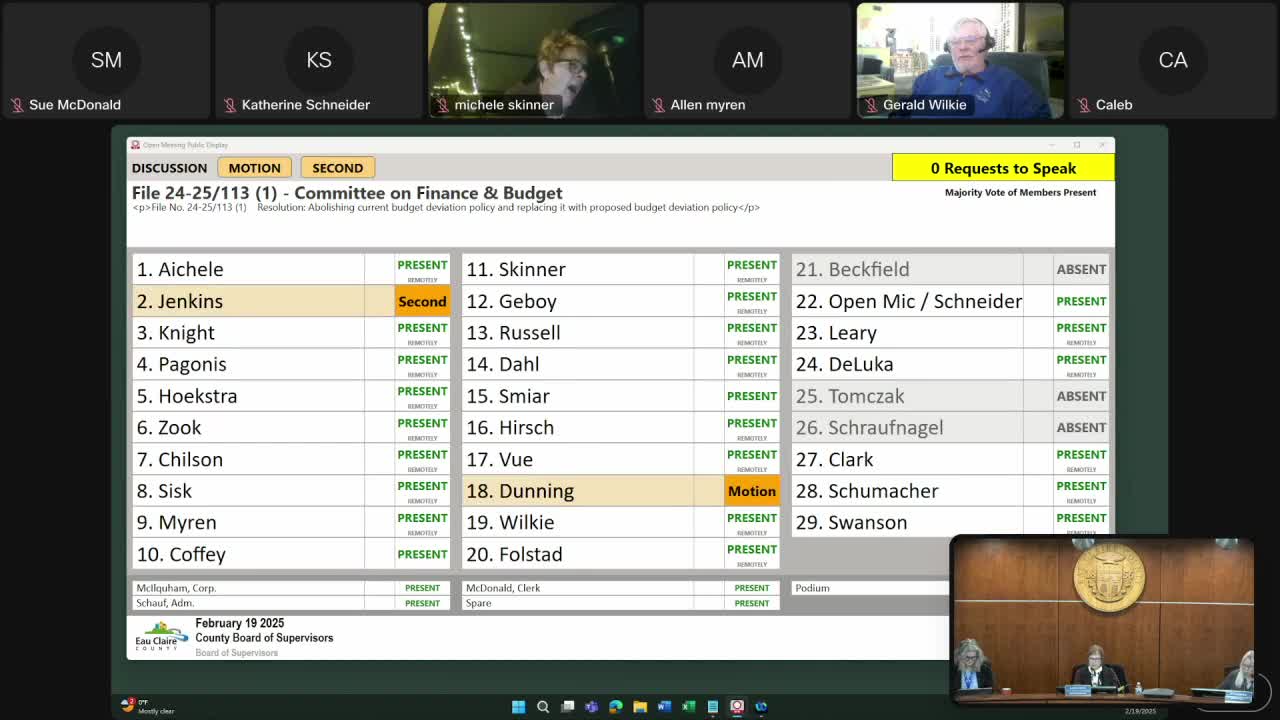
Eau Claire County replaced its prior budget-deviation policy with a new version that sets a threshold (greater of $50,000 or 2.5% of the department budget) requiring oversight-committee notification and submission of mitigation plans. The policy passed 21-6 amid debate about human services overages.
The Eau Claire County Board of Supervisors on Feb. 19 voted 21-6 to replace the countybudget-deviation policy with a revised procedure that defines dollar thresholds and formalizes a mitigation and reporting process.
Under the new policy, a department expenditure deviation that exceeds the larger of $50,000 or 2.5% of the department's annual budget triggers a requirement for the department head to notify the relevant oversight committee, provide an explanation and submit a mitigation plan to the Finance and Budget Committee. The policy also clarifies certain procedural steps and includes examples of typical mitigation measures.
Supporters said the policy increases transparency and provides a clear, auditable process for oversight committees and Finance & Budget to monitor and respond to emerging overages. Supervisor Pagonis, who led the Finance & Budget committee work, said the change codifies a process staff and committees have been using informally.
Opponents, including several supervisors who cited the Department of Human Services' recent and substantial 2024 overages, argued the policy does not itself prevent departments from spending beyond their budgets during the year and that stronger internal controls or automated spending locks would more directly prevent fund drainage. The board debate included discussion of timing for revenue recognition and the monthly reporting cadence between departments and finance staff.
The board approved the revised policy 21-6. Finance & Budget committee members said they will continue to monitor implementation and propose technical edits if needed.