Council approves HRT microtransit pilot; advocates and residents press for We Care Resource Center stop
Loading...
Summary
Council voted unanimously Feb. 11 to participate in a Hampton Roads Transit microtransit pilot intended to create a neighborhood on‑demand zone to connect riders to fixed‑route service.
Council approved a resolution to participate in the 2025 Hampton Roads Transit (HRT) transit ridership incentive program to develop a microtransit zone in Chesapeake, a program HRT has piloted in other Hampton Roads localities.
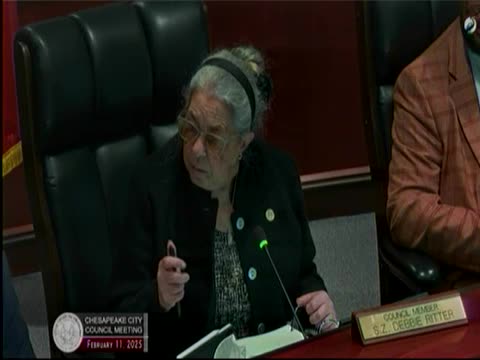
Councilmember Susan Ritter described constituent requests for better connections between the Military Highway bus stop (the old site for some services) and the new We Care Resource Center (Stepping Stone Square), and asked whether the microtransit pilot could address the need for a short shuttle or on‑demand link for people who cannot walk the distance. Manager Manning and staff said microtransit is designed to provide on‑demand, short‑trip connections to larger fixed‑route networks and can be a cost‑effective way to extend access; staff said they would coordinate with Human Services and HRT to evaluate exact stop locations and operational details.
During public comment volunteer Sharon Stahl of Agape Feast and Chesapeake Care urged council to consider placing a stop at Smith Drive and Stepping Stone Square to shorten a one‑mile walk for clients who are seniors, pregnant, disabled or carrying possessions. In contrast, resident Vic Nichols asked council to be cautious about the city’s match obligation, noting an approximate 20% local match figure of $260,400 cited by a public commentator and urging that any local contribution be tied to demonstrated route effectiveness.
The council approved the participation motion (moved and seconded on the floor) by a 9‑0 recorded vote.
Why this matters: The program could increase transit access for vulnerable residents by linking neighborhood on‑demand trips to the fixed bus network, but placement and design will determine whether it serves walk‑limited residents who use the We Care Resource Center.