Get Full Government Meeting Transcripts, Videos, & Alerts Forever!
Get email alerts on the Land Use Watershed topic
No spam. Unsubscribe anytime.
Council delays site-plan review after residents and watchdogs cite flood and tree‑removal concerns
Summary
The Austin City Council on Feb. 13 postponed Item 42— a site-plan matter— until March 6 after a mix of environmental advocates and neighborhood residents pressed the council to allow more time to evaluate flooding and tree‑removal impacts.
The Austin City Council on Feb. 13 postponed Item 42— a site-plan matter— until March 6 after a mix of environmental advocates and neighborhood residents pressed the council to allow more time to evaluate flooding and tree‑removal impacts.
Bill Bunch, executive director of the Save Our Springs Alliance, told the council he supported the postponement and urged members to “pay attention to your watershed protection staff and their recommendations” when the item returns. He argued the city’s recently adopted flood-mitigation plan contains provisions that shift responsibility for lot-to-lot runoff onto downstream property owners, and urged council to bring back any relevant flood mitigation materials with the item.
Other speakers said the site work already done at the project area has removed large numbers of trees and threatened local habitat. A neighborhood resident who addressed the council with a two‑minute presentation said “thousands of trees have been removed, including 13 heritage trees,” and that heavy grading and increased impervious cover will increase runoff into downstream creeks.
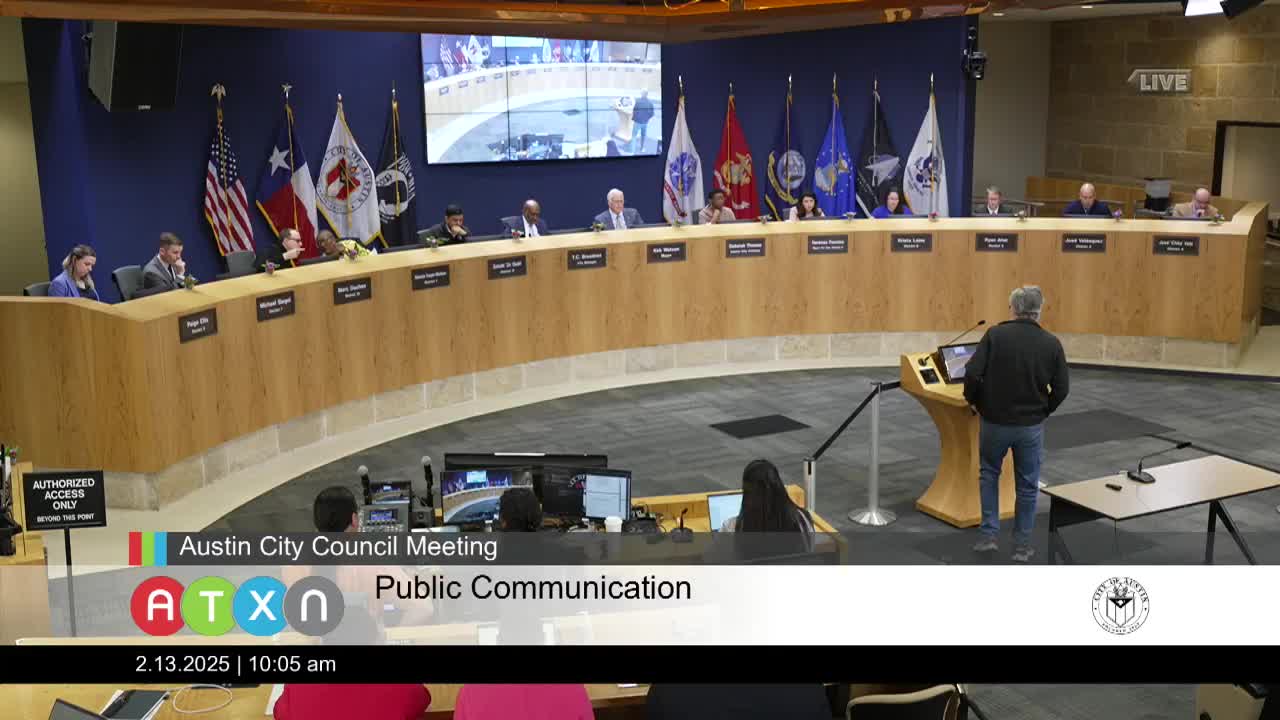
Mayor Kirk Watson opened the hearing to allow commenters to speak to the merits of postponing the item; with public testimony concluded, the council voted to postpone Item 42 to March 6 so staff and stakeholders can supply additional materials and staff recommendations.
What happened next: the council did not make a final decision on the site plan. The postponement gives watershed protection staff and the applicant time to provide technical materials and for councilmembers to review the flood‑mitigation issues raised by speakers.
Why it matters: Speakers tied the postponement to potential neighborhood flooding, habitat loss and the adequacy of mitigation measures. The case highlights recurring tension in Austin land-use decisions between development activity and watershed/heritage-tree protections.
Quotes from the record: “When you bring this back next time, you pay attention to your watershed protection staff and their recommendations,” Bill Bunch said. A neighborhood resident said, “Thousands of trees have been removed, including 13 heritage trees… It is going to be more water down Bull Creek.”
Next steps: The item is scheduled for staff and applicant follow-up and will return to council on March 6, 2025.