Get Full Government Meeting Transcripts, Videos, & Alerts Forever!
Get email alerts on the School Performance And Accountability topic
No spam. Unsubscribe anytime.
Commission adopts renewal and performance-framework updates; staff report preopening enrollment averages about 75–80%
Summary
The School Performance & Accountability committee finalized renewal criteria and set a 70% student retention threshold within the school performance framework, removed teacher retention as a framework indicator, and heard a preopening update reporting average year‑one enrollment at about 75–80% across new schools.
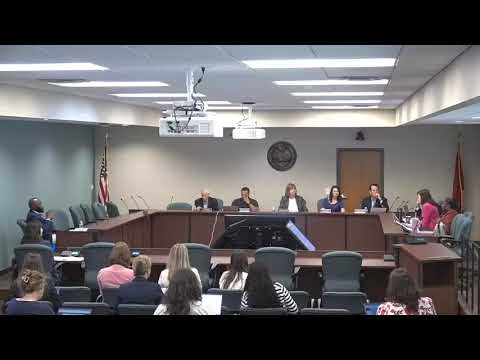
The Tennessee Public Charter School Commission’s School Performance & Accountability committee on July 24 completed final review of renewal criteria, advanced revisions to the school performance framework (including a 70 percent student retention threshold), and reviewed preopening progress across seven new schools that will open for 2025–26.
Deputy Director of Authorizing Maggie Lund told the committee the renewal criteria were developed to align authorizing practice to State Board of Education policy and the commission’s strategic plan. Lund said the criteria are broad and applied across academic, organizational and financial areas; the academic standard in the proposed criteria requires a school to ‘‘meet standard for the majority of the years in the current charter term, and they meet standard for at least 2 of the 3 most recent years,’’ with similar formulations for organizational and financial performance.
On the school performance framework, Lund and data coordinator Rebecca Ledderbur said staff recommended two organizational changes after three years of implementation. First, the committee set a 70 percent student retention threshold as the indicator for meeting standard on student retention; staff presented a pressure test showing the vast majority of existing schools would meet that level. Second, the commission removed the teacher retention indicator from the framework because of national staffing volatility, limited data reliability and the difficulty of establishing a reasonable, portfolio-wide threshold. Lund said teacher retention will continue to be discussed during site visits and annual closeout meetings even though it is no longer a scored framework indicator.
Authorizing coordinator Sophie Benefield Gilmore reviewed the preopening process for seven schools authorized to open in 2025–26 and described the commission’s ‘‘ready to open’’ criteria (start-up plan, facilities, staffing, enrollment and financial plan). She said year‑one enrollment targets had aimed for 75 percent enrolled by April and 100 percent by June, but that most preopening schools were at roughly 75–80 percent as of the July update and that Memphis schools showed later enrollment momentum. Sophie said staff will consider adjusting timeline expectations and continue to require adjusted budgets and contingency plans for networks and single-site operators.
Staff also reported hiring and staffing challenges common to the sector, particularly recruiting licensed special education teachers and supports for English learners, and said two new preopening schools originally delayed for facilities reasons are now on track for the current opening. Commission staff described board engagement work and confirmed American Classical Academy Jackson Madison relinquished its charter to allow its governing board to focus on its Rutherford campus.
Looking forward, Lund previewed the 2025–26 portfolio (Empower Career and College Prep – Memphis; Invictus Nashville (Montessori); Encompass Community School; KIPP Antioch Global Elementary; Lehi Southeast Elementary; Nurses Middle College Nashville; Wood Dale Middle School) and outlined the academic accountability timeline: TCAP estimates in mid‑August, TVAAS/growth scores in October, federal designations in November, letter grades in late December and the commission annual report on Jan. 1.
Speakers quoted and attributed in this report are those who spoke at the meeting: Maggie Lund, deputy director of authorizing; Rebecca Ledderbur, data and accountability coordinator; Sophie Benefield Gilmore, authorizing coordinator; Chair Terrence Patterson.