Tuolumne County keeps hybrid ambulance model, orders RFP after consultant review
Loading...
Summary
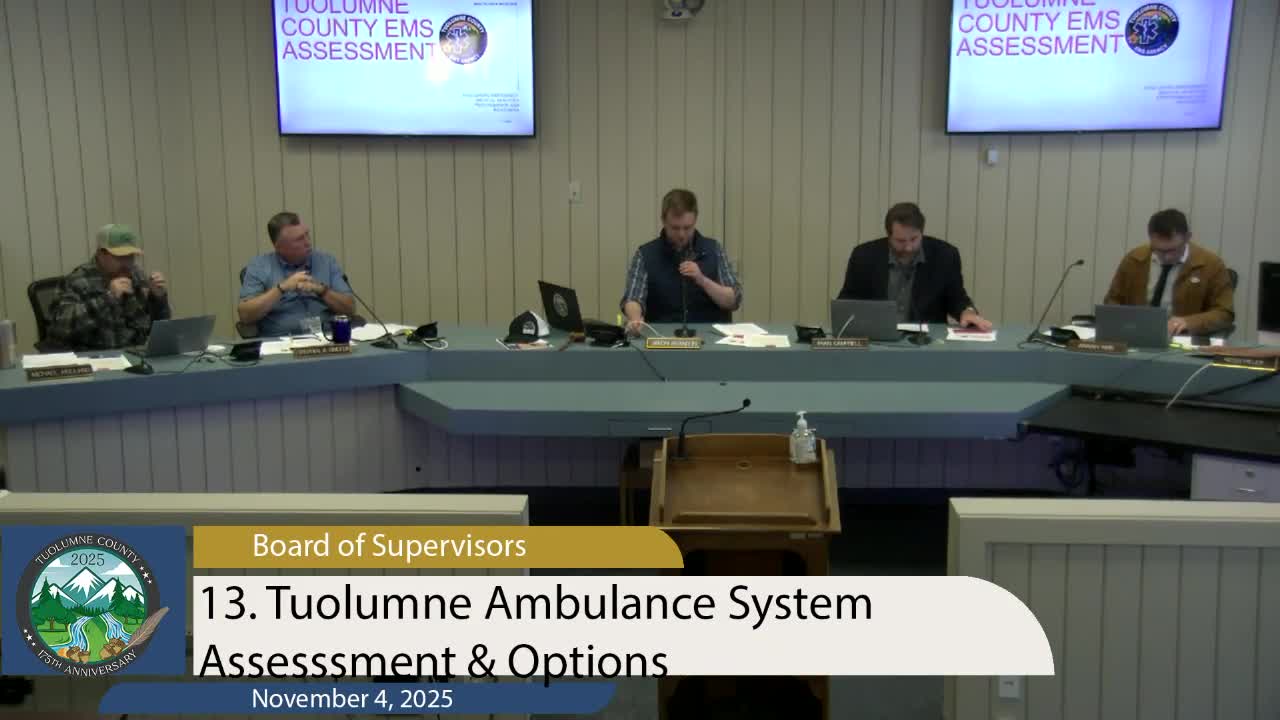
Consultants hired to assess Tuolumne County’s ambulance system recommended the county keep its existing hybrid public‑private model and seek a new provider through an open request for proposals, the Board of Supervisors decided Nov. 4.
Consultants hired to assess Tuolumne County’s ambulance system recommended the county keep its existing hybrid public‑private model and seek a new provider through an open request for proposals, the Board of Supervisors decided Nov. 4.
Health Care Strategists presented the assessment, saying the county’s “public utility” approach lets it receive enhanced Medi‑Cal (GEMT) reimbursement unavailable to purely private providers and that it supports local clinical oversight. The consultant team recommended several near‑term operational changes to improve performance: better use of the computer‑aided dispatch system, establishing an electronic CAD‑to‑CAD link between the sheriff’s dispatch and CAL FIRE dispatch, adoption of emergency‑medical dispatch procedures, improved key performance indicator automation, and a stronger ambulance service medical director role.
The consultants also flagged staffing and deployment issues: many ambulance shifts are staffed on 48‑hour tours that do not match demand curves concentrated in afternoons and evenings; Tuolumne has a high volume of inter‑facility transfers (IFTs) in addition to 911 responses; and recruitment and retention remain a challenge in a high‑cost region. The team recommended the next ambulance contract require CAL FIRE crews serving the county to achieve at least EMT certification so lifesaving care is available on first‑arriving units.
Members of the board pressed consultants on specific points: whether call‑volume data included IFTs (consultants said yes, while noting some subcontractor volumes were not included), how an exclusive operating area (EOA) model compares in rural counties (consultants cautioned EOAs often require subsidies), and whether combining 911 and IFTs under one provider might improve oversight and efficiency. CAL FIRE Assistant Chief Nathan Gorham confirmed many of CAL FIRE’s front‑line crews in Tuolumne are EMT‑qualified and said staff would follow up with exact station staffing data.
During public comment, Manteca Ambulance representatives and longtime local paramedics urged recognition of local experience and cautioned about operational disruptions during any provider transition. After questions and public comment, the board voted unanimously to maintain the current public‑private model and to direct staff to prepare and issue an RFP for ambulance services, with the RFP to incorporate consultant recommendations and performance requirements. Supervisors also asked staff to return with an analysis of an internal “third service” and other long‑term models for future consideration.
The board’s motion to issue the RFP was moved by Supervisor Ryan Campbell and seconded by Supervisor Anne Holland and passed unanimously.