
Prescott staff present 2024 building and fire code amendments; council set to consider Nov. 18 vote
Get AI-powered insights, summaries, and transcripts
Subscribe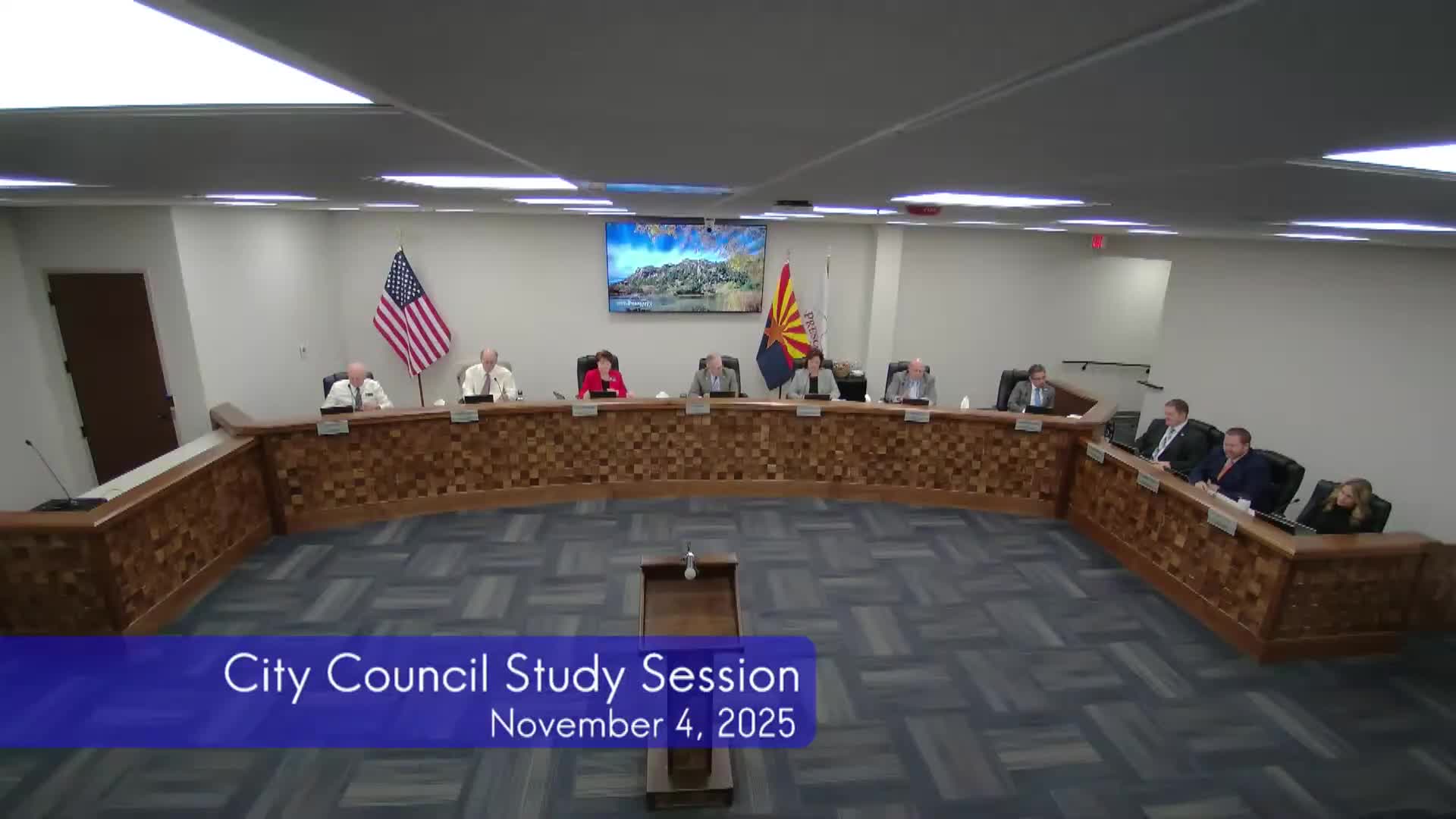
Summary
Prescott staff presented a consolidated package of proposed 2024 building and fire code amendments and said a tentative council vote is scheduled for Nov. 18, 2025.
Prescott City staff presented a combined package of proposed amendments to the city's building and fire codes at the Nov. 4 study session, seeking regional uniformity and fewer local amendments while adopting the 2024 model code family and the 2023 National Electrical Code. Staff said a tentative council vote on the package is scheduled for Nov. 18, 2025, and that several items will require additional stakeholder review before final adoption.
Doug Stowarski, Prescott's chief building official, said the proposal covers the 2024 editions of the International Building Code family (building, existing building, fuel gas, mechanical, plumbing and residential) and the 2023 National Electrical Code. He said the one exception is the energy code, which staff recommend remain at the 2012 edition so Prescott aligns with other regional jurisdictions and to avoid greater immediate costs for builders.
Stowarski described a multi-jurisdictional review process with Sedona, Cottonwood, Camp Verde, Dewey-Humboldt, Prescott Valley and Yavapai County, and said the goal was to reduce bespoke local amendments. "We worked hard to try to eliminate some of that," he said, noting meetings with the Yavapai County Contractors Association (YCCA), community outreach events and endorsements from the Building Safety Advisory Board.
Significant building-code items explained by staff include:
- Snow-load methodology: The IRC cycle introduces an address-specific hazard tool that gives point-by-point snow-load values. Stowarski said staff were initially concerned but supported adoption because it produces higher, site-specific design loads in extreme weather events and because neighboring jurisdictions are adopting the same approach. (Councilman Gamboge asked about equivalence to inches of snow; a staff reply noted that pounds-per-square-foot varies with snow moisture content and that "about 38 inches of snow" could produce roughly 47 psf in an example exchange.)
- Concrete slab vapor retarders: The city's amendment makes vapor-retarder requirements site-specific based on geotechnical recommendations rather than a universal rule.
- Plumbing tests deleted: Staff propose removing two rarely used tests (building sewer testing for non-pressure lines and shower-lining testing) after regional agreement.
- Future gas stubs and trenching: New requirements would label future gas stub-outs with maximum BTU ratings and require sealed caps; trench bedding standards were added to ensure appropriate backfill and reduce field failures.
- Receptacle locations for islands: The city would re-introduce a measurable standard allowing inspected receptacle installations or inspected conduit boxes below counters so future work is not left uninspected.
Stowarski said the building code package also consolidates language (for example moving the Building Safety Advisory and Appeals Board language into the code), preserves existing permit-fee references and incorporates an expedited plan-review option consistent with a state law (House Bill 2447).
Fire Division Chief Anthony Valdez presented the fire-code amendments and said the department likewise sought to reduce local departures from the model fire code while adopting updates important to public safety. Notable fire-code items Valdez highlighted include:
- Outdoor assembly threshold: Staff propose lowering the permit threshold from 1,000 expected attendees to 500 to reduce risk and allow appropriate plan review for more events.
- Conflicts with General Engineering Standards: New language would make the most restrictive requirement prevail where the fire code and city engineering standards overlap (example: hydrant clearance requirement of 5 feet in the GES vs. 3 feet in the model code).
- Inflatable/temporary structure permitting: Inflatable amusement devices and some temporary membrane structures would be specifically subject to permitting and inspection after several examples nationwide of serious injuries.
- Access/egress for new developments: Staff propose clarifying requirements for additional access and egress routes for new developments (intent to require both access and egress where feasible and to seek alternatives where infeasible), citing wildland-urban-interface risk.
- Blasting: Staff propose repealing the city's outdated local blasting ordinance and relying on the model code with targeted local amendments to reflect Prescott's needs.
Valdez noted the fire board of appeals had not yet reviewed the full package (a quorum for that board was formed recently and staff expect a hearing Dec. 4). He also said the Wildland-Urban Interface (WUI) code update would be brought back in the first quarter of next year to allow additional stakeholder outreach.
Stakeholders present voiced support at the meeting. Sandy Griffiths of the Yavapai County Contractors Association praised the multi-month collaboration and said the contractors association plans outreach to help implement changes; Angela Bauman of B and W Fire asked staff to provide the amendment text for contractor review.
Staff recommended the council consider the ordinance on the council meeting agenda Nov. 18, 2025. Several technical clarifications and outreach milestones remain, including fire-board review and additional WUI outreach in early 2026.