Get Full Government Meeting Transcripts, Videos, & Alerts Forever!
Get email alerts on the Budget topic
No spam. Unsubscribe anytime.
Spring Hill council approves $37.2 million 2026 budget after debate over reserve use and levy
Summary
After a three‑hour budget discussion, the Spring Hill City Council approved the 2026 operating budget with expenditure authority of $37,206,490. Council members debated use of a roughly $824,000 medical reserve to lower the mill levy and whether to fund two police positions; the motion passed 3–2.
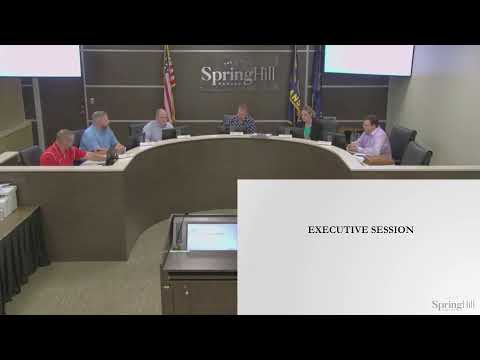
The Spring Hill City Council approved the 2026 operating budget on Sept. 11, setting expenditure authority at $37,206,490 after a lengthy discussion about mill‑levy reductions and use of city reserves.
Finance director Rhonda Dunn briefed the council on revenue assumptions, saying sales and service fees are the largest revenue drivers and that property tax revenue in the proposed budget reflects a 7.7% increase in assessed valuation. She described personnel costs driving expense growth, including a proposed 4.4% merit/COLA pool, two additional police officers (fully loaded cost roughly $128,500 each), and a proposed building official position (fully loaded cost roughly $165,000).
Dunn presented a set of options for reducing the city’s mill levy, including a 0.28‑mill reduction (the staff‑published option) and deeper reductions of 0.5, 0.75 or 1.0 mills. To cover larger reductions, she recommended using the city’s medical reserve fund, which she said held approximately $824,000 at the time of the meeting. She told the council that the city’s goal when creating the reserve was to hold a full year of premiums (projected to be about $1.4 million in 2026).
Council members questioned tradeoffs between using reserves to lower the levy and preserving budgeted positions. Multiple council members said they preferred using cash reserves rather than cutting positions; one member said retaining staffing — especially added police officers — was “way too important” to sacrifice for a levy cut. Others argued for a more conservative drawdown of reserves because future state legislation could cap valuations and change city revenue dynamics.
After floor debate and a procedural motion on the final budget document, council voted to approve the budget as presented, by a 3–2 margin. The motion approved the budget authority number the city will submit to the county; the county calculates the mill levy based on the approved budget and final assessed valuations.
The council directed staff to prepare the signed budget form for county filing by state deadlines. Staff said they would continue monitoring revenues and recommended replenishing reserves when possible.
Votes at a glance: The motion to adopt the 2026 operating budget (expenditure authority $37,206,490) passed 3–2. No change to the staff’s proposed personnel package was recorded in the adopted motion.
What happens next: The clerk will file budget forms with the county before the statutory deadline; council and staff will continue to track actual revenues and consider replenishing the medical reserve in future budget cycles.