Get Full Government Meeting Transcripts, Videos, & Alerts Forever!
Get email alerts on the K12.lab School topic
No spam. Unsubscribe anytime.
Senate committee advances bill to preserve University of Wyoming K–8 lab school after tense testimony
Summary
Senate File 126, which would establish the University of Wyoming Public Lab School as a K–8 independent public school located on the UW main campus, advanced out of the Senate Education Committee Tuesday after amendments and a 3–2 committee vote.
Senate File 126, which would establish the University of Wyoming Public Lab School as a K–8 independent public school located on the UW main campus, advanced out of the Senate Education Committee Tuesday after amendments and a 3–2 committee vote.
The bill’s sponsor, Senator Raufus, told the committee the lab school has existed in one form or another for more than a century and historically supported the UW College of Education’s preservice teacher training, student teaching and research mission. He said recent changes in the Albany County School District’s resourcing and the district’s interpretation of the lab‑school memorandum of understanding left the school “operating as a public school that happened to be on the University of Wyoming campus,” and that the university’s trustees had moved to close it without sufficient public engagement.
The legislation would codify the school’s K–8 status, require it to meet state assessment and accountability standards, set a minimum capacity determined by the State Construction Department (written in the bill as not to be less than 200), and create a governing board composed of a resident district trustee or designee, the district superintendent or designee, the UW College of Education dean (or designee) and an appointee of the dean, the state superintendent of public instruction (or designee), one teacher selected by the school’s teachers, one parent selected by the parents, and the principal serving ex officio as chair. The board would have contracting, budgeting and personnel authority and report annually to the Joint Education Interim Committee on student achievement, placements and university engagement.
Sponsor’s intent and amendments
Raufus said the bill is intended “to keep the lab school operating as it has operated, not to fundamentally change it,” while strengthening the lab school’s statewide role in educator preparation and in sharing best practices. He proposed and the committee adopted three technical amendments: (1) language to treat the lab school as a continuing school for the school foundation program to avoid an initial double‑funding fiscal impact, (2) striking statutory language that would have authorized compensation for governing‑board members, and (3) clarifying that services contracted with either the resident district or the University of Wyoming be provided at an incremental cost.
District concerns on funding, timing and process
Albany County School District witnesses, including CFO Tristan Green and Assistant Superintendent Dave Hardesty, testified in opposition or with reservations. Tristan Green said the district was not consulted before the bill was drafted, questioned whether there is adequate time to convert the school to the proposed funding model for next school year, and said the bill as drafted risked transferring roughly $2.5 million linked to the lab school’s average daily membership out of district control. Green also told the committee the lab school’s historical three‑year ADM average had been about 235 but that enrollment had fallen to roughly 160 after the university announced its intent to close the campus school.
Hardesty and Kate Kinnis, the district’s chief academic officer, characterized the district as a major preservice placement host for UW — placing dozens of practicum students each semester — and said the district already supplies many of the experiences Raufus described. District witnesses also warned the bill could force rapid contractual and operational decisions without adequate time to finalize funding, facility and staffing arrangements.
University perspective and renovation costs
University witnesses, including UW representative Mike Smith, described the trustees’ decision not to renew the lab‑school MOU as a function of curriculum and safety concerns and changing campus conditions. Smith said the building’s adjacency to dorms and campus growth had increased security and maintenance needs and that facility renovation estimates (cited to past study) would be substantial. He also said many of the college’s preservice placements occur across the state and throughout Albany County, and that the trustees concluded the campus lab school no longer served its prior role as effectively as it had a decade earlier.
Teachers, alumni and former staff testify in favor
Several longtime lab‑school teachers and alumni described the school as a unique bridge between research and practice, offering frequent, early practicum and student‑teaching opportunities because of its campus location and integration with UW’s College of Education. Testimony from former teachers and alumni emphasized hands‑on, play‑based and project‑based approaches, published classroom research and the lab school’s role in training teachers who later taught across the state. Many urged the committee to keep the institution alive in statute to preserve those statewide benefits.
Committee action and vote
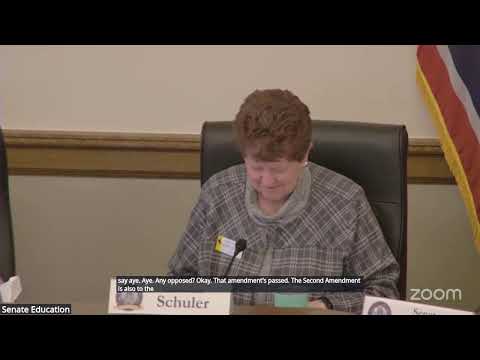
The sponsor moved and the committee adopted the three technical amendments described above. On final roll call the committee recorded the following votes: Senator Brennan — yes; Senator Olson — no; Senator Rothfuss — yes; Senator Scott — yes; Chairwoman Schueller — no. The bill as amended was reported from committee 3–2 and will proceed to the floor with the adopted amendments.
What the bill does not change
The enacted language (as reported) would not exempt the lab school from state health and safety requirements, assessment and accountability obligations, or public‑records and open‑meetings laws. It also retains a requirement that the lab school meet the state uniform educational program standards and comply with state assessment rules. The bill leaves several operational details to the governing board, the resident district and the university to negotiate, subject to the incremental‑cost and reporting provisions adopted in committee.
Next steps and outstanding issues
Senator Raufus said he will carry the bill to the floor. Outstanding questions raised during testimony that the bill or its implementing rules will need to resolve include the lab school’s LEA designation for special education, the final funding mechanism and reconciliation of the lab school’s ADM with district finances, specific facility responsibilities and renovation cost sharing, and whether the governing board and the two principal partners will reach operational agreements in time for the fall enrollment cycle.
Votes at a glance: Senate File 126 — Establishment of the University of Wyoming Public Lab School
Motion: Pass SF 126 (establishment of a K–8 public lab school) — moved by Senator Brennan; second not recorded in the transcript. Vote tally (roll call): Brennan — yes; Olson — no; Rothfuss — yes; Scott — yes; Chairwoman Schueller — no. Outcome: approved by committee (3–2).