Get Full Government Meeting Transcripts, Videos, & Alerts Forever!
Get email alerts on the License Plate Readers topic
No spam. Unsubscribe anytime.
License-plate reader rollout for Baltimore residential permits delayed amid testing and accuracy checks
Summary
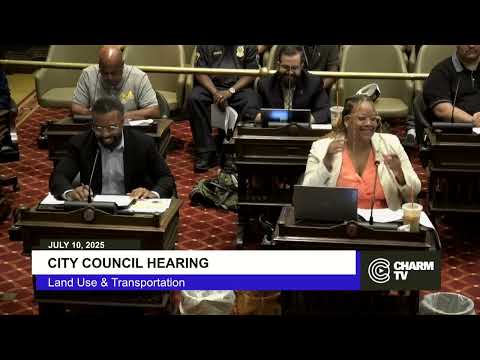
Parking Authority and city IT officials told the Land Use & Transportation Committee that license-plate-reader (LPR) technology intended to help enforce residential-parking-permit (RPP) zones has not yet been deployed citywide because of iterative software and configuration issues.
Parking Authority and city IT officials told the Land Use & Transportation Committee that license-plate-reader (LPR) technology intended to help enforce residential-parking-permit (RPP) zones has not yet been deployed citywide because of iterative software and configuration issues.
"At this point, we believe, yes, that all of the GIS and geofencing issues have been resolved," Eric Williams, agency IT portfolio manager for BCIT assigned to DOT, said about recent configuration work. Brian Thompson, division manager of on-street parking at the Parking Authority of Baltimore City, described the effort as an iterative testing process and said the team is in a third round of testing with vendors.
City staff and the Parking Authority said the platform includes a new software layer for RPP checks that differs from the older scofflaw enforcement product. That has required additional configuration and vendor code changes. Eric Williams said the team had received an updated software version but had not yet fielded it for the next round of testing.
"Provided it does perform as expected and resolves those issues, and nothing else is discovered in the process of that next round of testing, we believe within 4 to 6 weeks, we should have completely, functional platform," Williams told the committee, adding that the city would still need to evaluate accuracy and develop manual workflow procedures for operators.
Committee members requested a written follow-up that clarifies whether the same vehicles can scan simultaneously for scofflaw and RPP lists, a clearer launch timeline and a process for residents to dispute virtual-RPP tickets.
What remains to be done
- Final vendor code release installed and field-tested. - Operational accuracy assessment by BCIT and DOT, including speed and operator workflow impacts. - Written procedures for residents to dispute virtual RPP citations and for council offices to request abatement in pilot neighborhoods. - A written follow-up from DOT/BCIT/PA with a clearer schedule for testing and deployment.
Speakers
[{"name":"Brian Thompson","role_title":"Division Manager, On-Street Parking","affiliation_type":"government","affiliation_name":"Parking Authority of Baltimore City","first_reference":{"timecode":"00:53:51","transcript_line_range":[124,126]}},{"name":"Eric Williams","role_title":"Agency IT Portfolio Manager, BCIT for DOT","affiliation_type":"government","affiliation_name":"Baltimore City Information Technology (BCIT)","first_reference":{"timecode":"00:53:51","transcript_line_range":[127,129]}}]