Board approves code updates, ag fees and abatement costs; adopts clean-energy roadmap
Loading...
Summary
At the Nov. 4 meeting the board voted on a set of administrative and regulatory items: adoption of the 2025 California Building Standards Code with existing local amendments, an agricultural fee schedule update, two property-abatement cost confirmations, and adoption of a Clean Energy Roadmap for existing buildings.
The Contra Costa County Board of Supervisors handled several administrative matters on Nov. 4, 2025, taking final action on agenda items affecting county operations, codes and planning.
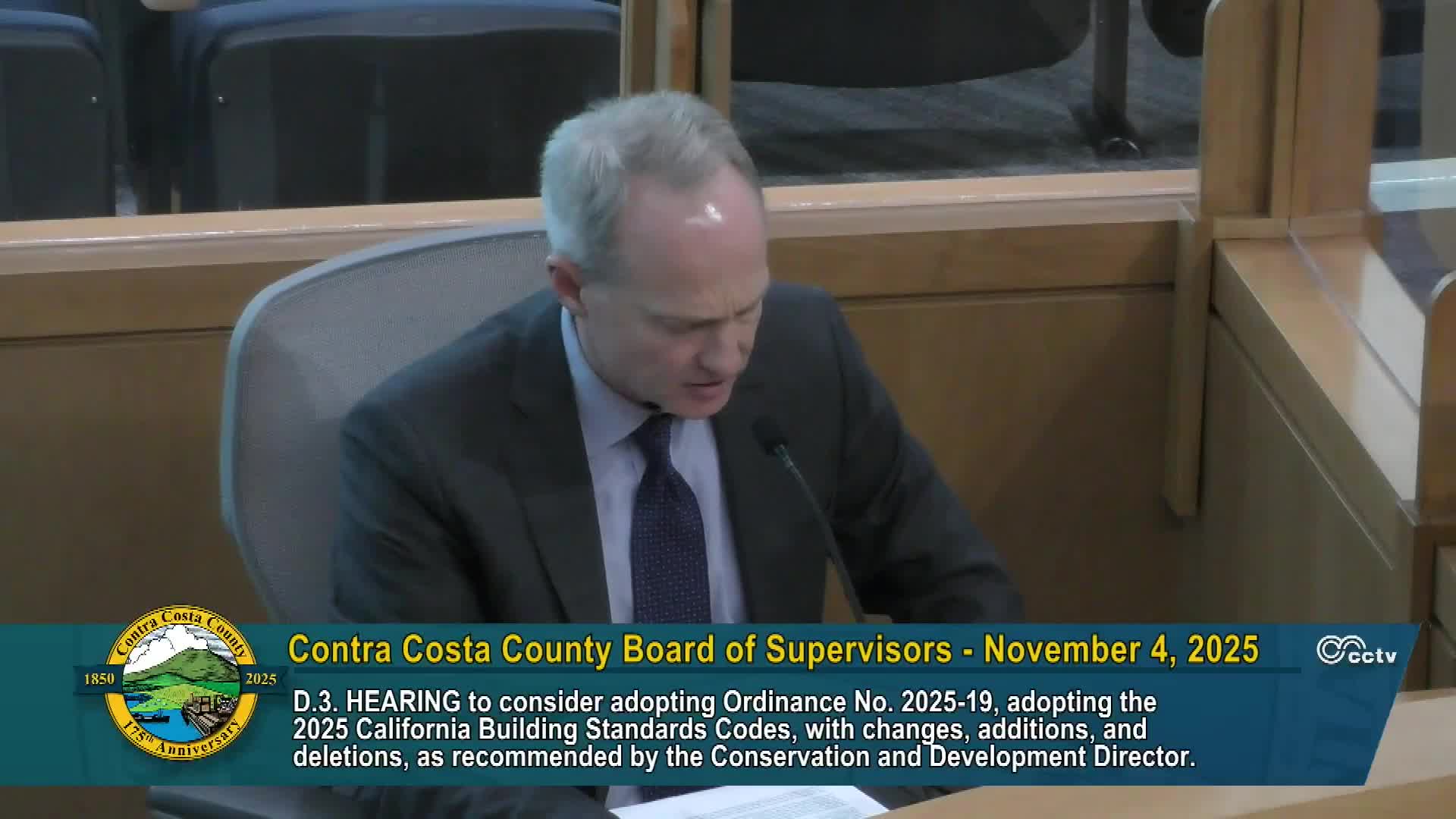
Adoption of 2025 California Building Standards Code (Ordinance 2025-19) The board unanimously adopted Ordinance 2025‑19, bringing the county into alignment with the 2025 California Building Standards Code while retaining pre‑existing local amendments that exceed the statewide minimums. Jason Crapo of the county’s Department of Conservation and Development told the board the county’s existing local amendments — particularly those responding to seismic risk, unstable soils and electric-vehicle (EV) readiness — would be carried forward. The county’s current EV-charging amendment remains more stringent than the statewide baseline and will continue to require at least 10% of parking spaces in new developments to include EV chargers. The county will not carry forward local energy-code amendments that the 2025 statewide energy code now exceeds; those statewide energy requirements will take effect Jan. 1, 2026.
Agricultural fee schedule The board approved updates to the Department of Agriculture and Weights & Measures fee schedule, raising selected fees to reflect current hourly costs and reintroducing a charged certificate of quarantine compliance item used by nurseries and shippers. Commissioner Matt Slattergin reported the department had not updated certain fees in many years and that some inputs and inspection costs had risen.
Property abatement cost confirmations The board accepted and confirmed itemized abatement accounts for two unincorporated properties where county crews removed vegetation, garbage and other code violations: a vacant lot at 1920 Sixth Street in Richmond (expense $7,258.30) and a vacant lot at 616 Grove Avenue in North Richmond (expense $13,186.47). The board authorized recording those costs as a special tax on the properties.
Clean Energy Roadmap for Existing Buildings The board adopted the county’s Clean Energy Roadmap for Existing Buildings, a largely informational, strategic document that responds to a Climate Action and Adaptation Plan strategy. The roadmap focuses on residential building electrification and lays out an implementation plan and next steps, including an EHSD‑led grant study funded by existing Energy Efficiency and Conservation Block Grant dollars, additional data collection on building stock and regional/state collaboration for incentives and permitting streamlining. The board directed staff to pursue grant opportunities, continue outreach and update the roadmap annually if needed.
Votes at a glance (recorded outcomes) - Ordinance 2025‑19 (2025 California Building Standards Code with local amendments): adopted, unanimous vote. - Department of Agriculture fee schedule amendments: adopted, recorded vote (4–0 in the meeting record). - Abatement charges, 1920 Sixth Street, Richmond: accepted and confirmed, unanimous. - Abatement charges, 616 Grove Avenue (Fannie Wilson estate): accepted and confirmed, unanimous. - Clean Energy Roadmap for Existing Buildings: adopted, unanimous.
What happened next Several board members and staff noted the need for coordination between counties, cities and state agencies as code changes become effective on Jan. 1, 2026, and asked staff to support outreach to affected businesses and building professionals.