
Contra Costa allocates up to $21 million to replace paused CalFresh benefits with debit cards, food boxes
Get AI-powered insights, summaries, and transcripts
Subscribe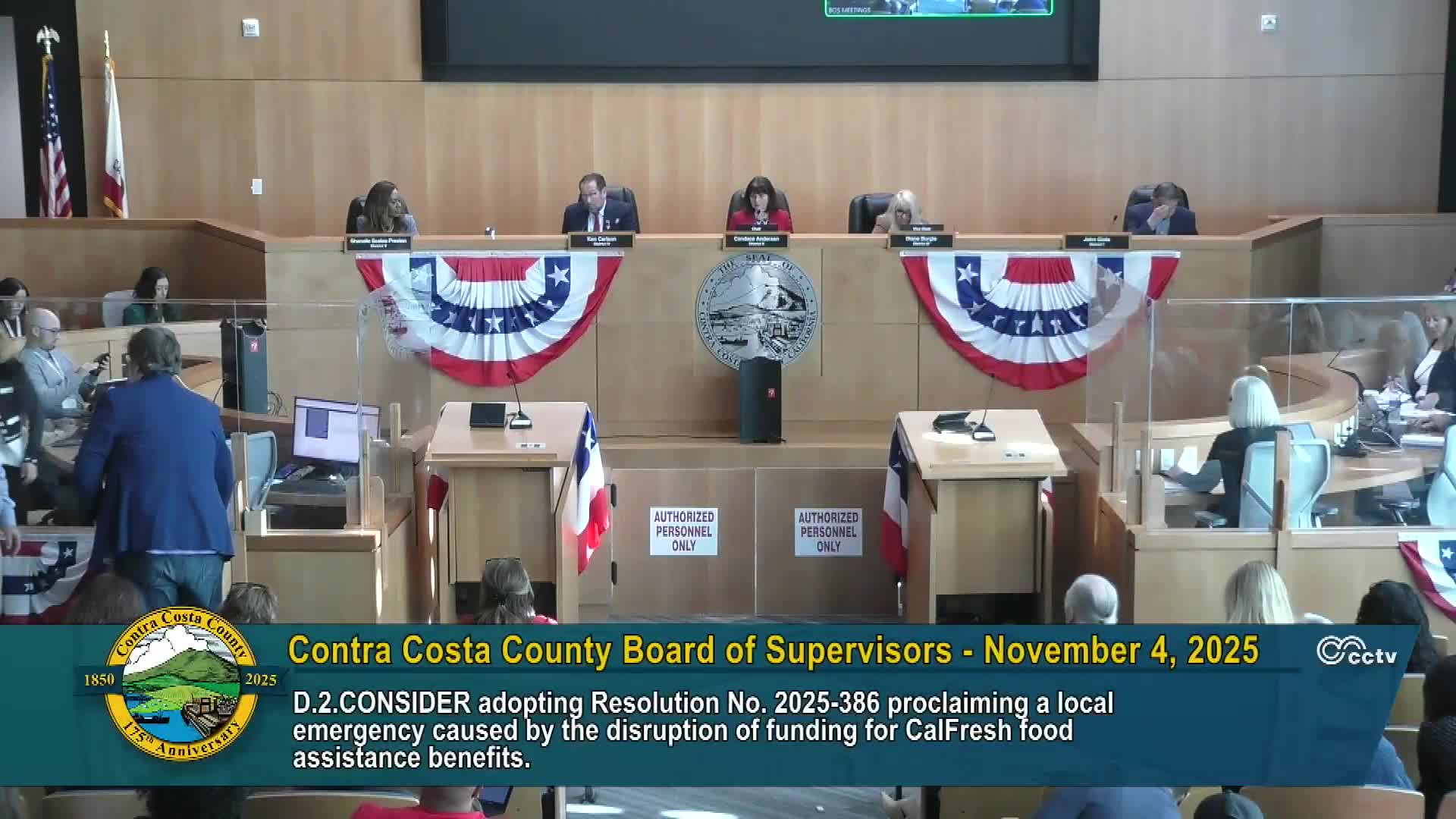
Summary
The Contra Costa County Board of Supervisors unanimously declared a local emergency and approved up to $21 million on Nov. 4 to provide prepaid debit cards and food boxes to households eligible for CalFresh after a federal shutdown halted benefit disbursements.
The Contra Costa County Board of Supervisors on Nov. 4 unanimously declared a local emergency and approved up to $21,000,000 to provide emergency food assistance after federal SNAP (CalFresh) benefits were disrupted by a federal government shutdown. The plan directs county staff to distribute prepaid debit cards and food boxes to eligible households and to report back within 60 days.
County Employment and Human Services Director Marla Stewart told the board that in September the county had 108,510 CalFresh recipients in 65,142 households and that monthly issuances totaled $21,089,996. Stewart said the county’s food providers were already strained and that the county’s recommendation includes immediate food-box deliveries and a phased debit-card distribution to ensure beneficiaries can buy groceries locally.
Stewart outlined a two-part plan: an initial emergency distribution of food boxes already underway from county sites, and a prepaid-debit-card program beginning Nov. 10 to deliver a portion of November benefits to validated recipients. The county will operate four service sites with extended hours (7 a.m. to 7 p.m.) and will load cards in stages — an initial 50% of the benefit, a possible additional 25% after two weeks, and a final top-up if federal benefits do not resume. She said the sheriff’s office will provide on-site security and county fraud teams will perform random audits.
County finance staff described the $21 million funding package the board approved: $8,181,373 drawn from an unassigned general-fund balance (FEMA reimbursement) and $12,818,627 from the county’s appropriation for contingencies. County staff said the card-vendor contract will include standard safeguards; the board authorized the director to execute a contract with the card vendor (payment limit for contracting services noted in the staff report not to exceed $200,000).
Chair Candace Anderson moved the funding allocation; Supervisor Ken Carlson seconded. The motion carried unanimously. The board directed staff to begin issuing cards and food boxes and to return within 60 days with an implementation report and results.
Community groups, food banks and philanthropies urged the action during a large public comment period. Caitlin Sly of the Food Bank of Contra Costa and Solano praised the county’s proposal and urged immediate approval: “We urge the board to approve this request and ensure no one in Contra Costa County goes hungry while CalFresh benefits are delayed.” The Dean and Margaret Lesher Foundation said it would make an emergency donation to the Food Security Collaborative; food providers including Loaves & Fishes, White Pony Express, Meals on Wheels and St. Vincent de Paul reported sharply increased visits and requested an additional pooled philanthropic fund of $5 million to help cover distribution and operating costs.
Officials emphasized operational safeguards and special populations. Stewart said some groups — independent living program (ILP) foster youth and some IHSS recipients — may receive cards by delivery or mail where appropriate. Stewart also said cards will be shipped to county offices blank and then loaded at issuance to reduce theft risks, and that identity and eligibility will be verified in person so that the card vendor is not given personal data. The board approved weekend and holiday schedule adjustments by direction (Veterans Day included) and asked staff to evaluate adding limited weekend hours at each distribution site so working households could access benefits.
Supervisor Chanel Scales Preston, who pressed for clarity on funding origins, asked that the board avoid using community-impact ARPA funds that had been earmarked for a public allocation process; the board’s approved motion instead used the FEMA reimbursement and contingency mix described above while preserving ongoing community-engagement conversations. County finance director Adam Nguyen highlighted the budget trade-offs: drawing reserves affects interest income and long-term reserve balances and should be used cautiously, he said, but acknowledged the board’s judgment to intervene in the short term to prevent hunger and local economic disruption.
The board asked staff to coordinate outreach with cities and nonprofit partners and to publish a unified volunteer and donation portal so community members can help with food distribution. Stewart said communications are being coordinated through EHSD and the county PIOs.
What the action does and does not do - Authorizes up to $21,000,000 to purchase and distribute debit cards and support food-box distribution; this is county general-fund spending and carries no guarantee of federal reimbursement. County staff said they anticipate litigation and federal remedies but could not rely on federal timing. - Directs the EHSD director to issue cards at county sites beginning Nov. 10, with identity and eligibility validation in person, staged card loading, and fraud/ audit protections. - Authorizes staff to contract with a vendor for the cards and to report back to the board within 60 days with an implementation update.
Key numbers from the staff presentation - CalFresh recipients (Sept.): 108,510 people in 65,142 households. - September CalFresh issuances in Contra Costa: $21,089,996. - Retail outlets used by recipients in Sept.: 705 unique retailers; about 75% of expenditures occurred in-county.
Why it matters County officials framed the action as a stopgap response to an unprecedented disruption in federal food assistance: local purchasing power supports neighborhood retailers, reduces immediate pressure on hunger-relief nonprofits and provides families with a measure of choice and normalcy while county and state leaders continue to press for federal resolution. Public and philanthropic partners said more funding and volunteer support will still be needed if federal benefits remain suspended.
Next steps Staff will operationalize sites and hours, begin food-box deliveries and card issuance starting Nov. 10, coordinate with nonprofit partners and philanthropy, and return to the board within 60 days with a full implementation report and recommendations.