Get Full Government Meeting Transcripts, Videos, & Alerts Forever!
Get email alerts on the Environment Stormwater Tree Canopy topic
No spam. Unsubscribe anytime.
Port Orchard staff outline tree canopy mapping, NPDES Phase 2 obligations and code gaps
Summary
Public works and planning staff presented initial tree canopy mapping and explained new NPDES Phase 2 stormwater permit requirements that call for canopy goals and consideration of canopy in stormwater planning. Staff reported 169.2 acres of canopy mapped in the right-of-way, identified gaps in the significant tree ordinance and McCormick Village
City staff briefed the Planning Commission on new tree canopy requirements tied to the National Pollutant Discharge Elimination System (NPDES) Phase 2 stormwater permit and on initial canopy mapping results. The presentation described why canopy matters for stormwater management, the mapping methodology, and code gaps staff intend to address.
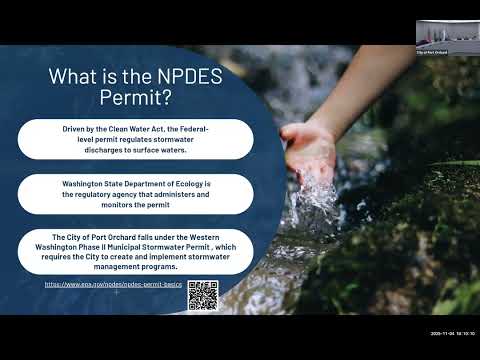
Dennis Ryan, Port Orchard's public works director, said the NPDES Phase 2 permit (administered by the Washington State Department of Ecology under the federal Clean Water Act) requires jurisdictions to adopt policies that set five- to 10-year canopy goals for city-owned properties, consider canopy in stormwater planning, and explicitly address canopy in overburdened communities and protections for mature trees. "Urban tree canopy is a natural stormwater filter," Ryan said, noting trees intercept rainfall, increase infiltration, and reduce runoff and pollutants entering Sinclair Inlet.
Staff described a mapping process using Nearmap imagery and AI to identify canopy and measure coverage, height and density. The city has mapped 169.2 acres of tree canopy within the public right-of-way to provide a baseline for planning and to guide future planting and preservation. Staff said the next steps include mapping canopy on city-owned parcels (parks and facilities), cataloging species composition, and developing an equation to estimate how existing canopy treats impervious area.
Planning staff and public works noted limitations in the current significant tree ordinance (POMC 20.129): the ordinance focuses on mitigation rather than proactively expanding canopy, replacement ratios may not yield equivalent mature canopy, protections are short term (construction period), and there is limited long-term monitoring and enforcement. The McCormick Village Overlay District has stronger, site-level canopy thresholds but applies to a small area only.
Commissioners asked about the specific methodology for calculating stormwater benefits from canopy and about species selection; staff said the quantitative methodology is still being developed and species/stock size matter for benefits and maintenance. Commissioners raised operational concerns (leaf litter plugging drains) and city capacity (two vacuum trucks and two street sweepers). Staff said the NPDES requirements will likely grow more stringent in future permit cycles and that planning and public works will jointly prepare code amendments and inventories for future hearings.
No formal action was taken; staff said code amendments will be drafted and return to the commission for review and public comment later in the process.