Get Full Government Meeting Transcripts, Videos, & Alerts Forever!
Get email alerts on the Homelessness topic
No spam. Unsubscribe anytime.
Brighton council begins downtown homelessness discussion; police urge services-first approach alongside targeted enforcement
Summary
City officials told Brighton's City Council that enforcement alone will not solve visible homelessness downtown and urged a coordinated, services-first strategy paired with targeted enforcement for criminal behavior.
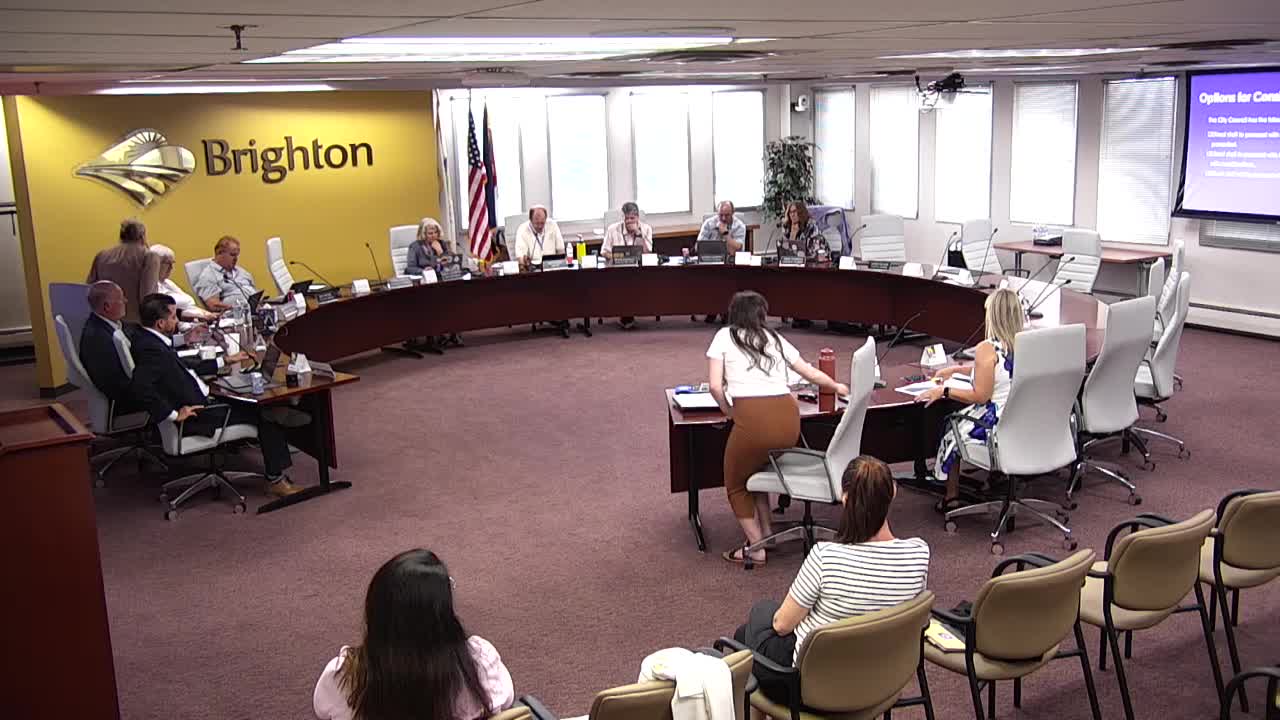
City officials and the Brighton Police Department told the City Council on July 8 that enforcement alone will not resolve the visible homelessness and related quality-of-life complaints in the downtown business district, and urged a coordinated, services-first approach paired with targeted enforcement when laws are broken.
"An enforcement first mechanism is really not a reasonable solution to addressing a lot of these issues," the Police Chief said during a presentation that reviewed common complaints: loitering, camping, public urination or defecation, discarded drug paraphernalia, and aggressive behavior.
The chief said Brighton and neighboring jurisdictions lack substantial local shelter capacity, and that many of the people officers contact "don't want to leave Brighton." The department said it is focusing on voluntary compliance, connecting people to services, and partnering with organizations such as Almost Home (a shelter and outreach provider) and Reaching Hope (mental-health clinicians who co-respond to scenes).
For situational data, the chief cited Adams County's most recent point-in-time count sorted by city: "36 total, 7 of which are unsheltered," but cautioned that such counts capture a single night and likely undercount the broader, transitory population.
Council members and staff discussed short-term measures to reduce public sanitation problems and improve downtown business conditions, including providing secure, well-lit portable restrooms, identifying safe-parking locations, and improving restroom access for non-24/7 businesses. Mayor Pro Tem Padilla and others noted that portable restrooms and a dedicated cleaning schedule could reduce incidents of public urination and provide short-term relief.
Council also discussed enforcement tools used elsewhere: sit-and-lie ordinances (Denver and Colorado Springs examples), camping bans in public spaces, and private-property camping prohibitions. City Attorney Calderon noted the city does not currently have a private-property camping ban and said that gap could be addressed if council chose to pursue it.
Several council members urged a balanced response: continue active enforcement when criminal or ordinance violations occur (stolen property, aggressive behavior, littering with drug paraphernalia), while investing in outreach and a case-management approach to connect people with benefits and shelter. Staff and the chief recommended considering a dedicated outreach or case-management position (potentially hosted by a nonprofit partner rather than the police department) to focus on long-term engagement.
Funding and capacity constraints were a recurring theme. Mayor Pro Tem Padilla said Almost Home is the only remaining shelter in Adams County for families (with seven rooms) and that "it's roughly 28 percent of Almost Home's budget that won't exist for the next fiscal year," a cut she said would limit the organization's ability to expand services.
City Manager Martinez told council the study-session discussion is the start of a multi-pronged effort; staff will return with options, continue coordination with urban renewal and housing authorities, and work with partners to identify potential resources and next steps.