Get Full Government Meeting Transcripts, Videos, & Alerts Forever!
Get email alerts on the Airport topic
No spam. Unsubscribe anytime.
Grand Forks County approves closure of section lines to accommodate airport runway extension
Summary
A petition from the Grand Forks International Airport Authority to close portions of public section lines west of the airport was approved by the Grand Forks County Board of Commissioners on Dec. 17, 2024.
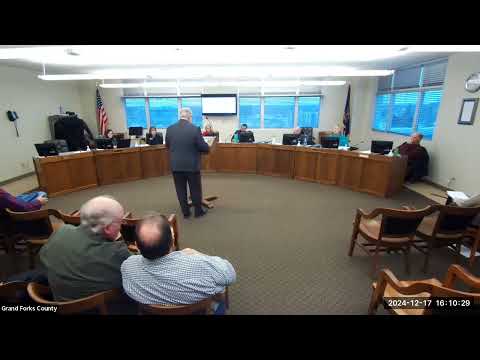
A petition from the Grand Forks International Airport Authority to close portions of public section lines west of the airport was approved by the Grand Forks County Board of Commissioners on Dec. 17, 2024. The board acted after a presentation by Tim Dittis, attorney for the airport authority, who said the closures are necessary to meet FAA-mandated safety zones created by a recent crosswind-runway extension.
Dittis told the commission the airport recently completed “a roughly 2,500 foot westerly extension” of the crosswind runway and acquired adjacent property so County Road 5 could be relocated west to create a larger runway protection zone, obstacle-free zone and runway safety area. He said federal regulations require exclusive control of the areas adjacent to the runway and that closing the specified section lines would allow the airport to restrict unauthorized personnel from those zones.
The petition explained that the Rye Township board previously altered County Road 5 and that, under North Dakota law, the underlying congressional section lines remain open for public travel until the county closes them. The airport authority furnished private access easements to adjacent landowners, Dittis said, and staff described those easements as maintaining the same points of access for property owners even if the section lines were closed to public travel. Dittis also asked the county to grant the airport written permission to place permanent obstructions within 33 feet of either side of the closed section lines to allow placement of fencing and gates.
No members of the public spoke during the public hearing; staff reported the landowners identified in the petition had been served and had not registered objections in person at the meeting. After questions from commissioners, the board moved and approved the resolution to close the identified portions of the section-line roads and to authorize the airport to place necessary permanent obstructions and perimeter fencing as described in the petition.
Why it matters: The action aligns county authorization with federal aviation safety requirements tied to the runway extension, and it affects access and rights along portions of County Road 5 and nearby section lines. The board’s decision included staff representations that adjacent private easements would preserve landowner access as described in the airport’s exhibits.
What the county approved: The commission approved the petition to close the specified section lines identified in the airport authority’s filing, and it granted the airport authority written permission to place permanent obstructions (fencing/gates) within 33 feet on either side of the closed section lines to support airfield security and compliance with FAA standards.
Staff and officials quoted in the meeting: Tim Dittis, attorney for the airport authority, summarized the justification and told the board, “As previously stated, the federal government requires the airport authority to exclude authorized personnel from certain designated zones and areas of the airfield.”
Next steps: The closure puts county action in place so the airport can complete security fencing and operational changes required by the FAA. Any follow-up filings or construction permits related to placing fences or gates will be handled under the terms the county approved and applicable federal and state requirements.