Get Full Government Meeting Transcripts, Videos, & Alerts Forever!
Get email alerts on the Early Childhood Funding topic
No spam. Unsubscribe anytime.
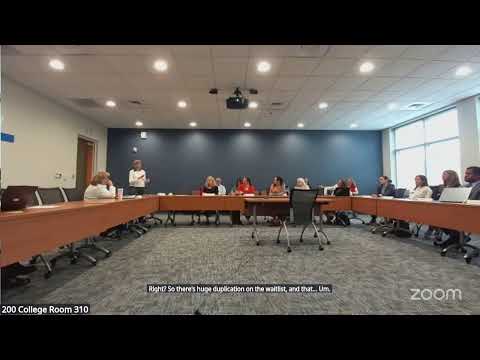
Buncombe committee weighs shifting early‑childhood fund toward focused, multiyear investments
Summary
Buncombe County’s Early Childhood Education Committee met Oct. 7 to consider a possible shift from short, dispersed grants toward focused, multiyear investments in early‑childhood care after a presentation from Buncombe Partnership for Children highlighted local workforce instability, growing classroom behavioral needs and the end of COVID‑era stabilization support.
Buncombe County’s Early Childhood Education Committee met Oct. 7 to consider a possible shift from short, dispersed grants toward focused, multiyear investments in early‑childhood care after a presentation from Buncombe Partnership for Children highlighted local workforce instability, growing classroom behavioral needs and the end of COVID‑era stabilization support.
Grama Lamott, senior staff with Buncombe Partnership for Children, told the committee that local programs have lost temporary federal stabilization funds and are now ‘‘scrambling’’ to cover compensation and operating costs. ‘‘All payments, almost $25,000,000 has come in between October 2021 and March into Buncombe County,’’ Lamott said, adding that more than half of that money went to educator compensation and that the payments have ended.
The presentation grouped immediate classroom pressures into three areas: teacher and director turnover, increased mental‑health and behavioral needs among children, and financial stress on providers and families. Lamott said 149 teachers in Buncombe participate in the state wages incentive program (a subset of the full workforce) and that turnover among those participants has been about 18–20% annually — higher than statewide averages. Partnership staff also counted roughly 19 director departures in the county this year.
The group described a paradox: several preschool‑age slots are unfilled not because of a lack of parental interest but because families cannot afford private tuition and some centers have reduced enrollment to match staffing or behavioral‑support limits. Lamott cited a national survey finding that 59% of North Carolina providers reported being underenrolled; affordability and staffing were the top reasons given.
Partnership staff presented several possible directions for new funding. One option would subsidize 3‑ and 4‑year‑old slots for middle‑income families, drawing on models in Durham and Wake counties that extend publicly funded pre‑K eligibility to higher income bands. The staff also recommended continuing the committee’s existing NC Pre‑K slot supplements and investing in countywide behavioral‑health and workforce supports, arguing those supports are needed to make expanded slots sustainable and high quality.
Committee members pressed staff on multiyear versus one‑year grants, data gaps and the potential for focused investments to displace existing grantees. Jenny Baub, director of childcare resources at the Partnership, said staff can fill many workforce and supply data gaps but that measuring true demand is difficult because many families piece together childcare informally and do not appear on wait lists. "Those are the families that we're not capturing," Baub said, describing a segment of working families who mix care from relatives, part‑day preschool and other arrangements.
Several members supported a structured community engagement plan. The committee agreed to schedule provider site visits, develop tailored surveys for parents, businesses and providers, and invite state and regional experts — including NC Division of Child Development and Early Education representatives and Department of Commerce staff — to its November meeting so members could better assess tradeoffs before changing funding strategy or timelines.
In public comment, Brian, a representative with Community Action Opportunities’ Head Start program, urged the committee to prioritize the highest‑need families if funding changes are implemented. "Our current Head Start waiting list is 273. One hundred ten of those are income‑eligible families, and 97 — 88% — are living under $15,000 a year," Brian said, warning against shifting limited local dollars away from very low‑income children.
The committee recorded one formal motion earlier in the meeting to approve the Sept. 2 minutes; the chair called for the ayes and recorded the motion as approved. Members left with assignments to draft survey questions, sign up for site visits and return Nov. 4 for the expert panel and further deliberation.
Next steps: staff will circulate proposed survey questions and a site‑visit schedule and will invite state and regional experts to the Nov. 4 meeting to inform any decision on multiyear or focused funding.