Get Full Government Meeting Transcripts, Videos, & Alerts Forever!
Get email alerts on the Grocery Tax topic
No spam. Unsubscribe anytime.
O'Fallon council advances first reading to continue 1% grocery tax after debate over reserves and equity
Summary
After public comment and extended council debate, the O'Fallon City Council approved on first reading an ordinance to continue a 1% municipal grocery retailer and grocery service occupation tax. Council members cited the revenue
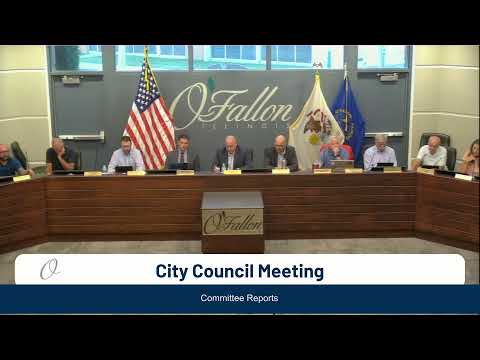
O'Fallon City Council on July 7 advanced on first reading an ordinance to continue a 1% municipal grocery retailer's occupation tax and a municipal grocery service occupation tax, sending the measure to a second reading at the council's next meeting.
The ordinance would maintain an estimated $1,200,000 annual revenue stream to the city's general fund, a figure cited repeatedly during the meeting by both public commenters and council members. The council's discussion centered on whether the money is needed to maintain current services and how the tax affects lower-income residents.
Public commenter Ron Zellms urged the council to oppose continuing the tax, saying the city has ample cash and recent years' audits show substantial general-fund surpluses. "I simply don't believe the city will experience any irreparable harm if this revenue stream of approximately $1,200,000 to the general fund is disrupted," Zellms said, and he cited a reported $134,479,890 in cash and investments as of March 31, 2025 and multi-year general-fund surpluses shown in recent audits.
Councilmember Jessica Lotz said she had reviewed options and staff estimates and concluded the grocery tax supports core services the city expects to maintain. "Staff estimates the grocery tax brings in about $1,200,000. That funds about $500,000 for the police, $200,000 for streets, our IT department, our dispatch center," Lotz said, adding that upcoming union contract costs next March could add roughly $250,000 in year-one police costs alone.
Councilmember Todd Roach argued a quarter‑cent sales tax would shift more of the tax burden to nonresidents and noted new commercial development could add future sales-tax revenue. "The grocery tax is affecting those who are most in need. Everyone has to buy food," Roach said. He offered an amendment to phase the grocery tax down over time to allow staff to reassess revenues after new development opens; that amendment did not receive a second.
After discussion and public comment, the council approved the ordinance on first reading by roll call (several councilmembers opposed). The mayor announced the ordinance will come back for a second reading at the next regular council meeting in two weeks.
Votes at a glance
- Ordinance (first reading): Continue 1% municipal grocery retailer's and grocery service occupation tax. Moved by Councilmember Parchment; second (not specified). Outcome: approved on first reading; second reading scheduled. Councilmembers recorded as voting "no" in roll call included Todd Roach and Vorce; a minority recorded "no." The council did not adopt phase-down language.
- Raffle permit (Clerk's report): Saint Clair and Assisi Catholic Church raffle (Aug. 22): approved on roll call.
- Appointment: Timothy Sadabres to the Planning Commission for a three‑year term ending 07/07/2028. Moved by Parchment; seconded; approved by roll call.
- Resolution authorizing transfers from reserves and budget amendments for FY25: moved, seconded, approved by roll call.
- Ordinance: Set public hearing for a Special Business District for West Highway 50 / North Greenmount Road: motion to set public hearing approved; Lotz noted this motion only sets the hearing date and is not approval of the district.
- Finance items: Council approved the budget/actual report for period ending 03/31/2025 and approved warrant No. 562 in the amount of $2,655,599.09 by roll call.
- Executive session: Council voted to enter executive session to discuss the possible sale or acquisition of property; the mayor said no votes will be taken after the executive session.
What council members said
Public and council discussion focused on two central points: the city's reserve balances and long-term recurring costs that the grocery tax helps fund. Proponents of continuing the tax emphasized the tax supports public safety and infrastructure and that using reserves to fund recurring operations is not prudent. Opponents and some public commenters said the city has large cash and investment balances and questioned whether a regressive grocery tax should continue when it disproportionately affects lower‑income residents.
Context and next steps
The measure approved tonight was a first reading; the city must hold a second reading before final adoption. Councilmembers said they will continue to review options and that staff will provide additional detail before the final vote. The public hearing for the special business district will be scheduled separately and notice will be posted per statutory requirements.
Quotes used in this story are taken verbatim from the meeting transcript and are attributed to speakers who addressed this topic during the July 7, 2025 O'Fallon City Council meeting.