
Kent County clerk cites early-voting costs, expands online records and property-fraud alerts
Get AI-powered insights, summaries, and transcripts
Sign Up Free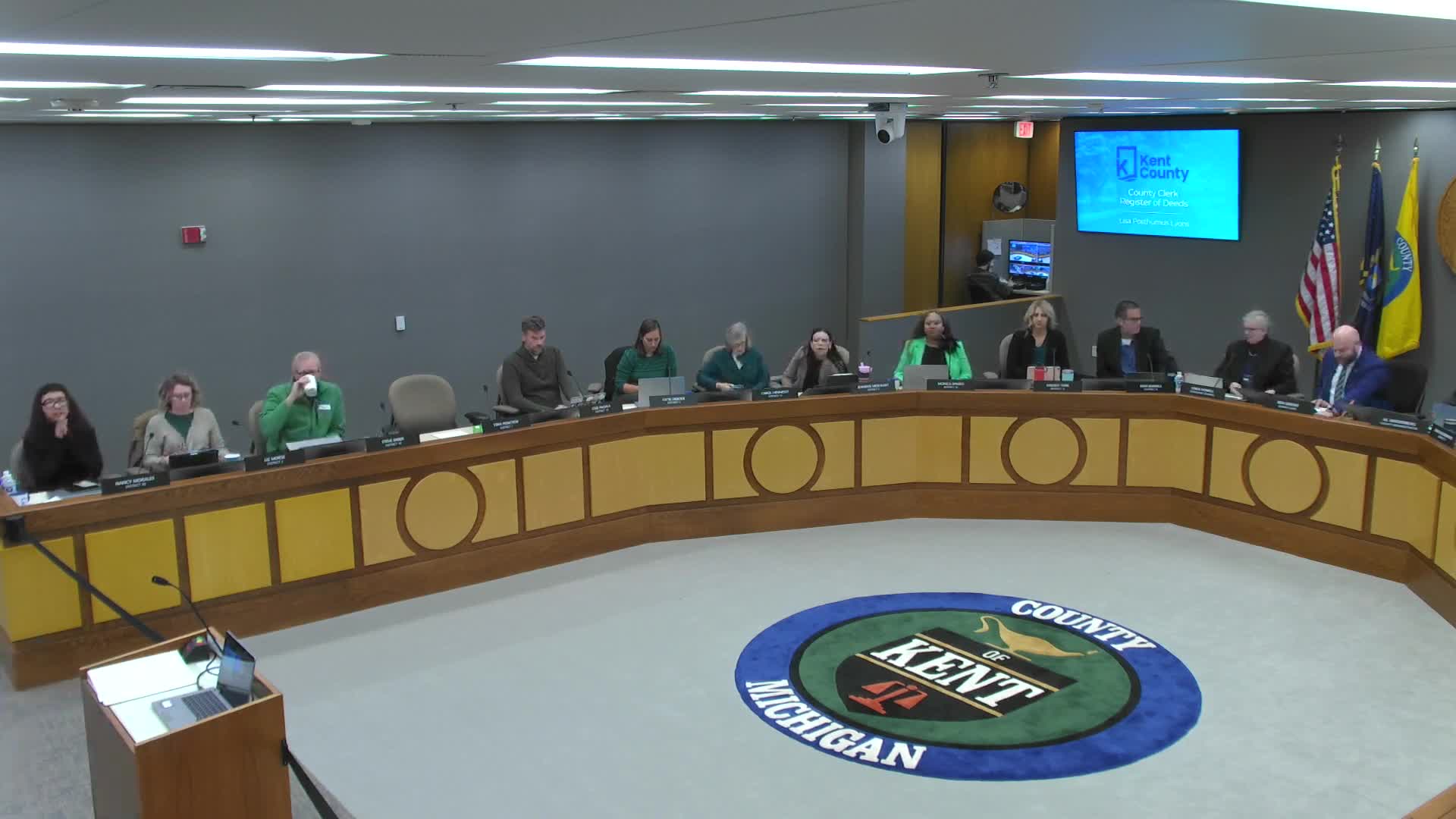
Summary
County Clerk and Register of Deeds Lisa Posthumous Lyons told commissioners the office launched new online services and fraud-notify alerts, saw record activity in some vital-record categories, and must front early-voting costs that have increased near-term expenditures pending state reimbursement.
County Clerk and Register of Deeds Lisa Posthumous Lyons delivered the office's annual report to the Kent County Board of Commissioners on Nov. 6, outlining 2024 activity across vital records, elections, register of deeds filings and circuit-court recordkeeping.
The clerk said vital-record transactions now average about 275 customer interactions a day and that the office issued nearly 98,000 certified copies of existing records in 2024, representing roughly 36,000 distinct requests. She reported births rebounding since 2020, deaths higher than 2023 but below peak 2021 figures, and marriage-license filings returning to pre-2020 levels.
Lyons summarized elections work in a year that included multiple local contests and the presidential-primary cycle. She said Kent County implemented county-level early voting in 2024 and that voting-method distribution from the November general split roughly 38% no-reason absentee, 26% early voting and 26% in-person/election-day voting. Lyons said the county will watch whether that distribution stabilizes in future cycles.
Lyons told the board that implementing early voting has required the county to pay the upfront costs and await state reimbursement, a change that makes the 2024 budget look as if expenses rose. "It appears our expenses have increased by around 25% really just to cover the early voting expenses," Lyons said, adding that the county is effectively fronting state reimbursements.
On land records, Lyons said recording volume fluctuates with real-estate markets. She projected 75,000'to'80,000 recordings in 2025 and noted the office collects a $30 recording fee; $5 of each fee goes to an automation ("tech") fund the office uses for modernization.
The clerk highlighted several technology initiatives: Bridal Access (an online portal for vital records), an online archive of election results dating to 2002, and "Project Paperless," a county-court partnership to expand electronic filing beyond the business docket. Lyons said e-recording has long been used by title companies and the office is exploring broader public e-recording and the ability to deliver electronically certified records for customers on short notice.
Lyons also described a new fraud-notify program for property owners who voluntarily sign up to receive immediate alerts when a transaction is recorded against a parcel; she said participation is low relative to the county's parcel count and identified outreach as a priority. In response to a commissioner question, Lyons estimated about 15,000 properties were enrolled in the program and asked for commissioner help promoting the service.
Lyons warned the board that the county will face costs to replace elections equipment when the statewide procurement cycle resets after 2026. She noted the Help America Vote Act (HAVA) supported earlier equipment purchases but said a similar federal funding stream is not guaranteed for the next replacement. "We are going to have to fund election equipment in the near future," she said.
Commissioners praised Lyons and her staff for customer service and transparency in elections, asked for a breakdown of deeds versus mortgages in recent recordings, and encouraged promotion of the fraud-notify program.
Lyons closed by saying the office will continue expanding online services and working with fiscal staff to manage the timing of reimbursements and automation-fund dollars.