
State advisory group caps units for single-exit buildings at 20, narrows appendix to R-2 apartments
Get AI-powered insights, summaries, and transcripts
Subscribe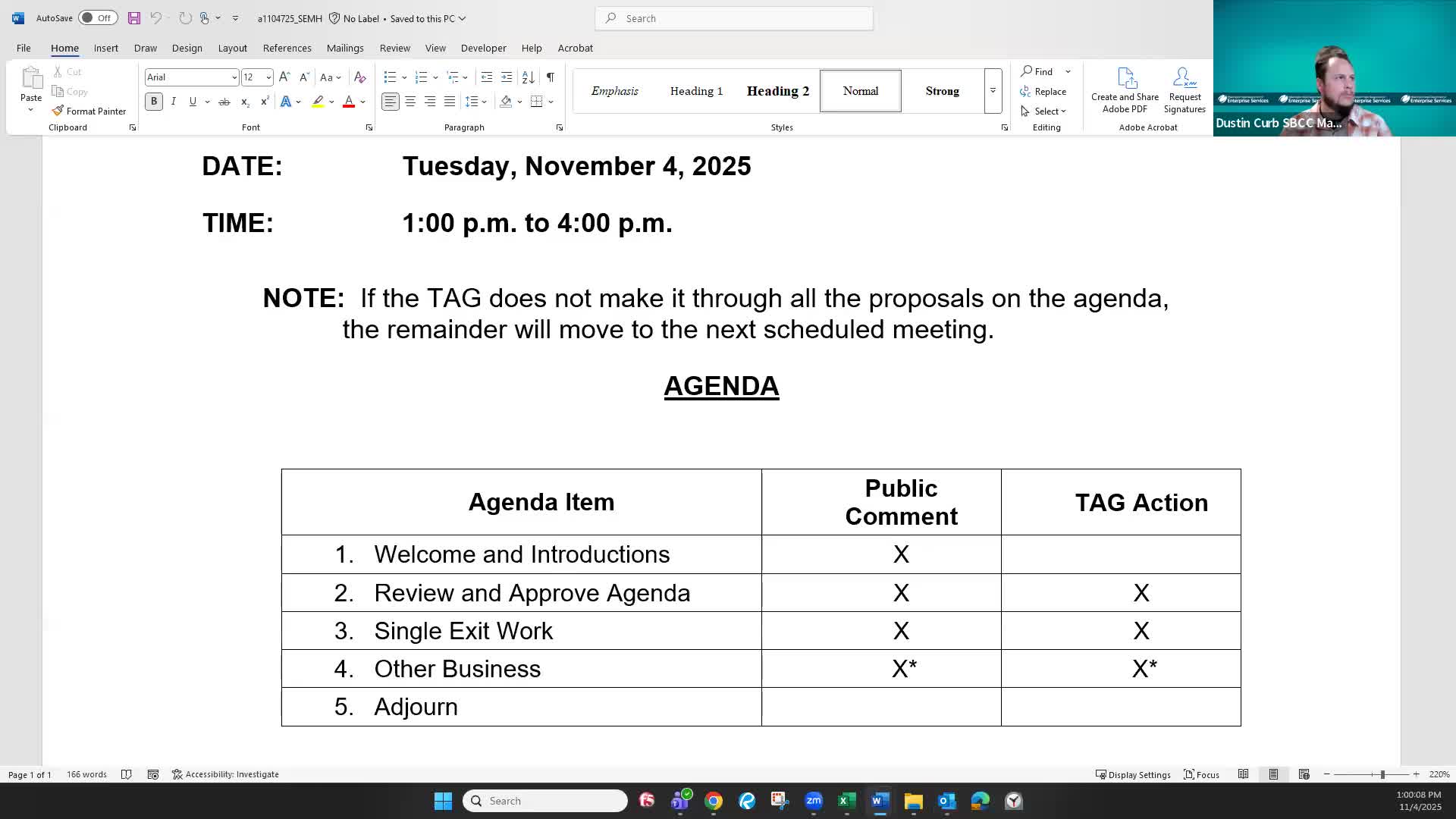
Summary
SEATTLE 94 The Building Code Council99s Single-Exit Multiplex Housing Advisory Group on Nov. 4 voted to cap at 20 the number of dwelling units that may be served by a single exit and to limit a proposed appendix to R-2 apartment houses. The group advanced related fire-department validation, tenant-preparedness, mutual-aid and inspection provisions for the draft appendix.
SEATTLE 94 The Building Code Council9s Single-Exit Multiplex Housing Advisory Group on Tuesday advanced a draft state building-code appendix that would allow certain multifamily residential buildings to use a single exit under strict conditions, and it approved two formal changes to the draft.
The committee voted to replace a provision that limited the design to "no more than four dwelling units on any story" with a cap that "there shall be no more than 20 units served by the single exit." The motion was made during the Nov. 4 meeting by advisory group member Spencer Gardner and seconded by Derek Huegel; a roll-call vote was recorded and the motion carried. The committee subsequently voted by voice to limit the appendix to R-2 apartment houses (boarding houses were explicitly excluded).
The changes come as the group completes language requested by the Legislature to enable some multifamily projects to reduce construction costs by allowing one protected exit when certain engineering and operational safety measures are met. During the meeting, drafting lead Mike Nasser told members the appendix is intended to use existing statutory definitions: "A professional fire department shall be defined by RCW 35 103020, RCW 52 33 020," and the draft ties the appendix99s operational requirements to those definitions and national apparatus standards.
Why it matters: The 20-unit cap is intended to limit the number of residents relying on a single protected exit while still giving developers flexibility to design 4- or 5-story buildings that could be less costly than fully separated, two-stair structures. Limiting the appendix to R-2 apartment houses excludes lodging and many congregate-living configurations that the group said carry different occupancy risks.
Key provisions advanced
- Fire-department validation: The draft requires a performance statement from the fire chief attesting in writing that the local professional fire department can perform occupant rescue using aerial apparatus "sufficient to reach the emergency escape and rescue openings of the highest story." Draft text references NFPA 1901 (apparatus manufacture standard) and allows the fire code official to review supporting documents, including annual reports and response-time data cited in state RCWs.
- Inspection and documentation: The appendix directs the fire code official to review the department99s most recent annual report (policy statement, staffing, certifications, response times) and authorizes the official to request additional documentation that substantiates response capability. Committee members debated whether that review is a ministerial review or an approval action; the draft keeps the local fire code official and the fire chief as a check-and-balance pair.
- Alternative means of compliance: Mutual- or automatic-aid agreements (contracted ladder coverage) may be used to meet the aerial-apparatus requirement if the fire code official finds the arrangement and response times acceptable.
- Emergency preparedness and tenant guidance: The draft borrows language from the International Fire Code (chapter 4) to require an approved fire safety and evacuation plan and a tenant emergency guide describing the building99s single-exit condition and occupant responsibilities.
- Inspections: Because single-exit designs rely heavily on sprinklers, alarms and fire-resistive construction, the group recommended an annual inspection cadence by the fire code official; members noted jurisdictions currently vary.
What members said
Mike Nasser, who presented the fire-related language, described the goal as creating a 9ccheck and balance9d between the fire chief and the fire code official and said the draft does not attempt to create new RCW definitions: "We are using the existing definition in RCW," he said, adding that the appendix99s definition of "professional fire department" adds a requirement that the department be capable of occupant rescue with an aerial ladder.
Advisory group member Derek Huegel warned that the performance-statement approach must avoid concentrating veto power in a single office: "You may have put too much power inside the fire chief and fire code official94between that camp, they might be able to kill a project when really they do have the capacity, but they don't like it at all," he said.
Spencer Gardner, who moved the unit-cap change, described the revision as a design-flexibility measure intended to preserve overall risk limits: "There shall be no more than 20 units served by the single exit," he said when moving the amendment.
Votes at a glance
- Motion (Spencer Gardner, second Derek Huegel): Replace per-story limit with a 20-unit cap served by the single exit. Outcome: approved (roll-call vote recorded). Vote record (as called during roll call): John Hall 94 yes; Michael Wright 94 yes; Mike Messer 94 yes; Spencer Gardner 94 yes; Derek Huegel 94 yes; Richard Williams 94 no; John Hsu 94 no; Andy Lorenz 94 no. Several primaries/alternates were absent or not recorded in the roll call published on the audio transcript.
- Motion to limit the appendix to R-2 apartment houses (moved and seconded): Outcome: approved (voice vote). The committee agreed to exclude boarding houses and to revisit other R-2 occupancy types in a future code cycle if warranted.
What was not decided
The group left several implementation details for future work: how the performance statement will be handled by legal counsel in jurisdictions concerned about liability; whether approval of documentation is project-by-project or can be handled by annual/standing approval for a department; and whether to pre-adopt duplicated language in the International Fire Code as well as the International Building Code.
Next steps
Staff (Dustin) will incorporate the meeting decisions into a consolidated draft appendix and circulate it for committee review. The advisory group scheduled follow-up meetings in mid-November and December to finalize edits and prepare the full package for the Building Code Council99s review and public comment period.
Sources: Meeting transcript of the Building Code Council Single-Exit Multiplex Housing Advisory Group, Nov. 4, 2025.