
Johnson County BZA approves special exception for 290‑foot Verizon tower; variances continued
Get AI-powered insights, summaries, and transcripts
Subscribe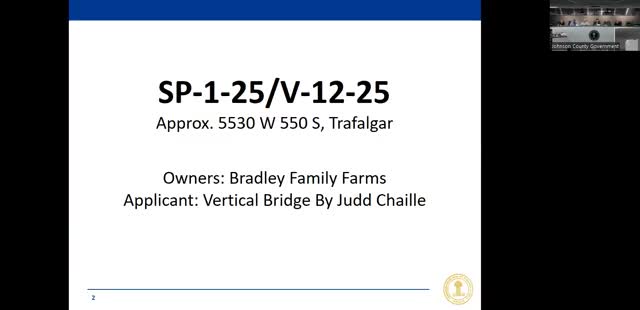
Summary
A majority of the Johnson County Board of Zoning Appeals on Oct. 28 approved a special exception allowing Vertical Bridge and Verizon to build a 290‑foot wireless communications tower on a 45‑acre Bradley Family Farms parcel southwest of Trafalgar, but the board continued companion variances to let the petitioner and staff file written findings of fact.
A majority of the Johnson County Board of Zoning Appeals approved a special exception Oct. 28 to permit a 290‑foot wireless communications tower on a 45‑acre agricultural parcel near Trafalgar, while deferring decisions on the variance requests tied to the tower design and equipment compound.
The special exception (SP‑1‑25), which was filed by Bradley Family Farms and Vertical Bridge with Verizon as the prospective tenant, passed on a 3–2 roll call after public comment from multiple neighbors and deliberation by the board. The board agreed to continue the companion petition for development‑standards variances (V‑12‑25) to the November meeting to allow the petitioner and staff to file written findings of fact on the variances.
The application seeks permission for a standard three‑legged lattice tower 290 feet tall, an equipment compound that the applicant described as sized to accommodate future collocations, and waivers of landscaping and camouflaging requirements in the county zoning ordinance. Planning staff told the board the proposed tower site is on a 40–45‑acre agricultural field at the corner of State Road 135 and 550 South in Hensley Township and that the proposed tower location meets the county’s 1,000‑foot separation requirement from residential structures as mapped in the staff packet.
Michelle, a planning staff member, summarized the request for the board and noted the ordinance still contains a 60‑foot cap on tower height that is rarely achievable for commercial wireless coverage. “Our ordinance requires a 60 foot limitation on cell towers,” she said, and added that staff supports the special exception while recommending an opaque fence be installed in lieu of the landscaping and camouflage standards given the farm location and crop‑management constraints.
Attorney Judge Shaley, representing Bradley Family Farms and Vertical Bridge and speaking for Verizon’s interests, said the project is a build‑to‑suit intended to remedy coverage gaps flagged by Verizon’s engineers. “This project is a build to suit project where Verizon and their engineers have decided that they needed, additional coverage, to further develop their network in this area,” Shaley told the board. He described the choice set as co‑locating on an existing tower, building a tower for a single carrier, or contracting with an infrastructure company such as Vertical Bridge; Verizon selected the latter option and specified the 290‑foot height for its coverage objective.
Residents who live near the proposed tower location addressed the board during the public comment period and raised concerns about visual impacts, property values and perceived health risks. Drew Eggers, who identified himself as the nearest neighbor, said he would see the tower from his bedroom and called the proposal “noxious.” “This is gonna be right outside my bedroom window, and I’m not gonna be able to look anywhere,” Eggers said on the record.
Several residents also questioned whether existing towers in the Trafalgar area could be used instead of building a new structure, whether the project notice reached all potentially affected property owners, and whether small‑cell or satellite solutions might make a new tall tower unnecessary in coming years. Petitioner representatives replied that Verizon’s coverage model showed a contiguous area of insufficient coverage that the proposed tower would address and that structural and distance constraints can make co‑location infeasible for the specific coverage objective.
Petitioner counsel also read a portion of federal law and the FCC’s regulatory framework to the board, noting that local governments are generally barred from denying or conditioning placement of wireless facilities based on the environmental effects of radio‑frequency emissions when the facilities comply with FCC rules. The counsel quoted the federal regulation on the record: “No state or local government or instrumentality thereof may regulate the placement, construction, modification of personal wireless service facilities ... on the basis of the environmental effects of radio frequency emissions to the extent that such facilities comply with the commission’s regulations concerning such emissions.”
After questioning, deliberation and reference to the seven special‑exception criteria in the county zoning ordinance, a board member moved to approve the special exception and to adopt the petitioner’s findings of fact. The motion passed 3–2. The roll‑call statements in the meeting record were: Chris Campbell — yes; Mister Hoffman — no; Mister Koehler — no; Mister Canary — yes; Mister Meyer — yes. The board then voted to continue the V‑12‑25 development‑standards variances (height, accessory compound size, landscaping/camouflage) to the board’s next meeting so the petitioner and staff can file written findings of fact addressing the variance standards.
Votes at a glance: SP‑1‑25 special exception — Approved 3–2 (Chris Campbell: yes; Mister Hoffman: no; Mister Koehler: no; Mister Canary: yes; Mister Meyer: yes). V‑12‑25 variances — continued to the November meeting (no final vote).
The board’s staff packet stated the site would: be accessed from 550 South via a gravel drive; place the tower pad approximately 209 feet from property lines; keep the tower at least 1,000 feet from residential structures per the county measurement; and install an opaque fence around the equipment if the landscaping requirement is waived. The petitioner said construction, if permitted, typically takes four to six weeks once permits and driveway approvals are secured and projected the earliest construction window in first quarter 2026.
The BZA also approved routine items including the September 23 meeting minutes and the 2026 calendar for BZA meetings. The development‑standards variances for the tower will return to the board at its next monthly meeting for formal findings and a vote.
Notes: This article reports only what was stated in the meeting record, staff packet, and in‑meeting oral presentations. Where the transcript did not supply exact details (for example, the petitioner’s exact proposed equipment‑compound square footage if later to be updated), the article indicates the matter is “not specified” or relies on the numbers provided in the staff packet and petitioner presentation.