
Council extends 'civility' ordinance to more of East End and 2nd Ward; supporters cite safety, critics press for services
Get AI-powered insights, summaries, and transcripts
Subscribe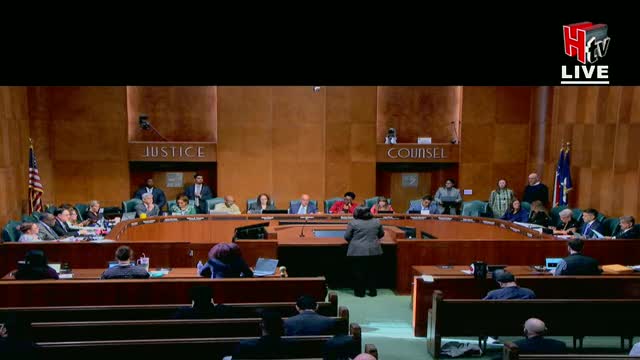
Summary
The council moved forward on Item 17 to expand a civility (sitting/lying) ordinance covering additional East End neighborhoods and the area around the planned 4/19 Emancipation site. East End leaders backed the change; council discussion and public comment emphasized pairing enforcement with services, outreach and mental‑health supports.
Houston City Council advanced an ordinance on Nov. 5 to extend the city's civility rules (restrictions on sitting and lying on certain public sidewalks) to a broader area of the East End, encompassing additional parts of Magnolia Park, most of the 2nd Ward and land adjacent to the planned 4/19 Emancipation site.
Veronica Chapa Gorchinsky, president of the East End District, told council there are roughly 83,000 residents and 3,500 businesses in the district and said the expanded zone reflects community requests for tools to promote public safety. Councilmembers who represent the area described long‑running concerns around the Greyhound transfer point and related pedestrian encampments and said the ordinance is designed to be one part of a response that includes coordinated outreach and services.
Several councilmembers and staff emphasized that enforcement should be paired with compassionate options and additional services. Chief Satterwhite (HPD) and council members described planned "hot‑team" outreach and a proposed low‑barrier navigation center — referred to in public comments as a potential place to direct unsheltered individuals — and said constables and HPD will coordinate response and referral. Multiple speakers cautioned that citation‑based approaches alone would not solve mental‑health, substance‑use, or chronic homelessness issues and urged investment in coordinated services.
At the meeting, the item was called and later included among items approved in the consent sequence. The council also scheduled community briefings and a virtual meeting to discuss boundaries and services with residents and stakeholders.