Buckeye proposes five-year water and sewer rate plan to fund aging infrastructure
Loading...
Summary
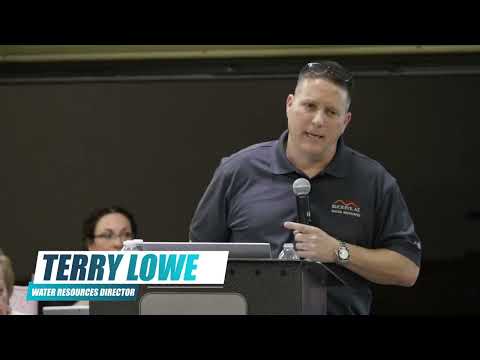
Buckeye Water Resources Director Terry Lowe on Thursday outlined a proposed five-year rate schedule for the city—s water and wastewater utilities that would change how base fees are set and phase in funding to cover major asset replacement and rehabilitation.
Buckeye Water Resources Director Terry Lowe on Thursday outlined a proposed five-year rate schedule for the city—s water and wastewater utilities that would change how base fees are set and phase in funding to cover major asset replacement and rehabilitation.
Lowe said the utility operates like a business inside the city government and "we are totally beholden to our customers," adding that revenue from rates must cover personnel, supplies, debt service and long-term capital work. He described asset management as a principal driver of rates: "asset management ... really drives rates," he said.
Why it matters: Lowe told attendees the department has been operating on 2013-era revenue while infrastructure has aged; staff estimate the utility manages assets on the order of hundreds of millions to about $1 billion and said reinvestment should ultimately be roughly 2% of asset value annually. To avoid a single, large immediate increase, the Water Rates Committee and staff recommend a phased, or "gradualism," approach to reach full asset-management funding over multiple rate cycles.
Key elements of the proposal
- Five-year rate cycle and predictability: Staff recommended the council adopt rates for five years at once so customers and credit-rating agencies have a clearer outlook.
- Roll-in of repair-and-replacement fee: The separate $3.05 repair-and-replacement fee would be eliminated and its revenue incorporated into the new base rates.
- Meter-size base fees: Instead of a uniform residential base, the proposal sets base fees by meter size. "The larger your meter, the more water can be pushed through it," Lowe said, and base fees will reflect meter capacity.
- Tiered volumetric charges: Residential customers will keep tiered volumetric pricing (most Buckeye accounts fall in the 0to6,000-gallon band). Commercial accounts move away from a near-flat per-bill charge to a tiered volumetric structure so very large users pay proportionally more.
- Landscaping and nonpotable adjustments: Landscaping tiers were adjusted to match observed usage (about 75% of landscaping bills are below 50,000 gallons/month) and nonpotable (reclaimed) rates were raised to reflect the actual cost of delivering reclaimed water to customers such as golf courses.
- Sewer simplification and sample-bill impacts: Staff showed example bills under the proposal: a typical 1-inch residential water account using 6,000 gallons plus sewer would move from roughly $60 today to about $62 in 2026; Lowe said the package produces an approximate cumulative increase of about 50% by 2030 under the current forecast.
Process and timeline
Lowe said the Water Rates Committee (WRC), appointed by the mayor and council, analyzed multiple structures and on Oct. 9 voted to advance the committee—s recommended structure. Staff plan more open houses, a social-media outreach campaign and a council workshop in early January. Adoption steps include a Notice of Intent (NOI) to raise rates, a 60-day public comment period, council adoption and a 30-day ramp-up with a target go-live in May.
Water supply, development and reclamation
Lowe explained Arizona—s assured water supply program under the 1980 Groundwater Management Act and said certificates require developers to show a 100-year supply; utilities or the Central Arizona Groundwater Replenishment District (CAGRD) handle replenishment responsibilities. He noted Terravalis has certificates for its Floreo subdivision, has built three wells and a water-treatment campus for that component, and that broader Terravalis plans remain under developer review.
On regional sourcing, Lowe said the city invested in Harquahala Valley water and described the purchase as a general-fund investment rather than a rate-funded acquisition; he said moving that water will require regional infrastructure and participation from multiple municipal purchasers.
Water quality and conservation
Lowe said all Buckeye drinking water "meets all EPA, Clean Water Drinking Act standards" but taste and salinity vary across the service area. He said staff are testing commingling of supplies and will use a developer-installed reverse-osmosis system as a test case in a localized area with higher salinity. Lowe also cited conservation successes: he said one program secured about $40,000 in grants and is expected to save roughly 800,000 gallons annually for a participant.
What staff emphasize
Lowe framed the proposal as seeking a balance between customers— ability to pay and the city—s need to preserve and replace major assets over time. He said staff reject a single-year, $20 million immediate increase as too aggressive and prefer phasing reinvestment to reach full funding in later rate cycles; after full funding staff expect future increases to track near inflation.
No formal action was taken at the open house; staff will incorporate public feedback and bring a proposal to the council for workshop and formal consideration.