Get Full Government Meeting Transcripts, Videos, & Alerts Forever!
Get email alerts on the Beltline topic
No spam. Unsubscribe anytime.
Atlanta BeltLine CEO says trail pace, affordable-housing goals on track; transit mode still undecided
Summary
Atlanta BeltLine Inc. reported continued progress on trail construction and affordable housing and described a new ambassador safety program ahead of the FIFA World Cup, while officials cautioned that the transit mode for the East Side corridor remains undetermined and that long-term maintenance funding is unresolved.
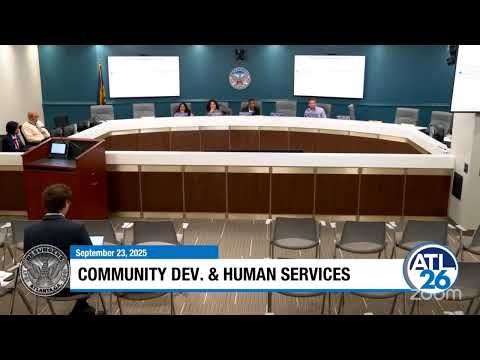
Clyde Higgs, chief executive officer of Atlanta BeltLine Inc., told the Community Development/Human Services Committee on Sept. 23 that the BeltLine has delivered "almost 13 miles of mainline BeltLine trail to date" and expects about 18 miles to be completed ahead of the FIFA World Cup next year.
Higgs said ABI had acquired nearly 3.5 acres at the former Club 1145 site on Bennett Street and finished a challenging open segment from Trabert to Northside Drive. He described a growing Ambassador program—"right now, we have a team of about 9 folks. We hope to expand that to 20"—tasked with corridor education, basic maintenance spotting and communicating with Atlanta Police Department when safety incidents occur.
The BeltLine update covered multiple areas: parks work and new trail openings, an RFP tied to a land-acquisition strategy in Pittsburgh (the former Annie E. Casey site), and progress on affordable housing. "We're at about 4,300 units out of the 5,600 unit goal," Higgs said, putting the initiative over 75% toward its target and expressing confidence the program will exceed the goal before early 2030.
Committee members pressed Higgs on long-term maintenance funding. He said current state law constrains the use of Tax Allocation District (TAD) revenues for maintenance and that the way the Special Service District (SSD) is written also excludes maintenance. "It's definitely being studied right now, but there is not a firm fixed plan to address that," Higgs said, calling maintenance a priority to preserve the newly built infrastructure.
On transit, Higgs discussed the BeltLine Transit Study released in August. He said MARTA participated as a partner but did not lead the study and that the report left open who would operate any new system. Committee members asked whether the study’s cost estimates included infill stations; Higgs said concept-level costs for four potential infill stations were part of the study and that infill stations could add anywhere from about $150 million to $400 million each in order-of-magnitude costs. He also clarified that the roughly $3 billion–$3.5 billion top-line transit estimate covers the main transit system but does not include the infill stations.
Higgs declined to rule out light rail on the East Side but said more study is required: "I don't want to suggest that light rail is fully off the table, but I just don't like to play these games and give people... false hope that this is exactly what's going to happen." He described strong community disagreement about mode choice on the East Side and said ABI intends to study technology options and impacts before recommending a path forward.
The presentation also highlighted community and economic-development work: a recent BeltLine career fair that drew a larger-than-expected crowd (more than 600 attendees), commercial-affordability measures (targeting 300,000 square feet of affordable commercial space by asking developers to dedicate roughly 10% of space at discounted commercial rents), and arts- and culture programming.
The committee voted to renew, for one year, a city services agreement with Atlanta BeltLine Inc. to support continued maintenance, design and construction of certain park and green-space work in the BeltLine Tax Allocation District (the ordinance passed on a recorded committee vote of 4 yays, 0 nays).