Comal County judge unveils recommended 2026 budget proposing 30.5015¢ tax rate; public hearings set
Loading...
Summary
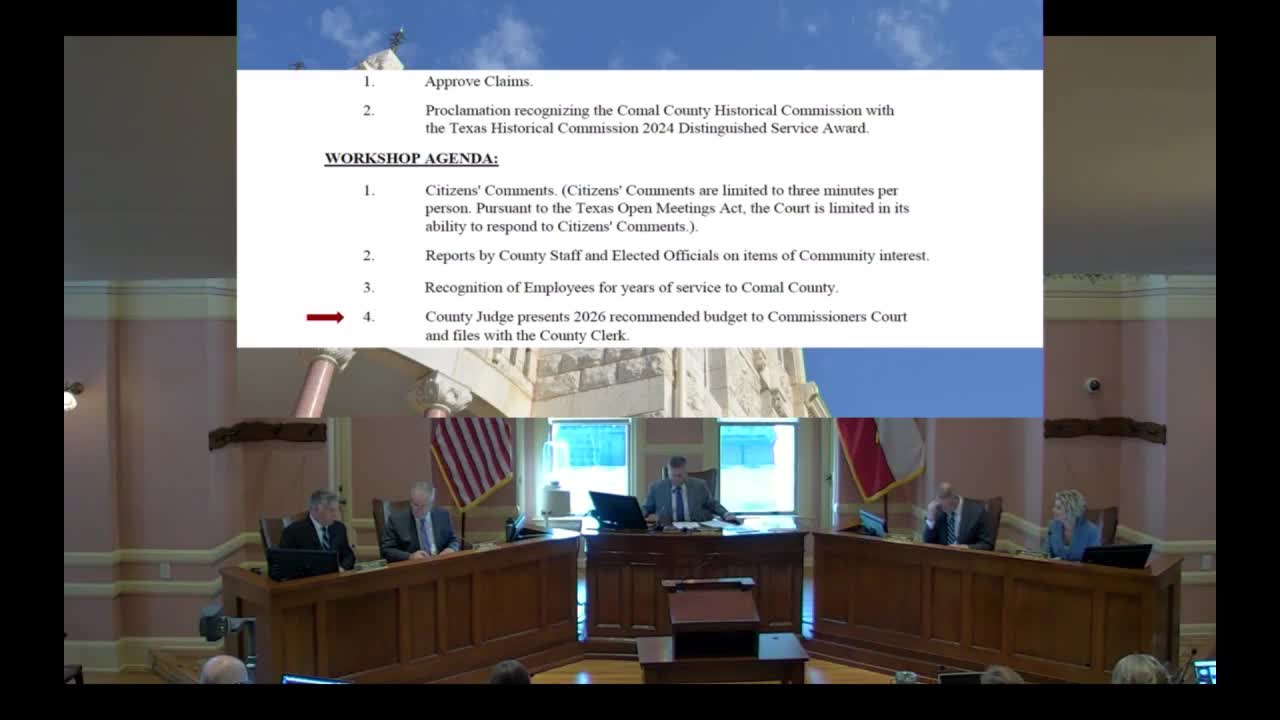
County Judge Krause presented the recommended Comal County 2026 budget on Aug. 7, proposing a tax rate of 30.5015¢ per $100 valuation to fund pay increases, infrastructure projects and a range of capital and non-capital needs.
County Judge Krause presented the recommended Comal County 2026 budget at the Aug. 7 Commissioners Court meeting, proposing a tax rate of 30.5015¢ per $100 valuation to fund pay increases, personnel changes and infrastructure projects.
Krause told the court the recommended budget includes a 4% pay-scale advancement across county employees, which he said will cost about $7.8 million; he said roughly 71% of that amount would flow to law-enforcement positions. The proposal also separates pay charts to create distinct pay scales for law enforcement, corrections and telecommunications to remain competitive, and includes tiered incentive pay for law-enforcement staff: $1,000 per year for 0–4 years of service, $2,000 for 5–8 years and $3,000 for 9+ years, plus an increase in field-training pay from $25 to $35 per shift.
The recommended budget contains new positions and reclassifications; Krause said not all requested positions were included, and that Public Health requests were reduced by two positions. He also said the county will change how it pays Texas A&M AgriLife Extension agents: rather than processing payroll for the four local agents, the budget includes a flat $50,000 contribution per agent paid to Texas A&M via an interlocal agreement so the agents remain Texas A&M employees.
Krause detailed large capital and land-improvement items: $3.7 million in capital equipment, about $800,000 in non-capital equipment, and roughly $15.5 million for land and property improvements. Highlighted projects include expansions to Justice of the Peace buildings for Precincts 3 and 4, a facilities-maintenance building at the Churchill Campus, tax-office improvements, $450,000 in parks projects, a $1.5 million bridge over Jacobs Creek and $5 million budgeted for flood-control-structure improvements across six county dams. He said the county is also pursuing grants and state conversations for some projects and has included funding for additional outdoor warning sirens, weather stations and low-water-crossing cameras to improve emergency response and flood monitoring.
Krause said a $3.5 million contingency is included but that it is not funded by the tax rate calculation. The budget document presented to the court shows the county—s no-new-revenue tax rate at 25.6¢ per $100 valuation and the voter-approval rate at 38.25¢; adopting the recommended rate would raise the current rate (about 26.6¢) by roughly four cents and produce a total tax levy of about $123 million.
Commissioners questioned financing strategies for large capital items. Krause said the court would likely use a mix of pay-as-you-go budgeting, grant-seeking and issuing debt, and cited a likely need to issue debt for a future jail expansion. He also described how vacancies (for example, vacancies in corrections staff) produce year-end savings that increase fund balance; the county—s fund-balance policy target remains between four and six months.
Krause acknowledged one omission in the recommended package: an assistant emergency management coordinator position requested for succession planning. He said that position will be added as an amendment and brought back to the court in two weeks.
Motions and next steps: Commissioners moved to set the required public hearings because the proposed tax rate is above the no-new-revenue rate. Commissioner Hogg moved (second by Commissioner Leacock) to set the public hearing on elected-official salaries for Aug. 21, 2025, at 8:30 a.m.; the motion carried. Commissioner Hogg then moved (second by Commissioner Leacock) to set the public hearing on the proposed tax rate (30.5015¢ per $100) for Sept. 4, 2025, at 8:30 a.m.; the motion carried.
Why it matters: The recommended budget allocates the majority of its growth to public safety, corrections and courts and funds multiple large infrastructure and flood-control projects. The proposed tax rate exceeds the county—s no-new-revenue rate, triggering statutorily required public hearings and wider public scrutiny before adoption.
Speakers quoted or referenced in this report are drawn from the meeting transcript and county staff presentations.