Get Full Government Meeting Transcripts, Videos, & Alerts Forever!
Get email alerts on the Code Enforcement topic
No spam. Unsubscribe anytime.
Deerfield Beach approves six-month code lien amnesty to clear long-standing fines
Summary
The Deerfield Beach City Commission voted 4' 1 on March 4 to approve a six-month code enforcement lien amnesty program that staff said is intended to clear long-standing liens, reduce reinspection and abatement costs, and enable owners to sell or refinance properties that otherwise carry prohibitive fines.
The Deerfield Beach City Commission voted 4' 1 on March 4 to approve a six-month code enforcement lien amnesty program that staff said is intended to clear long-standing liens, reduce reinspection and abatement costs, and enable owners to sell or refinance properties that otherwise carry prohibitive fines.
Roy Davis, the city's code manager, told commissioners the program (branded in staff materials as a "code embassy" program) applies only to properties that have been brought into compliance and will not cover properties currently in bankruptcy, foreclosure or active litigation. Davis said staff estimates the city has about $140 million in unpaid liens and described a formula that yields different amnesty amounts for four property classes: homesteaded residential, non-homesteaded residential, nonresidential/commercial and very small liens below the recovery threshold. Under the formula, a homesteaded residential example worth $260,000 with $67,000 in liens would pay a calculated amnesty amount of $6,400 using the lower of two formula results; commercial parcels have a higher minimum recovery amount but a larger percentage lien reduction option.
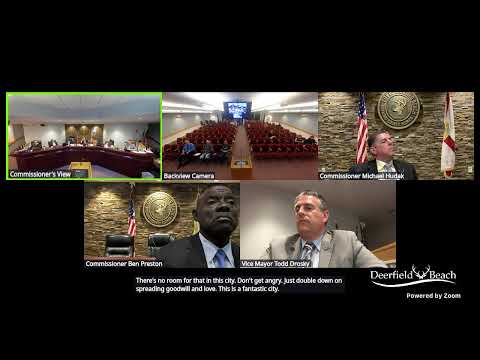
Commissioners debated the policy implications. Commissioner Dan Parnas said the program risked encouraging scofflaws, arguing: "It seems to me we're encouraging people to violate the code and get away cheap." Roy Davis, and several other commissioners, countered that the program is limited to properties that first come into compliance, that it is designed to resolve liens that impede sales and refinancing, and that some owners simply cannot clear large historical fines without assistance. Vice Mayor Todd Droski added the program is a finite, limited-term pilot intended to encourage compliance and said staff outreach will include mailers and door hangers to affected property owners.
The city sets application deadlines and outreach steps in the approved plan: applications will be accepted through Sept. 3, 2025; staff will mail notices and distribute door hangers and offer application assistance at the code compliance office; the city will provide a final payoff figure upon acceptance and the magistrate will certify lien dismissals after payment. City staff also said ineligible properties include those with outstanding lawsuits, active foreclosure or bankruptcy, or properties currently being auctioned.
Public comment reflected sharp divisions. Supporters, including property owners and nonprofit representatives, said the amnesty would allow homes to be sold or refinanced and clear title issues that block lending. Opponents, including condominium representatives and residents, urged the commission to exclude dangerous or unpermitted work (for example, electrical or plumbing work performed without permits that could present fire or structural hazards) from eligibility. Several commissioners asked staff how to ensure safety-sensitive violations would not be forgiven; staff replied the program requires compliance before filing and that review of individual cases and supporting documentation is part of the intake and magistrate certification process.
Final vote: Commissioner Hudak Yes; Commissioner Parnas No; Commissioner Preston Yes; Vice Mayor Droski Yes; Mayor Bill Gans Yes. The motion passed 4' 1. The program will be in effect for applications filed by Sept. 3, 2025, with implementation and outreach steps to be handled by code compliance.