Get Full Government Meeting Transcripts, Videos, & Alerts Forever!
Get email alerts on the Community Policing topic
No spam. Unsubscribe anytime.
Racine council accepts donor funds, approves lease for downtown COP office after debate over metrics and sustainability
Summary
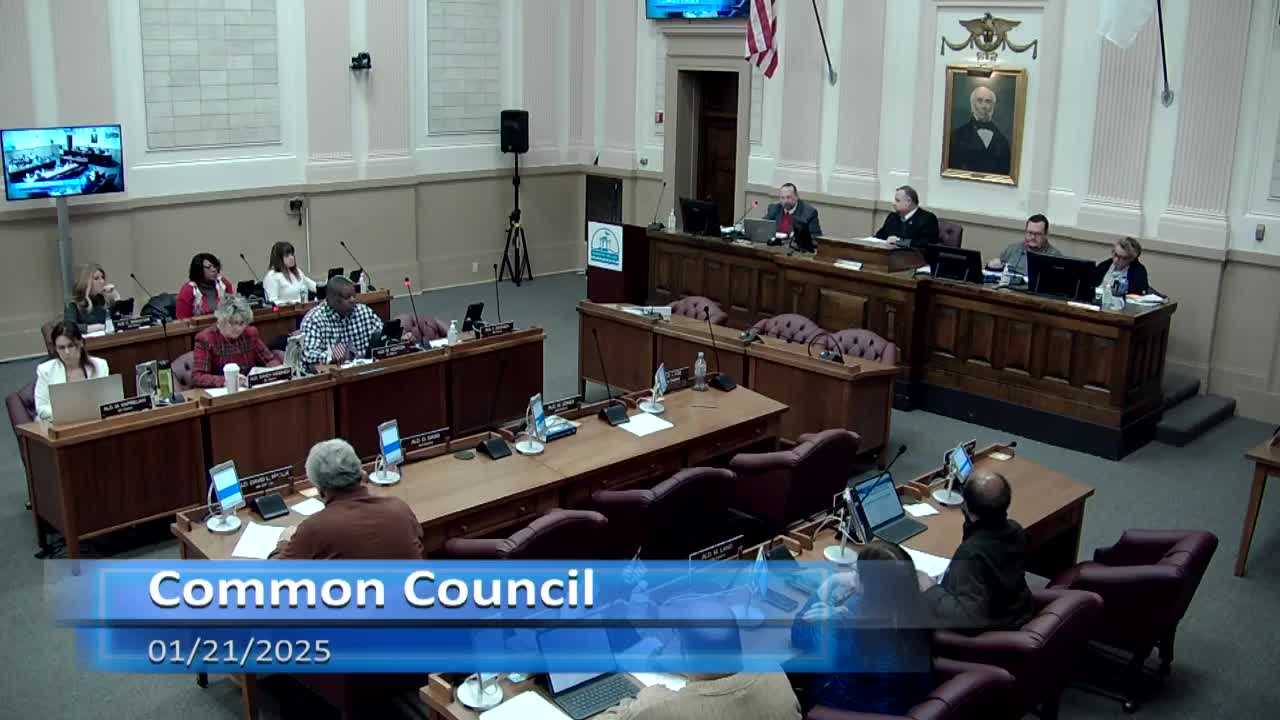
The Racine Common Council voted Jan. 21 to accept donor funding to help start a downtown community‑oriented policing office and to enter a three‑year lease for space at 434 Main Street.
The Racine Common Council voted Jan. 21 to accept donor funding to help start a downtown community‑oriented policing office and to enter a three‑year lease for space at 434 Main Street.
Mayor Corey Mason presented the two items after the Finance and Personnel Committee recommended them for approval. The council first approved item 0037‑25, authorizing the chief of police to accept funding from the Racine Community Foundation and SC Johnson to cover start‑up costs for a downtown COP office and one officer; the motion passed 10–1. The council then approved a related lease authorization (agenda item 0053/0054‑25) to occupy 434 Main Street; the lease vote carried 9–1 with one member recorded as present but not voting.
The police department described the planned downtown location as a smaller, nontraditional COP office intended to “address a lot of the downtown issues,” particularly quality‑of‑life complaints, vulnerable populations and problems that occur after bars close. The chief of police told the council, “We will assign 2 officers to that. They will walk the beat, they'll stop in the businesses, get to know the business owners, and have meetings when everyone is requested there.”
Council members pressed for details. Alder Kaprielian asked for the lease terms and performance metrics; the chief said the lease is three years and the donors would cover furniture, wiring and IT startup costs, and he offered to provide the specific budget items to council members. Director Tate of the Department of Community Safety described the department’s need to “put resources behind our ability to express to our community what it is we're doing,” and said professional communications work was part of planned outreach.
Several council members sought clarity on the office's role and longevity. Alder Davis, voting no on the funding item, repeatedly asked whether the office would be staffed primarily for enforcement or for connecting vulnerable people to services. The police response emphasized discretionary, situational responses and partnerships with homeless and mental‑health advocates: “We approach things differently. Discretion is used differently when it comes to dealing with individuals,” the chief said.
Council discussion also noted operational questions: what hours the downtown officers will cover, how the office will coordinate with existing COP houses and whether the nonprofit Outpost would be used to apply for future grants if donor support ends after the three‑year period. Several members said they supported the pilot but urged staff to pursue additional funding if the program is continued beyond the donor period.
The council recorded these results: item 0037‑25 (accept funding) passed 10 ayes, 1 no (Alder Davis). Item 0053/0054‑25 (lease authorization) passed with a tally announced in the meeting as 9 ayes, 1 no (Alder Davis), and one member recorded as present/not voting. The police and department directors agreed to provide the council with the lease terms and measures of effectiveness for the pilot.
The downtown COP office will be located near Fifth and Main and is expected to provide a visible police presence in downtown streets and parking ramps. The council directed staff to return with details for evaluation as the pilot proceeds.