Get Full Government Meeting Transcripts, Videos, & Alerts Forever!
Get email alerts on the Uwsp Campus Future topic
No spam. Unsubscribe anytime.
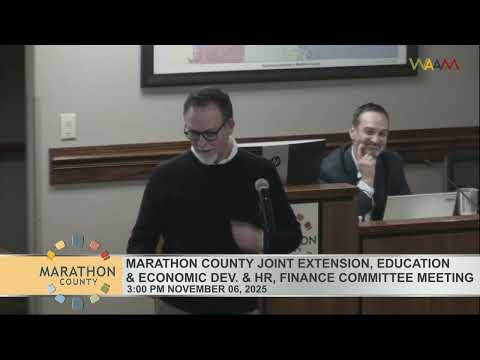
Marathon County hears push to preserve UW-Stevens Point at Wausau campus; staff outline RFP and grant options
Summary
Marathon County officials and staff received public comment urging preservation of the Veninga Theater and other campus facilities at UW-Stevens Point at Wausau, and discussed options for future ownership and use including an internal RFP and the possibility of state redevelopment funding.
Several dozen residents, arts leaders and nonprofit representatives urged Marathon County officials to preserve the UW-Stevens Point at Wausau campus and its Veninga Theater while county staff outlined options for the site and a process for soliciting proposals.
Brian Kolich, executive director of the North Central Wisconsin Workforce Development Board, urged the committees to consider relocating the county job center to the UW-Stevens Point at Wausau campus, saying the current job center building across from the YMCA will be demolished for an assisted-living facility and “we need space to go to.”
The comment period that followed featured repeated appeals from arts organizations and educators. “That facility is turnkey ready,” said Sarah Rudolph, who ran the UWMC theater program for three decades, and urged the county to retain knowledgeable technical staff. Paul Radke, president of the Wausau Community Theater, said the Veninga has been essential to local performing arts groups that draw participants and audiences from across the region. Jim Hawkins, a longtime stagehand and performer, and Rick Laframbe (representing Central Wisconsin Children’s Theater) also described the facility’s value and emphasized the role of facilities staff such as Chris Berg in keeping the theater operational.
County staff then presented an inventory and condition report for the campus. Chris Berg and county facilities staff described a campus that totals roughly 10.5 acres and just under 240,000 square feet of buildings. They said the theater building is largely standalone with its own HVAC, while much of the remainder of the campus ties into a central heating plant located across the railroad tracks. Staff described localized deferred maintenance (nineteen-sixties–era restrooms, elevator modernization, exterior EIFS repairs) but reported that recent work addressed significant HVAC needs. Staff also said the campus’ older arts building currently lacks water because it historically drew water through Marathon Park and restoring utilities is complicated by parcel boundaries and Tax Increment District (TID) number 8 constraints.
Administrator Lance Leonard and staff briefed the committees on a state branch-campus redevelopment program administered by the Wisconsin Economic Development Corporation (WEDC). Staff said the program makes up to $2 million available per branch campus for nonacademic redevelopment, and that planning funds used by peer counties have ranged in examples to about $150,000; however, staff cautioned that eligibility details and match requirements remain to be clarified.
Leonard laid out two high-level approaches for moving forward: an internal request for proposals (RFP) from local and regional groups to solicit offers for the campus or parts of it, or an external, consultant-led planning process that could be partially funded by WEDC planning dollars. He told the committees that the UW plans to occupy the facility through the middle of 2026 and has committed to holding costs through 2026, but that the county will need to define an interim approach for the many nonprofits and programs that currently use campus space.
Committee members and members of the public asked staff to compile more detail on WEDC eligibility, lessons learned from peer counties (Sauk, Fond du Lac, Waukesha), and whether redevelopment grant funds could be applied piecemeal to portions of the campus while other parts remain for academic use. Miranda (UW-Stevens Point at Wausau staff) said UWSP expects a long, phased exit and that nothing large will move out before classes end in mid-May; she said UWSP is open to conversations about interim uses of underutilized spaces.
Multiple supervisors expressed a preference to begin with an internal RFP to gauge local interest, while preserving the option to pursue external planning if needed. The board asked administration to prepare timeline options, to explore whether an additional six-month “off-ramp” for existing tenants is feasible, and to return to a joint meeting on December 4 with those details.
No final decisions about sale, lease, or disposition were taken at the meeting. The committee recorded procedural motions later in the agenda (see "Actions"), and staff were directed to bring revised timelines, WEDC-eligibility clarifications and an RFP draft back to the boards.