
Buncombe County to seek formal adoption of Helene long-term recovery plan after public feedback
Get AI-powered insights, summaries, and transcripts
Subscribe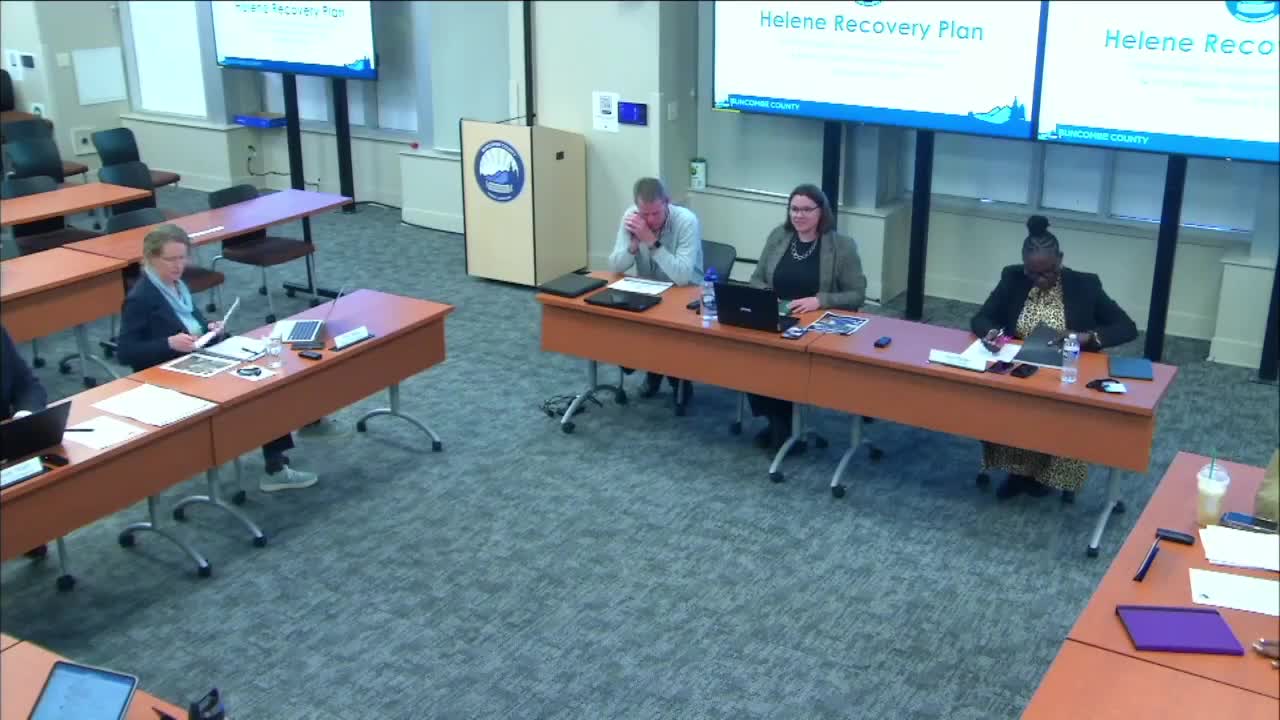
Summary
County staff said the multi-jurisdiction Helene recovery plan reflects public input gathered in spring and fall engagement rounds and will return to the Board of Commissioners for a formal adoption vote on Nov. 18; Buncombe County’s section lists 31 county-led projects.
Rachel Sawyer, strategic partnerships director for Buncombe County, told commissioners the county is transitioning from response to long-term recovery and will present the final Helene long-term recovery plan for adoption at the board’s Nov. 18 meeting. "We are going to be fully in long term recovery," Sawyer said, describing this meeting as a process update rather than a request for action.
Staff reviewed the public-engagement process that shaped the plan. The county ran two public-input phases: a spring ranking survey that produced about 2,600 responses and an online fall feedback round that produced roughly 100 responses across jurisdictions (34 responses were specific to Buncombe County projects). Sawyer said the fall feedback was qualitative and resulted in modest clarifications to project descriptions and listings of additional partners; she said there were no material changes to the county’s projects.
The adopted plan will be multi-jurisdictional: county staff reported the combined plan includes 114 projects and that 31 of those will be the responsibility of Buncombe County and the newly established recovery office. Staff said the county will share survey responses directly with project implementers to help guide prioritization and implementation decisions.
Commissioners asked staff about coordination with municipalities and what "accountable housing" references in plan themes mean. Sawyer said jurisdictions agreed to include projects the county and its municipal partners have responsibility and capacity to carry out, while also recognizing that many system-level solutions (for example, workforce or economic development programs) require multi-jurisdiction cooperation. On the term “accountable housing,” Sawyer said it was a phrase that emerged from residents’ narrative responses and offered to provide the raw comments that fed that label.
Sawyer and staff emphasized next steps: the Buncombe County section of the plan (the 31 county projects) will be included in the commissioners’ packet ahead of the Nov. 18 meeting, and staffer Mr. Radisson is scheduled to present the final plan for the board’s consideration on that date. The presentation material will include more detail about project responsibilities, sequencing and funding pathways so commissioners can evaluate what the county would carry forward versus work led by cities or towns.
Commissioners and staff also discussed implementation concerns raised in public feedback: that not all projects can be carried out at once, that infrastructure projects may be prioritized, and that coordination and funding clarity will be critical. Staff described the work to stand up a recovery officer and recovery office to manage county responsibilities in the plan.
The board did not take formal action on the plan at this meeting; staff framed Thursday’s presentation as preparation for a formal adoption vote expected on Nov. 18.
Ending: The board will receive Buncombe County’s section of the Helene recovery plan in their Nov. 18 packet, when staff will ask commissioners to endorse the multi-jurisdiction recovery plan and Buncombe County’s assigned projects.