Get Full Government Meeting Transcripts, Videos, & Alerts Forever!
Get email alerts on the Evidence Admissibility topic
No spam. Unsubscribe anytime.
Appeals court considers whether redacted federal indictment prejudiced domestic‑abuse trial evidence in Fuentes appeal
Summary
Mike Maloney told the court that admitting an eight‑page redacted federal indictment and a profile image linked to the online moniker 'Slim Deals' prejudiced Jerome Fuentes at trial.
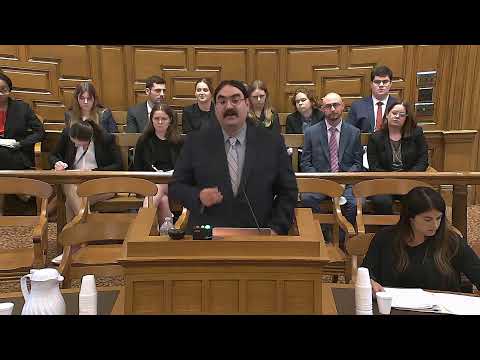
Mike Maloney, arguing for Jerome Fuentes, told the panel that admitting an eight‑page, heavily redacted federal indictment and a profile picture tied to the moniker "Slim Deals" unfairly prejudiced his client in proceedings on two 209A‑related allegations.
"This was a nonviolent, nonthreatening offense," Maloney said of an Instagram condolence post that underpinned one conviction, adding that the indictment and the profile image were cumulative and invited impermissible inferences. He argued the trial judge should have excluded the multi‑page document or limited its presentation rather than admitting it wholesale.
Commonwealth counsel Charlie Marshall countered that the redacted indictment was a public record and could be admitted under the public‑records exception to prove the defendant used that moniker; he described the admission as one confirming circumstance in a circumstantial proof scheme. He told the court the victim had communicated with the account over years, identified the profile picture as depicting the defendant, and that the content of the message included relationship‑specific knowledge.
The panel examined whether the admission of the multi‑page document and its limited redactions created an unacceptable risk of prejudice despite contemporaneous limiting instructions. The court discussed whether trial counsel’s alternative — a stipulation to the moniker — would have been sufficient for authentication and whether the jury’s exposure to the document’s form (a federal indictment caption) could have been unduly prejudicial.
Maloney also raised cumulative‑prejudice and joinder complaints: he said prior 209A incidents and reference to a prior acquittal were improperly before the jury and that testimony and police report stipulations were handled in ways that impeded defense preparation. The Commonwealth said the items admitted were relevant and that trial counsel had options but chose not to stipulate in full.
The panel asked for no immediate ruling from the bench and pressed counsel on distinguishing recent SJC and Appeals Court decisions about confirming circumstances and redaction scope. No decision was announced from the bench; the court took the case under advisement.