Milton officials urge disciplined use of circuit-breaker reimbursements, aim to rebuild revolving fund
Loading...
Summary
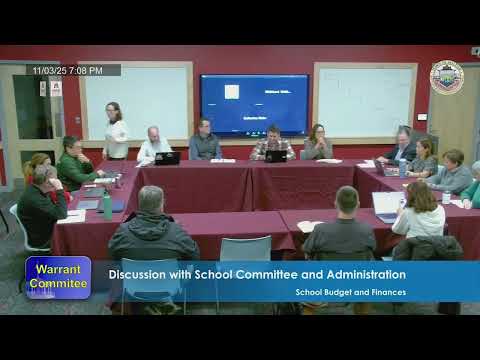
District finance staff told the Warrant Committee on Nov. 3 that circuit-breaker reimbursements (state special-education reimbursement) are paid in arrears, are budgeted as revenue offsets and should be kept in a dedicated revolving account to smooth volatility. Staff said the district expects roughly $3.5 million from the program for last-year
District officials told the Warrant Committee on Nov. 3 that circuit-breaker reimbursements are a reimbursement program that repays districts for prior-year special-education costs above a state-set threshold. Assistant Superintendent for Finance Katie Blake explained the mechanics: districts submit prior-year expenses, the state sets a per-student threshold and a reimbursement percentage (district staff used 75% as the example used in state guidance), and payments are calculated after the state processes all communities' data.
Blake and Interim Superintendent John Fallon emphasized timing and predictability: circuit-breaker payments reimburse last-year expenses, arrive on a quarterly schedule, and are not an immediate operating grant for the same fiscal year. Fallon said prudent practice is to hold circuit-breaker receipts in a dedicated revolving account so the district can plan for next-year special-education obligations rather than rely on uncertain mid-year supplemental state funding.
Fallon described the district's fiscal goal to rebuild the circuit-breaker stabilization account to the state-recommended level over several years and said the district expects a significant reimbursement for the current cycle (district staff referenced roughly $3.5 million in expected reimbursements for the prior year, with an incremental plan to deposit about $800,000 into the fund in the current year as a plausible target). He said the revolving account acts as a "shock absorber" to protect classroom operating funds from sudden special-education cost spikes.
Committee members asked whether the state percentage (75% in the example) is certain; district staff said the percentage is set through the state budget process, can vary (transportation funds recently paid at a lower rate because statewide expenses rose), and can be affected by supplemental budgets. Staff offered to brief small groups or individual warrant members on the detailed special-education cost drivers and billing cadence.
The district noted that special-education costs are inherently variable because different students have different needs, some students require out-of-district placements and transportation costs can spike; those dynamics make the circuit-breaker and other revolving-account management a central financial priority.