Middleton officials outline costly wastewater upgrades as residents voice alarm over rising sewer bills
Loading...
Summary
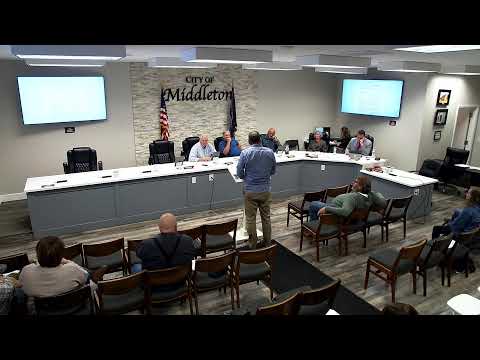
Residents pressed city leaders on wastewater costs and confusing public messaging at Middleton’s Nov. 5 City Council meeting, where council members and staff reiterated that state environmental mandates are driving a multi‑phase upgrade and that the price has risen since earlier estimates.
Residents pressed city leaders on wastewater costs and confusing public messaging at Middleton’s Nov. 5 City Council meeting, where council members and staff reiterated that state environmental mandates are driving a multi‑phase upgrade and that the price has risen since earlier estimates.
Several residents said they were worried about rising sewer bills and the financial strain on older homeowners and veterans on fixed incomes. “They are extremely concerned,” said Teresa Down (public comment), who told council she frequently hears from disabled and older residents who fear they cannot afford future increases. Dan Don Reynolds urged the city to explain the process in plain language and noted that different stakeholders value growth and services differently.
Mayor and staff responses emphasized limits on local discretion. City officials said the Idaho Department of Environmental Quality (DEQ) and federal environmental requirements leave the city little option but to upgrade treatment. The mayor said prior engineer estimates for earlier phases had ranged from roughly $35–40 million to $55–60 million and that the first phase is currently estimated at $78 million; a public commenter said a podcast referenced a figure of $120–130 million for all phases. Council acknowledged the differing figures in public materials and said staff would clarify the numbers.
Staff described programmatic constraints that affect costs and timing: the project includes required treatment upgrades to meet DEQ standards, a phased approach tied to permitted equivalent dwelling units (EDUs), and design and bidding work that has been subject to rising construction costs since early estimates. The mayor and staff said the city has pursued grants and other funding; the mayor noted the city obtained a small grant (about $40,000) from a recent application effort but that larger funding remains elusive.
Councilmembers and staff urged patience while promising more public information. City staff alerted the council that a workshop on wastewater — covering rates, funding plans, connection fees and impact fees — is scheduled for the next week to provide much more detail. In the meeting, council also noted mitigation steps the city has taken, including reuse arrangements described as reducing potable discharge to the Boise River.
What council did: no new ordinance or rate action was taken at the Nov. 5 meeting; rather, council heard public comment, reiterated that DEQ/ federal requirements are driving the upgrades, and scheduled a workshop with staff for a deeper presentation on funding options.
Why it matters: Middleton serves a relatively small number of households (council cited roughly 5,000–6,000 homes), so large capital projects required by regulators can produce high per‑household costs. Residents on fixed incomes and veterans at the meeting urged clearer public communication and options to mitigate hardship.
Clarifying detail: Council and staff repeatedly referenced (a) a current first‑phase engineering estimate of about $78 million, (b) a larger multi‑phase figure cited by a public commenter/podcast of $120–130 million, and (c) the city’s limited ability to avoid required upgrades because of DEQ mandates. Staff said the city is pursuing grants and mitigation measures but did not announce a funding package or a change to rates at this meeting.
Provenance: This article summarizes public comments beginning at the public‑comment period (00:05:39 onward) and the longer wastewater discussion during the final public‑comment block and mayor/staff response (00:52:36–01:21:24).