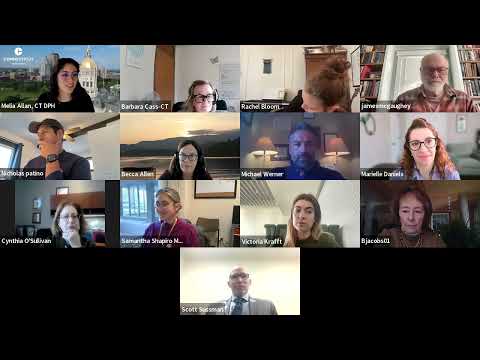
CT Department of Public Health updates MOLST training, plans recordings and regional coordination
Loading...
Summary
DPH staff told the MOLST Advisory Council that policies, training and the website have been revised and that recorded training segments will be produced starting in December with a planned 2026 launch. Members discussed production logistics, provider uptake, regional interoperability and possible licensure‑linked training requirements.
Barbara Cass, senior adviser to the commissioner for long‑term care at the Connecticut Department of Public Health, briefed the MOLST Advisory Council on program updates and training plans, saying that policies, the training curriculum and the website have been revised and that the materials "are in our legal review" and under consideration for potential legislative changes.
Melia (DPH), who is managing the training production, told the council that Kathy Ludlum—s narrated segment is recorded and that DPH will begin direct outreach in December to schedule additional short recorded segments with subject‑matter experts, either by Zoom or in person at DPH. Melia said the plan is to assemble short videos with on‑screen credentials and natural transitions so the revised course can be delivered through the CT Train platform and other channels.
Members discussed technical production details — standard background options, editing and slide transitions — and noted the training will be flexible about the order and style of recorded segments. Scott Sussman (hospitalist, palliative care) and other clinicians said the new training and a digital MOLST could address current underuse in some large systems, but several council members emphasized that training availability alone has not been sufficient to guarantee uptake.
Barbara reported outreach outcomes including pediatric hospice engagement and an APRN conference session that reached about 100 attendees; Leah Ward and Rebecca Gagne Henderson presented at the APRN conference. She said the council faces a substantial scale problem: DPH estimates more than 75,000 eligible health‑care providers could benefit from MOLST training, and broad outreach will be a heavy lift.
Council members discussed making MOLST training a licensure requirement. Past efforts to require the training at licensure failed; members agreed the council could begin work on a recommendation for 2027 but that it should first engage provider associations and assess potential threats and feasibility.
Barbara also described a new New England collaborative of states working on interstate operability of MOLST/POLST/COLST forms and noted participants are early in the process and are discussing fiscal and technical barriers. Members cautioned that Connecticut—s program has unique scope and eligibility rules, which would need review before inter‑state standardization.
At the start of the meeting Jim McGahee moved to approve the October 7 minutes; Scott Sussman seconded and the motion carried by voice vote.