
State Water Board workshop finds Tuolumne voluntary agreement adds modest flows; debate remains over unimpaired‑flow standard
Get AI-powered insights, summaries, and transcripts
Sign Up Free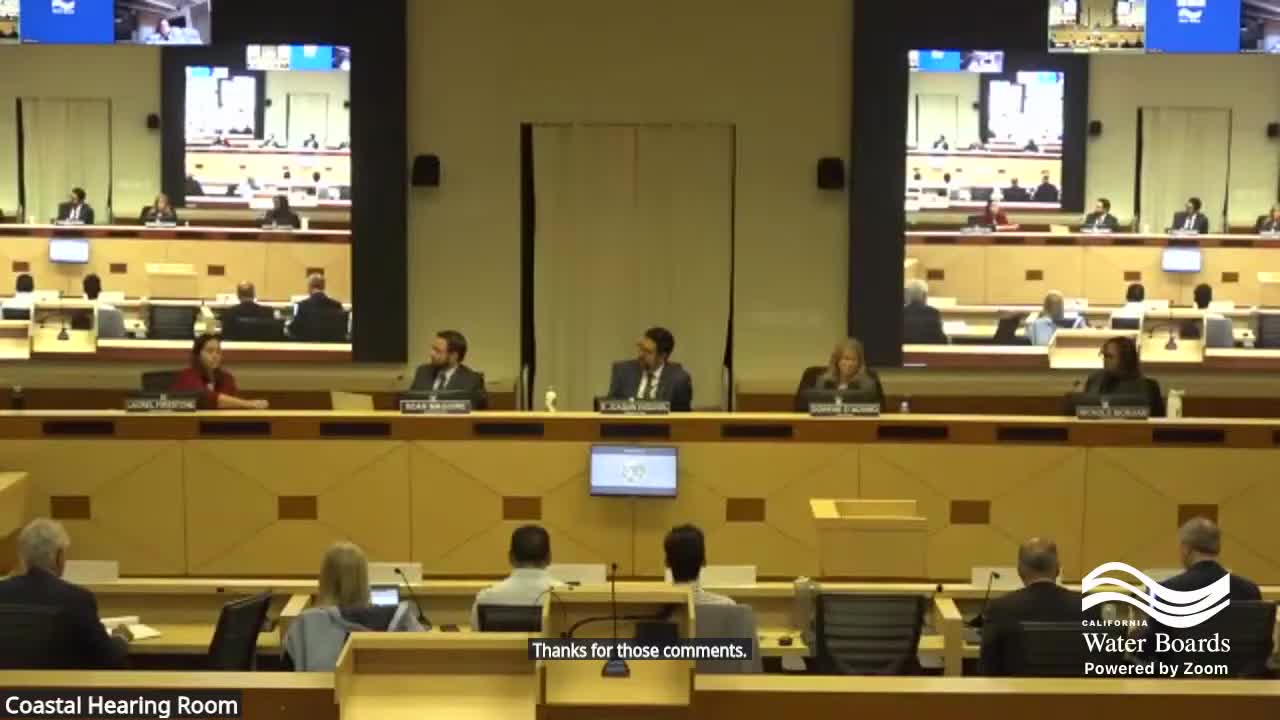
Summary
The State Water Resources Control Board on Nov. 5 reviewed a staff scientific report supplement analyzing the Tuolumne River’s proposed Healthy Rivers and Landscapes voluntary agreement. Staff found the HRL would add modest new flow in many drier years and fund early habitat projects, but showed 30–50% unimpaired‑flow scenarios generally produce cooler spring temperatures and greater floodplain habitat activation — outcomes that many technical reviewers and conservation groups said are central to recovering Chinook salmon.
The State Water Resources Control Board on Nov. 5 held a public workshop to review a draft scientific‑basis report supplement (SBR) assessing the Tuolumne River Healthy Rivers and Landscapes proposal (HRL), a voluntary‑agreement package developed by the Modesto Irrigation District, Turlock Irrigation District and the San Francisco Public Utilities Commission.
State Water Board staff summarized modeling and monitoring analyses that will inform whether to amend the Bay‑Delta Water Quality Control Plan. The report compares: existing (2023) operations; the HRL alternative (schedule‑based base flows plus spring and floodplain pulses and specific habitat commitments); and 30%, 40% and 50% of unimpaired‑flow alternatives adopted as a framework in the 2018 Bay‑Delta Plan.
The SBR finds the HRL would add modest new water in many dry and critical years — staff presented a modeled range of roughly 2,000–12,000 acre‑feet of ‘‘new’’ Tuolumne flow in many years and roughly 7,000–17,000 acre‑feet of additional modeled Delta outflow under some assumptions — and that the HRL’s non‑flow actions (gravel augmentation, constructed rearing habitat, large woody debris, predator management and early habitat projects) would likely increase temperature‑filtered spawning habitat by about 14%, in‑channel rearing by about 8% and modeled floodplain habitat by about 17% compared with existing conditions. The SBR also shows large uncertainties in those estimates and stresses that a robust monitoring and adaptive management program would be needed to verify outcomes.
Staff emphasized that many of the SBR’s most powerful statistical predictors of juvenile Chinook productivity are spring water temperature, spring flow magnitude and meaningful floodplain inundation. The report’s stock‑recruit and habitat analyses indicate unimpaired‑flow scenarios (the 30–50% range) generally produce cooler spring temperatures and greater floodplain activation than the HRL modeling, and therefore larger modeled gains in juvenile habitat in most scenarios. Staff described two accounting methods used in the analysis: a daily accounting spreadsheet supplied by the HRL parties and the State Water Board’s WSE water‑supply spreadsheet model, and noted inherent differences between the tools.
The HRL parties — Turlock and Modesto irrigation districts and the SFPUC — told the Board they are prepared to self‑fund early habitat projects and have committed roughly $80 million to implementation and roughly $17 million for operations and maintenance over an initial eight‑year term. The districts said HRL flows are firm schedule‑based minima (they described them as ‘‘floors’’) that are intended to be implemented flexibly to benefit fish, and that some of the HRL pulse volumes would be protected as Delta outflow pending operations discussions with the Department of Water Resources. HRL parties said they have started early actions and design work and that they can start construction quickly if the HRL pathway is approved.
Board members and staff probed how HRL flows would be accounted and protected downstream, how ‘‘off‑ramp’’ drought years would operate if droughts continued for multiple years, and whether the HRL provides a sufficient proportion of additional cold water in the months when juvenile salmon are most sensitive. HRL technical presenters described the HRL’s schedule‑based compliance approach, the new ‘‘floodplain pulse’’ (designed to provide targeted inundation for 20–30 days in many site designs), and modeling runs that showed a handful of years (including 2025) in which HRL flows would have substantially increased overall January–June flows on the Tuolumne.
The workshop included two afternoon panels of technical reviewers and conservation groups who urged considerable caution. Independent reviewers and conservation organizations — San Francisco Baykeeper, Friends of the River, the California Sportfishing Protection Alliance, Yosemite Rivers Alliance and Golden State Salmon Association — told the Board the SBR is useful but that the HRL as currently designed does not provide sufficient flows, temperature protection or reliable Delta outflow to meet the Board’s biological objectives. They urged the Board to use the 2018 phase‑1 Bay‑Delta amendments (the 30–50% unimpaired‑flow range), or to require any VA path to demonstrate quantitative equivalence to the biological goals adopted in the Bay‑Delta planning process.
Local elected officials and Bay‑Area water suppliers asked the Board to weigh the HRL’s local funding, implementability and potential effect on regional water reliability. Representatives from wholesale buyers in the Bay Area emphasized that Santa Clara‑area economies and housing plans rely on the Hetch‑Hetchy regional supply and that a 40% unimpaired flow requirement would create severe water shortfalls under current demand assumptions. Several cities and wholesale agencies asked the Board to consider the HRL’s self‑funding, the potential for habitat‑leveraged benefits, and the HRL parties’ promise to implement projects quickly if the HRL pathway is adopted.
Public comment ran late; roughly 75 speakers addressed the Board. Commenters were sharply split: some urged the Board to adopt or advance the HRL pathway because it is funded locally and could be implemented quickly; others urged the Board to reject the HRL and move to implement the 2018 unimpaired‑flow standard or to require a VA that demonstrably meets the Board’s biological goals. Many commenters — technical and lay — asked the Board to clarify how any HRL flows would be protected through the Delta and how ‘‘off‑ramp’’ drought provisions would operate in multiyear droughts.
Next steps. Staff said written public comments on the draft SBR are due by noon on Friday, Nov. 7; staff will consider revisions and then submit a revised SBR to independent scientific peer review in 2026 (per Health & Safety Code peer‑review requirements). The Board did not take any formal action at the workshop; any decision to propose plan amendments would follow additional public‑process steps, agency coordination and required environmental review.
Key quote: “The HRL is predicted to provide between 2 and 12,000 acre‑feet of new flow on the Tuolumne River and between 7 and 17,000 acre‑feet of new Delta outflow per year,” State Water Board staff said; conservation groups said those magnitudes are insufficient to meet the Board’s salmon‑doubling goals without substantially higher spring flows and more frequent meaningful floodplain events.
What the Board will weigh next: the SBR gives a clearer comparison of tradeoffs between a locally funded HRL pathway and the unimpaired‑flow approach adopted in 2018. Board members and the public will need further detail about (1) how HRL flows would be protected downstream (Delta outflow and Vernalis), (2) the operational details and triggers for drought ‘‘off‑ramps,’’ (3) the proposed HRL monitoring, accountability, and adaptive‑management program, and (4) whether any VA path can be shown quantitatively to meet the Board’s biological goals before the Board considers plan amendments.