Get Full Government Meeting Transcripts, Videos, & Alerts Forever!
Get email alerts on the School Discipline topic
No spam. Unsubscribe anytime.
Witnesses urge inclusion of discipline metrics in school accountability; committee hears H730/H376 and RAISE Act testimony
Summary
Vice Chair Bruce Ayers called the hearing to order and the committee heard a sustained block of testimony urging changes to how the commonwealth addresses exclusionary discipline in K‑12 schools.
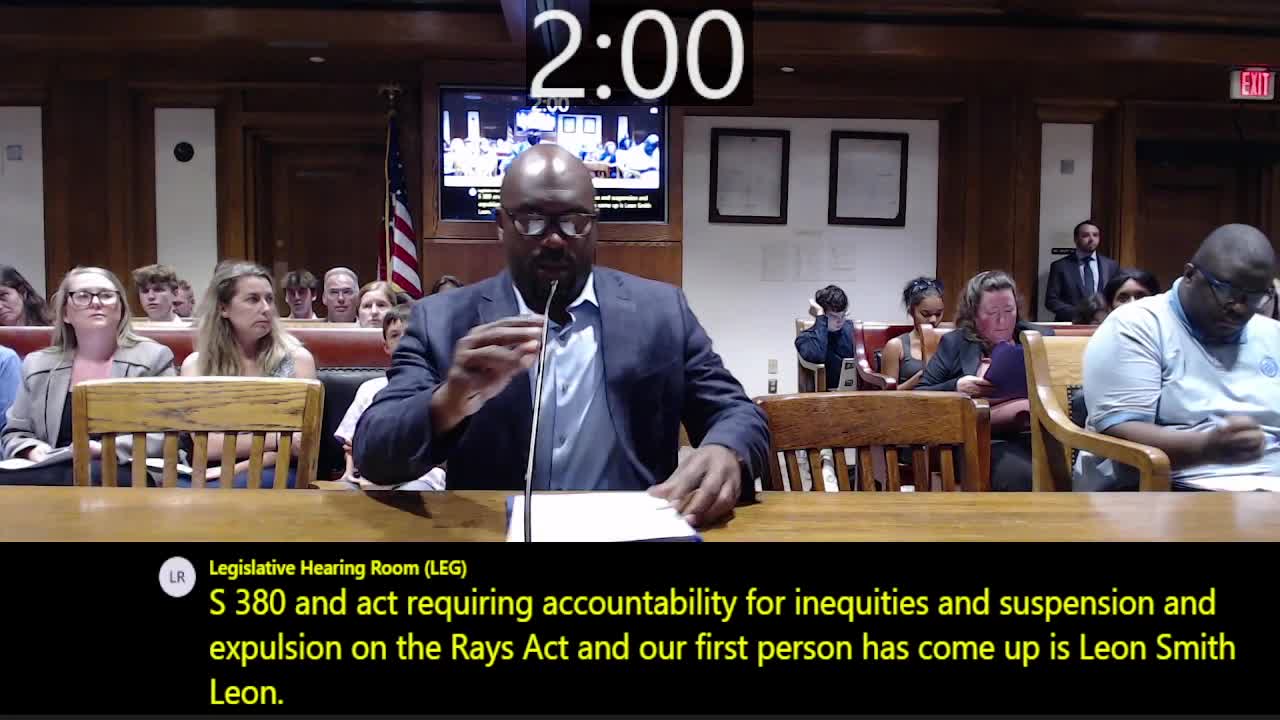
Vice Chair Bruce Ayers called the hearing to order and the committee heard a sustained block of testimony urging changes to how the commonwealth addresses exclusionary discipline in K‑12 schools. Leon Smith, speaking as a testifier in favor of the RAISE Act, said Massachusetts "prides itself on being a leader in K‑12 education" but that achievement measures omit disciplinary outcomes that research ties to lower graduation and enrollment rates. Smith cited a state‑level average of 16 lost days of instruction per 100 enrolled students and higher rates for students with disabilities and Black students.
The RAISE Act — described by witnesses as an amendment to how the Student Opportunity Act measures school performance — would add suspension and expulsion rates to accountability metrics and require disaggregated reporting. "Students who are suspended or expelled from school once or twice [are] as likely as their peers to drop out of school," Leon Smith told the committee.
Massachusetts Advocates for Children education staff attorney Jennifer White gave a case example she said was "not atypical": an eighth‑grade Black girl who was racially bullied and ultimately expelled after a single physical act in response to prolonged harassment. White testified that in 2023–24 Black students made up 10 percent of the statewide population but 18 percent of students excluded from school, and she urged the committee to favorably report H730/S376.
Representatives from the Committee for Public Counsel Services' Ed Law Project and MassAppleseed described related legal and research findings. Marly Spangard (CPCS Ed Law Project) urged clarifying statutory definitions (for example, of "weapon" and what constitutes an "assault on educational staff") and asked the committee to limit permanent expulsions where contact was incidental or the student lacked intent. MassAppleseed's Miriam Bara Krugman said the proposed changes would use data already collected by the state and federal government, rather than imposing new reporting burdens.
Other witnesses, including mental‑health legal advocates and school discipline counsel, emphasized procedural protections for students facing indefinite suspension when a felony complaint issues. Matt Krager of the Mental Health Legal Advisors Committee argued H730/S376 would align practice with constitutional due‑process requirements, requiring notice in the family's language and hearings scheduled with family availability. Attorneys and advocates recounted cases in which school officials treated incidental or non‑intentional contact as an "assault on staff," triggering permanent exclusion.
Why this matters: witnesses told the committee that exclusionary discipline has downstream effects on educational attainment, juvenile justice involvement, and homelessness, and that disparities widened after the pandemic. Proponents asked the committee to report the bills favorably so the Department of Elementary and Secondary Education (DESE) and districts would be required to use discipline data to identify and address inequities.
Committee procedure: no formal action or vote was recorded during the hearing; the panel left the written record open for additional submissions.
Sources: oral testimony of Leon Smith; Jennifer White; Marly Spangard; Matt Krager; Miriam Bara Krugman.