
Board continues Northeast 78th Street future‑land‑use and rezoning items after neighborhood concerns
Get AI-powered insights, summaries, and transcripts
Subscribe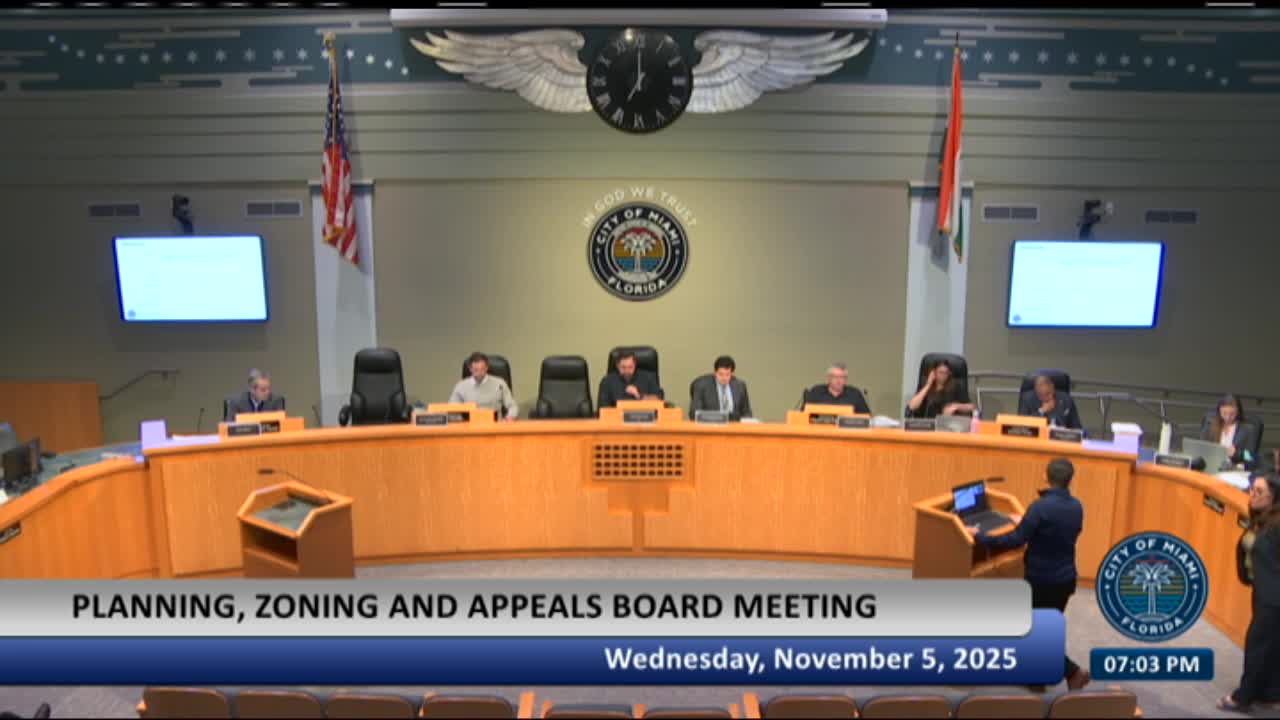
Summary
The board continued a small‑scale future‑land‑use amendment and zoning map change for three parcels along Northeast 78th Street, agreeing to a December 17, 2025 deferral so the applicant can meet with neighbors about concerns including potential five‑story buildings, waterfront setbacks, and the Little River buffer.
The Planning, Zoning & Appeals Board on Nov. 5 continued two land‑use applications (files 18247 and 18241) that sought to change the comprehensive plan future‑land‑use designation from medium‑density multifamily residential to restricted commercial and to rezone three parcels along Northeast 78th Street from T4‑R to T5‑O. Planning staff recommended approval; several neighbors urged delay and asked for community outreach.
Catherine Engleton of the City of Miami Planning Department presented the future‑land‑use amendment and explained staff’s analysis, including an inventory of existing uses within a quarter‑mile, vacancy levels, and a concurrency review. Staff reported there was adequate capacity for potable water, sewer, solid waste, transportation, park access within a ten‑minute walk, and that Miami‑Dade emergency management found no loss of shelter or evacuation capacity for the proposed increased density. The department recommended approval of the small‑scale amendment under the city’s comprehensive‑plan policies and state small‑scale procedures (cited by staff as Florida Statutes section 163.3187).
Clara Diaz (Land Development) summarized zoning context and noted the three parcels total approximately 49,225 square feet (about 1.13 acres). She said the existing zoning is T4‑R (restricted) with a maximum of three stories and 36 dwelling units per acre; the applicant requested T5‑O (urban center transect, open), which would allow up to five stories and a higher density (staff cited 65 units per acre as a comparison). Staff also noted waterfront standards that would require a 25 percent depth setback for lots under 200 feet, estimating a river setback between about 34 and 44 feet given plat lines and shoreline geometry, and that waterfront‑walkway standards would apply under the T5 designation.
Applicant counsel Anthony Dehuri said the owner had invested in the neighborhood and sought a zoning designation consistent with historical zoning allowances and nearby higher‑intensity transects; he requested the board rely on staff’s consistency findings. Several residents testified in opposition. Elvis Cruz said the application “reads like a self‑serving real estate brochure,” argued the Little River (he described it as about 71 feet wide) was not a sufficient buffer from the Palm Grove historic single‑family neighborhood, and urged the board to deny the upzoning. Longtime neighborhood resident Eileen Batory said Palm Grove residents had helped craft Miami‑21 zoning and that they did not view the river as an adequate barrier, warning that commercial conversion along the river would bring increased traffic, deliveries and garbage operations adjacent to Manatee Bend Park. Alyssa Zaveda said she received only a postcard notice and asked for a deferral so neighbors could discuss cumulative impacts with the applicant.
Board members asked staff for clarifications on parcel size, maximum allowed height under a T5‑O (staff said five stories), whether public‑benefits bonuses were available (not applicable absent TOD designation), and the applicable FLR/density and waterfront setbacks. Members discussed transitional zoning options (T4‑O or T5‑L versus T5‑O), coastal high hazard considerations, and the potential for public‑benefit features such as an improved riverwalk or additional setback and design conditions to reduce impacts on the park and adjacent residences.
Given the neighborhood concerns and the opportunity for applicant‑led outreach, a board member moved to continue both items for stakeholder discussion. The applicant agreed to a later date; the board continued both the future‑land‑use and zoning items to the Dec. 17, 2025 meeting. The motion passed on roll call, 7–0. No zoning or land‑use changes were approved at the Nov. 5 hearing; the items will return after outreach and renotification.
Actions recorded in the public record match the transcript: staff recommended approval, members expressed concerns about scale and transition, neighbors asked for deferral, and the board approved a postponement to allow outreach and potential adjustments to the request.