Get Full Government Meeting Transcripts, Videos, & Alerts Forever!
Get email alerts on the Emergency Management Agreements topic
No spam. Unsubscribe anytime.
County approves Red Cross data‑use agreement and state mutual‑aid MOU to secure reimbursement for deployed responders
Summary
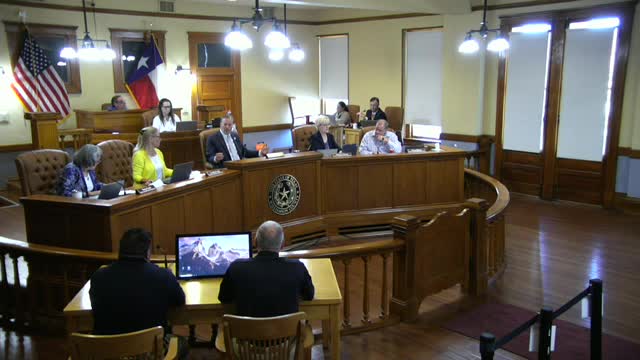
Williamson County signed a data‑use agreement with the American Red Cross to enable case managers to follow up with registered residents after disasters, and approved a Texas Emergency Management Assistance Teams (TMAT) MOU that allows county personnel to deploy under TDEM incident command and be reimbursed. Both passed 5–0.
The commissioners approved two items intended to strengthen post‑disaster coordination and reduce county costs when staff deploy to assist neighboring jurisdictions.
Bruce Clements, director of the Office of Emergency Management, described a data‑use agreement with the American Red Cross that allows the Red Cross to share registration information for disaster‑impacted residents with vetted county case managers so casework and long‑term recovery can be coordinated. "No funding is involved. It's just a matter of us assuring them that we're gonna protect their data," Clements told the court. The motion to approve the data‑use agreement carried 5–0.
The court also unanimously approved a memorandum of understanding with the Texas Division of Emergency Management to formalize participation in the Texas Emergency Management Assistance Teams (TMAT) program. The MOU allows Williamson County employees to serve alongside state teams (including Texas Task Force 1 and state incident management teams), places county personnel under the incident commander while deployed, and assures the county will be reimbursed for expenses and salaries for deployed staff. Bill Zito and other staff explained that current mutual‑aid practices often lack reimbursement; the MOU creates a path to state reimbursement and clarifies the command and reimbursement process.
Commissioners asked how deployments are currently authorized and how reimbursement is triggered; staff explained the county judge must consent to send assets and that the TMAT arrangement allows for reimbursement when a deployment exceeds typical mutual‑aid durations. The motion to approve the TMAT MOU passed 5–0.