Get Full Government Meeting Transcripts, Videos, & Alerts Forever!
Get email alerts on the Climate Action topic
No spam. Unsubscribe anytime.
Laguna Beach adopts Climate Action & Adaptation Plan with wildfire resilience and EV charging as top near‑term priorities
Summary
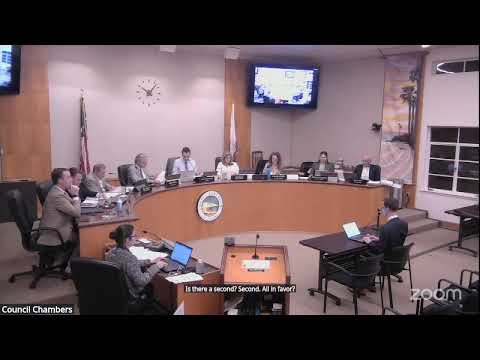
Laguna Beach City Council adopted a Climate Action & Adaptation Plan on Feb. 25, prioritizing wildfire resilience, EV infrastructure, building energy efficiency and renewable power as near‑term actions.
The City Council adopted the Climate Action & Adaptation Plan (CAP) on Feb. 25. Staff presented an inventory of community and municipal greenhouse gas emissions and a vulnerability assessment showing wildfire, extreme heat, and sea‑level rise as top risks for Laguna Beach. The plan sets targets consistent with state goals (40% reduction by 2030, 85% by 2045) and a local council goal of carbon neutrality.
Staff recommended 16 mitigation strategies and six adaptation strategies and identified six near‑term priorities to pursue first: (1) community resilience to wildfire risk, (2) facilitate private‑sector adoption of zero‑emission vehicles and build public charging infrastructure, (3) support energy efficiency upgrades in new and existing buildings, (4) accelerate transition to renewable and resilient power sources (including evaluation of Community Choice Aggregation), (5) accelerate municipal fleet electrification, and (6) public education and preparedness measures. The CAP also proposes a certified greenhouse‑gas reduction checklist so that future projects can rely on the CAP for CEQA streamlining.
Council adopted the CAP and added direction that staff coordinate with other local public agencies (e.g., water district, school district) to explore joint projects such as shared solar, microgrids and combined procurement strategies that could improve resilience and lower costs. Staff will prepare an implementation schedule, an annual monitoring dashboard and return with specific budget items and financing options for council review.