Mesa staff propose one‑time water/wastewater capacity fee to raise $400M; council asks for rate‑shift scenarios
Loading...
Summary
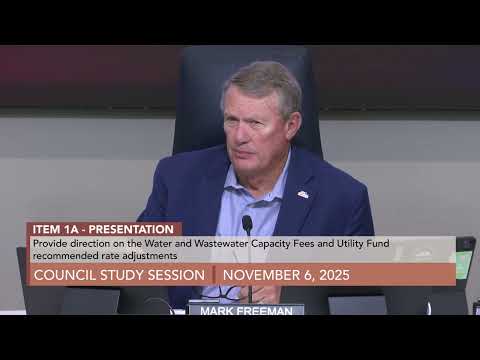
Mesa staff on Nov. 6 proposed a one‑time water and wastewater capacity fee intended to raise about $400 million to pay for growth‑only infrastructure; staff offered grandfathering for permit applications submitted before Jan. 1 and a six‑month, 50% discount for the smallest residential meters.
Mesa City staff on Nov. 6 outlined a proposed water and wastewater capacity fee and a linked set of utility rate adjustments, saying the fee is intended to raise about $400,000,000 over a roughly ten‑year horizon to pay for growth‑only infrastructure identified in the city's integrated master plan. The city would introduce the ordinance Nov. 17, act to adopt Dec. 1 and — if adopted — make the fee effective Jan. 1.
Brian Mitchell, the city's Office of Management and Budget director, and Chris Hassard, the city's Water Resources director, told the council the proposal is designed so new development pays for its incremental demand rather than existing ratepayers. "It's to really raise $400,000,000 over the next decade or so," Hassard said, describing the charge as a one‑time fee tied to new meters. Staff said consultant Black & Veatch reviewed the methodology.
Staff described two ordinance modifications offered after outreach to developers: anyone who submits a completed permit application before Jan. 1 would be grandfathered (staff explained the protection applies per lot/meter), and the city would offer a 50 percent discount on the capacity fee for 3/4‑inch and 1‑inch meters for the first six months after the ordinance takes effect. Larger meters and developments would not receive a discount, staff said.
On process, staff explained the difference between an impact fee under the impact‑fee statute and the capacity fee. They said the impact‑fee process includes a lengthy grandfathering window (described in presentation as effectively two years in statute plus a year for the study), which would delay developer contributions and shift capital costs onto existing customers. The capacity fee, by contrast, is an alternate statutory path some Arizona cities use and was described as having been upheld in prior litigation involving another city.
Technical methodology: staff said the $400 million total comes from the city's integrated master plan and an AWWA incremental approach that attributes growth‑driven capital costs to meter sizes. The total cost of growth projects is distilled to a single‑family 3/4‑inch meter equivalent and scaled to larger meters by flow characteristics; multifamily buildings using a master meter pay on that master meter size but typically spread that single meter cost across units.
Regional comparisons: staff said the single‑family 3/4‑inch meter fee would be about $9,500 — below the middle of peer cities but above some — and noted Phoenix has very high per‑unit fees in certain zones tied to large new infrastructure needs.
Utility rates: Mitchell showed the net effect of adopting the capacity fee would be to lower the recommended residential rate adjustment in the proposed rate ordinance (staff reduced a prior recommendation from roughly 5.5% to 4.3% during internal review and said implementing the capacity fee would move the recommended year‑one impact for a typical customer to about 3.5%; the presentation showed a 4.2% average when service charges and usage are combined). Staff said the notice of intent process sets the high end of what may be adopted and that certain commercial increases beyond posted notices would require re‑notice.
Council direction and next steps: council members pressed staff for more scenario modeling focused on equity and reserve impacts. Several members asked staff to model alternatives that would avoid a residential increase in the near term by shifting more of the increase to commercial and landscape classes — and to show the multi‑year consequences of that choice. Staff agreed to return with order‑of‑magnitude analyses and multiple scenarios (for example: (a) zero residential increase, (b) zero residential + multifamily, and (c) accelerated parity on commercial rates) and indicated they would present those numbers at the next Thursday briefing and attempt to have ordinance materials ready for introduction on Nov. 17.
What's next: staff intends to introduce the rate ordinance Nov. 17 with adoption scheduled for Dec. 1 and implementation Jan. 1, 2026, unless council directs additional changes that would require re‑posting the notice of intent. The capacity fee proposal, if adopted, would be a one‑time charge on new meters; the council is expected to weigh grandfathering, the six‑month discount for small meters, and how much of the short‑term rate burden to shift from residential customers to nonresidential classes.