Get Full Government Meeting Transcripts, Videos, & Alerts Forever!
Get email alerts on the Wireless Infrastructure topic
No spam. Unsubscribe anytime.
Planning commission approves 80-foot stealth cell tower with conditions after design debate
Summary
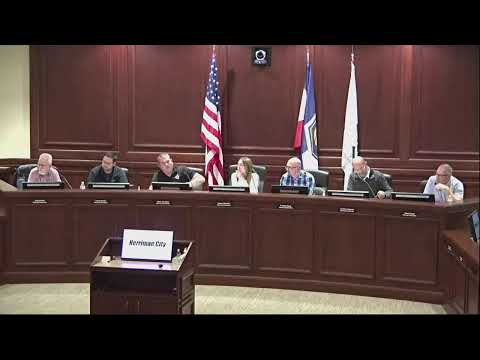
The Herriman Planning Commission voted unanimously to approve a conditional use permit for an 80-foot wireless communication tower in a commercial zone, adding conditions requiring three antenna shrouds to be installed within two years, a staff-approved color scheme and a compound wall built to the business park standard.
The Herriman Planning Commission voted unanimously to approve a conditional use permit for an 80-foot wireless communication tower and associated utility cabinet in a commercial zone, adding conditions requiring three antenna shrouds to be provided and installed within two years, a color scheme to be approved by staff, and a compound wall that matches the business park standards.
The application applicant Mark Williams said the company and city staff have worked together for almost two years to identify a location that meets coverage needs and city standards. "We ask that you approve this application with this design," Williams said, describing the proposal as a stealth solution that can accommodate three carriers and reduce the number of separate facilities in the area.
Staff told the commission the city recently amended its code to allow some wireless facilities on private commercial property so long as proposals include a stealth element. Staff reviewed several possible stealth approaches and showed renderings of options including a shrouded canister, a monopine (tree), and a water-tower treatment; staff noted trade-offs of cost and co-location capacity.
A technical witness, Larson Quick of Skyway Towers, answered a question about vertical spacing for multiple carriers: "Each carrier needs approximately 15 feet vertically," he said, explaining why the applicant planned for space that would permit three co-locators. Commissioners and staff discussed scale, noting the applicant’s renderings were not always to scale and that different stealth approaches vary in both cost and ability to host multiple carriers.
Commissioners debated the visual mass and context-sensitivity of alternative treatments. Some said the three-box shroud offered a cleaner, more modern appearance and could be painted or treated as an art installation; others preferred a water-tower or monopine in some contexts but acknowledged those options can be cost-prohibitive or limit co-location. One commissioner proposed — and the motion adopted — that all three antenna boxes be provided and installed (or have covers available) within a two-year period and that staff approve the color scheme; the motion also required the enclosure wall to match the business park materials as approved by staff.
Jackson moved to approve the three-box solution with the staff recommendations and the additional conditions; Brody seconded the motion. Roll call was taken and the motion passed unanimously (yes: Andy; Forrest; Adam; Preston; Jackson; Brody).
Approval is conditional on final building permit review to ensure the installation meets the city’s stealth standards and other code requirements identified in the staff packet. Staff indicated that any required building permits and final plans must be consistent with the conditions and that the city will withhold certificate of occupancy for any units or facilities that depend on the tower until required standards are met.
The commission’s action closes this application at the planning level; any construction, final permitting and equipment installation will proceed under the conditions set by the commission and as reviewed by staff.