
Wayne County approves Rx Kids cash-allowance pilot for six high-need communities
Get AI-powered insights, summaries, and transcripts
Subscribe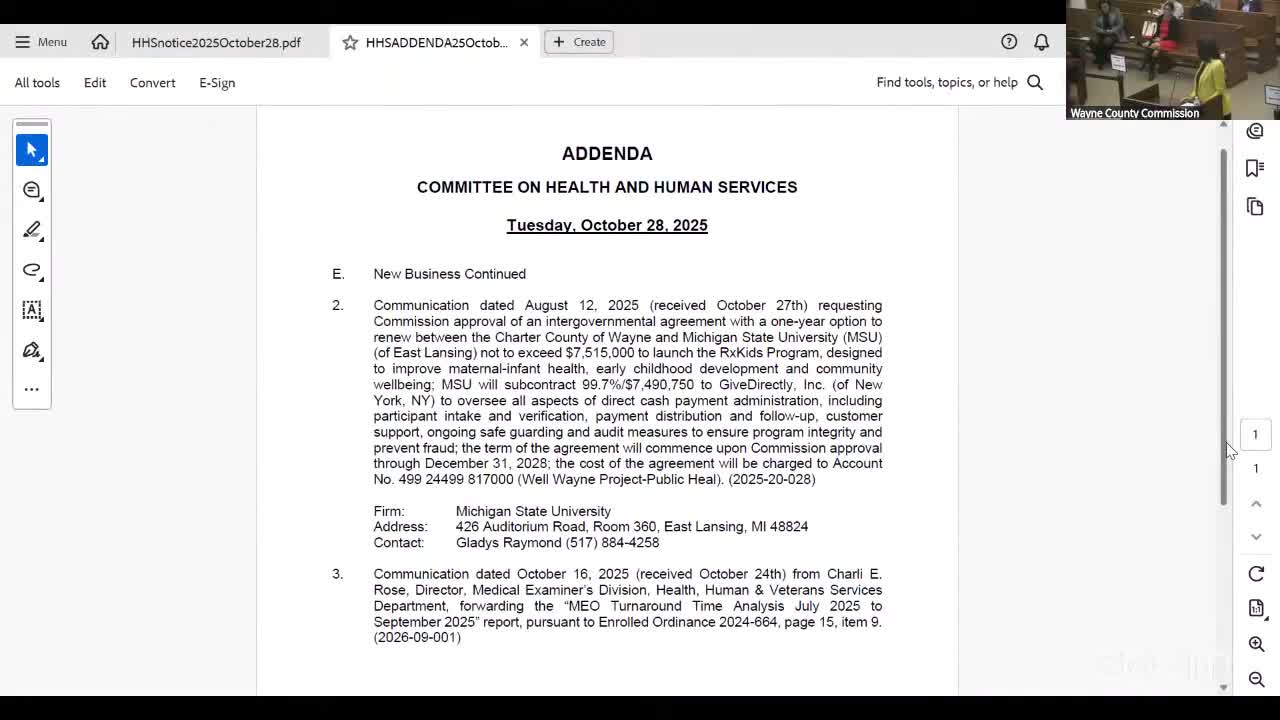
Summary
The Wayne County Commission on Nov. 7 approved an agreement with Michigan State University to launch Rx Kids, a place-based cash-allowance program that provides expectant mothers in designated communities a one-time prenatal payment of $1,500 and $500 per month for the first six months after birth.
The Wayne County Commission on Nov. 7 approved an agreement with Michigan State University to launch Rx Kids, a place-based cash-allowance program that provides expectant mothers in designated communities a one-time prenatal payment of $1,500 and $500 per month for the first six months after birth.
Kanele Johnson, interim director of the Department of Health and Human and Veteran Services, told commissioners the program will launch in six high-need communities — River Rouge, Inkster, Highland Park, Hamtramck, Melvindale and Dearborn — chosen for their elevated social vulnerability and childhood poverty rates. Johnson described Rx Kids as a public-health intervention aimed at reducing financial stress in the prenatal and early-infancy window, improving birth outcomes and giving families stability when newborn-care costs are highest.
"Rx Kids provides direct cash allowances to mothers during pregnancy and their babies' first 6 months of life," Johnson said, explaining enrollment requires residing in a designated Rx Kids community and verification at or after 16 weeks of pregnancy.
Dr. Mona Hanna, associate dean for public health at Michigan State University College of Human Medicine and founding director of the MSU Pediatric Public Health Initiative, described the program’s evidence base and implementation model. She said Rx Kids began in Flint and has expanded to multiple Michigan communities; MSU’s implementation and evaluation work shows higher prenatal-care utilization, reductions in smoking during pregnancy, and fewer premature and low-birth-weight births in participating places. "This is done across the world," Hanna said, noting other nations use child allowances and citing the 2021 expanded child tax credit as a U.S. precedent.
GiveDirectly will administer the cash transfers and verification processes, Hanna said; MSU will lead planning, evaluation and dissemination. She told commissioners the program keeps administrative costs low — under 15 percent — and relies on data-sharing agreements (including vital records) to verify births and residency. Enrollment is place-based (the community, not individual income), and organizers said take-up in prior sites has been high, with most participants enrolling during pregnancy.
Commissioners questioned funding, equity and scale. Johnson said the local portion being considered is roughly $7 million and that the program is structured as a two-year effort; she said staff estimated a total program cost over two years of about $7.5 million. Dr. Hanna added that county contributions help draw down state funds and noted that state budget action included a large statewide allocation for Rx Kids: "$250 million in general fund dollars from the state of Michigan went to Rx Kids," she said, and the county contribution will leverage additional state money.
On targeting and fairness, several commissioners pressed presenters about means-testing versus a place-based approach. Commissioner Memorecki said he was troubled that higher-income residents located inside a qualifying place could receive funds, calling that distribution "inherently not fair." Presenters responded that the program was intentionally place-based to reduce administrative complexity, limit eligibility barriers and avoid stigma; they said historical birth-certificate data and Medicaid rates were used to estimate costs and plan allocations by community. Johnson noted the contract includes monitoring language and that county staff will "continuously monitor how much is being distributed to each community" and make adjustments as needed.
Presenters cited evaluation evidence and operational details: MSU reported prescribing more than $16 million to about 4,000 families across Rx Kids communities to date; GiveDirectly handles payment distribution and fraud detection; and the county will receive regular updates and access to a publicly updated dashboard that tracks enrollments, demographics and cash distributed by community.
Commissioner Anderson moved to approve the agreement; Commissioner Killeen supported the motion. The motion carried with one recorded opposing vote (Commissioner Memorecki).
The commission approved the MSU agreement and asked staff to provide the contract and to include Rx Kids updates in routine quarterly reports and the online dashboard for ongoing monitoring.