
Cape Cod Commission submits final 2025 Regional Policy Plan to Barnstable County Assembly for review
Get AI-powered insights, summaries, and transcripts
Subscribe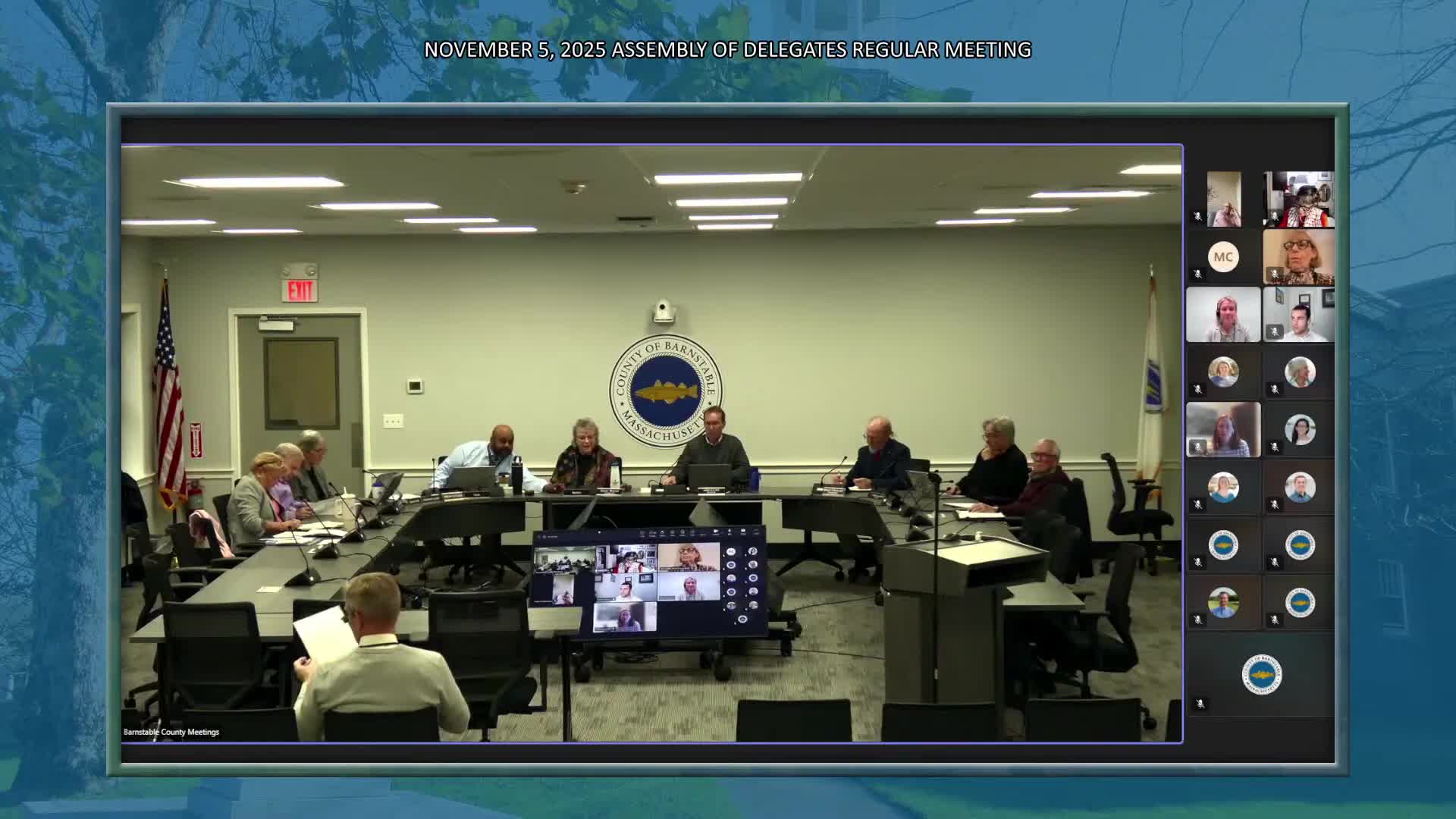
Summary
The Cape Cod Commission on Nov. 5 presented the final draft 2025 Regional Policy Plan to the Barnstable County Assembly of Delegates and asked the assembly to receive it as an ordinance for review.
The Cape Cod Commission on Nov. 5 presented the final draft 2025 Regional Policy Plan to the Barnstable County Assembly of Delegates and asked the assembly to receive it as an ordinance for review.
Christy Sanitary, the commission—s executive director, and Chloe Schafer, chief planner, told delegates the draft reflects more than 100 public comments and includes seven regional priorities: protecting open space and natural resources, restoring water quality, mitigating and adapting to climate change, preserving historic resources, increasing housing attainability, planning infrastructure, and strengthening the economy. Schafer said the plan was approved by the commission on Oct. 16 and that the commission held a 60-day public comment period that was extended 30 days.
Why it matters: the RPP guides regional planning and implementation across Cape Cod and frames where the commission will target technical assistance, metrics, and recommended actions. Commission staff said the plan now emphasizes climate adaptation as well as mitigation, expands monitoring through an online metrics viewer, and adds recommended actions that include a regional open-space plan, advanced groundwater modeling, model wetland bylaws, and multimodal considerations for Sagamore and Bourne Bridge replacements.
What the commission outlined: Chloe Schafer said the plan—s growth policy retains an emphasis on focusing growth in centers with infrastructure and guiding development away from sensitive areas, and staff added the adjective "finite" to describe the region—s resources. New and revised recommended actions address natural systems (including pond protection and aquifer capacity studies), built systems (regional capital planning, flood-risk reduction and post-disaster planning), and community systems (historic inventories, the regional economic strategy and tools to implement the state—s Affordable Homes Act).
On post-disaster planning, staff described future work as technical assistance to communities to plan for redevelopment after major natural disasters, including severe coastal storms and, to a lesser degree, wildfire. "The idea is to get ahead of that and think about the infrastructure investments that would be best for the community in the long term," said Steven Topper, deputy director.
Committee and process notes: commission staff said they would provide the assembly a spreadsheet detailing each public comment and how it was addressed in the draft. Staff and delegates discussed process: the commission—s adoption means the assembly must hold a public hearing before it votes and that a 45-day timeframe for county review will apply after receipt; delegates and staff discussed timing, with one delegate noting the assembly must act within the statutory trigger period.
Next steps: the commission submitted the RPP as an ordinance to the assembly; the speaker said the assembly would schedule a public hearing and that the ordinance will be assigned a formal number and circulated. Commission staff said they will share the comments-response spreadsheet with the clerk so delegates can examine which comments were incorporated.
Sources: Presentation and Q&A with Christy Sanitary (executive director, Cape Cod Commission) and Chloe Schafer (chief planner).